


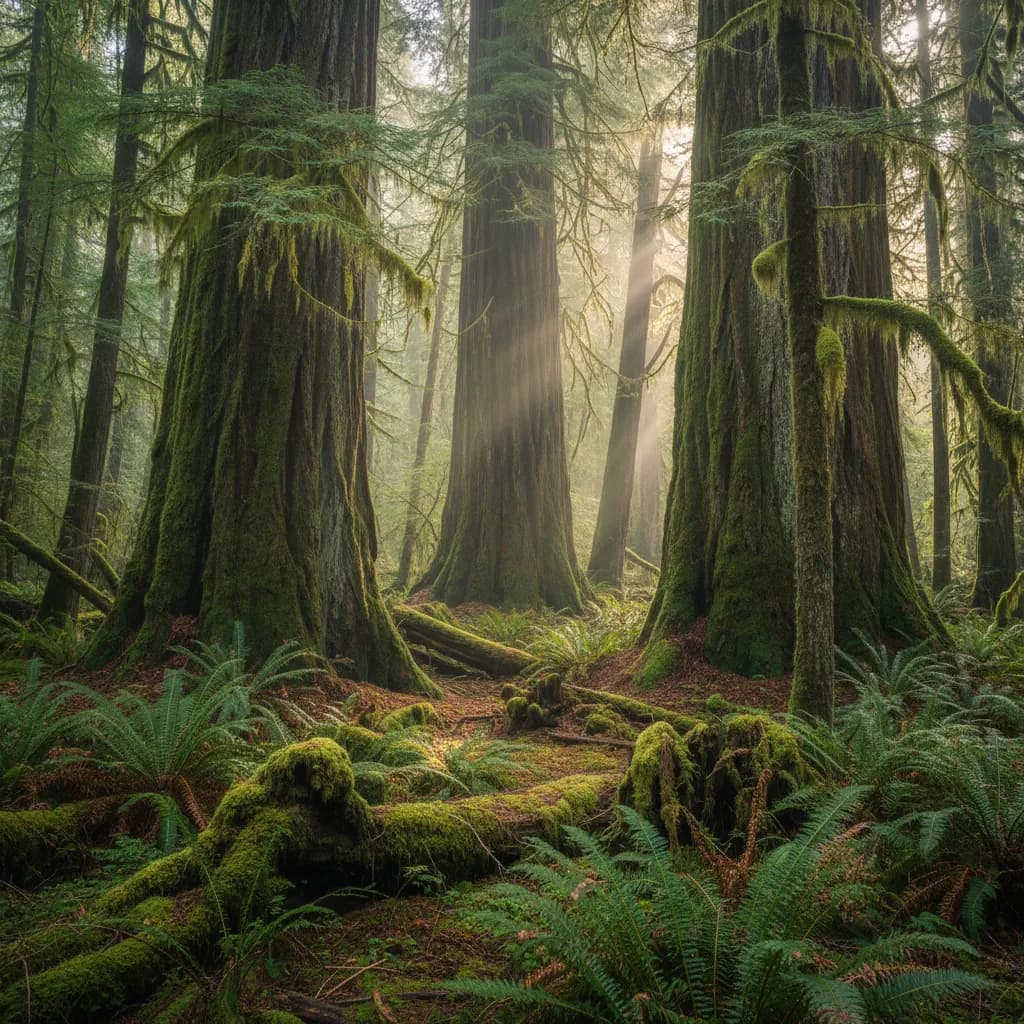
British Columbia is, without exaggeration, one of the greatest mushroom foraging destinations on the planet. The combination of temperate rainforests, diverse elevation zones, massive tracts of crown land, and a long, wet autumn creates conditions that support an extraordinary variety of edible fungi. From the chanterelle-carpeted floors of Vancouver Island's old-growth forests to the pine mushroom grounds of the Interior, BC offers foraging experiences that rival anything in Europe or the Pacific Northwest of the United States.
This guide covers where to go, what to look for, when to find it, and how to forage responsibly in British Columbia.
Regulations: Where You Can Forage in BC
Understanding BC's land management framework is essential before you head into the bush.
Crown Land
Approximately 94% of British Columbia is crown land, making it the most accessible province in Canada for wild foraging. Under BC's Forest and Range Practices Act and associated policies, personal-use harvesting of non-timber forest products — including mushrooms — is generally permitted on crown land.
Key rules:
- Personal use harvesting does not require a permit in most areas.
- Commercial harvesting requires a permit issued by the Ministry of Forests. Commercial pine mushroom harvesting, in particular, is subject to specific regulations in some forest districts.
- Tenured areas (active forestry licences, woodlots, community forests) may have additional rules. Check with the local forest district office.
- Leave no trace. Pack out your garbage, stay on established trails where possible, and minimize disturbance to the forest floor.
Provincial Parks
BC Parks generally prohibits the removal of natural objects from provincial parks. This includes mushrooms, plants, rocks, and animals. However, some parks have specific exemptions or traditional-use provisions. Always check with the specific park before foraging.
Notable exception: Some provincial parks in the Interior allow personal-use berry picking. Mushroom picking permissions vary — ask before you pick.
National Parks
Parks Canada prohibits foraging in all national parks, including Pacific Rim, Glacier, Mount Revelstoke, Kootenay, Yoho, and Gwaii Haanas. Do not forage in national parks.
First Nations Territory
Much of BC is unceded Indigenous territory, and many First Nations communities have traditional harvesting rights and governance over natural resources in their territories. Always respect Indigenous rights and relationships with the land. If foraging near communities or on reserve land, seek permission. Some Nations have co-management agreements for non-timber forest products.
Municipal and Regional Parks
Rules vary by municipality and regional district. Metro Vancouver regional parks, for example, prohibit foraging. Check local bylaws.
Prime Foraging Locations
BC's diverse geography creates distinct foraging regions, each with its own specialties.
Vancouver Island
The crown jewel of BC foraging. Vancouver Island's west coast rainforests — particularly around Tofino, Port Renfrew, and the Carmanah Valley — produce some of the most prolific chanterelle harvests in North America. The old-growth and second-growth Douglas fir forests create ideal mycorrhizal habitat.
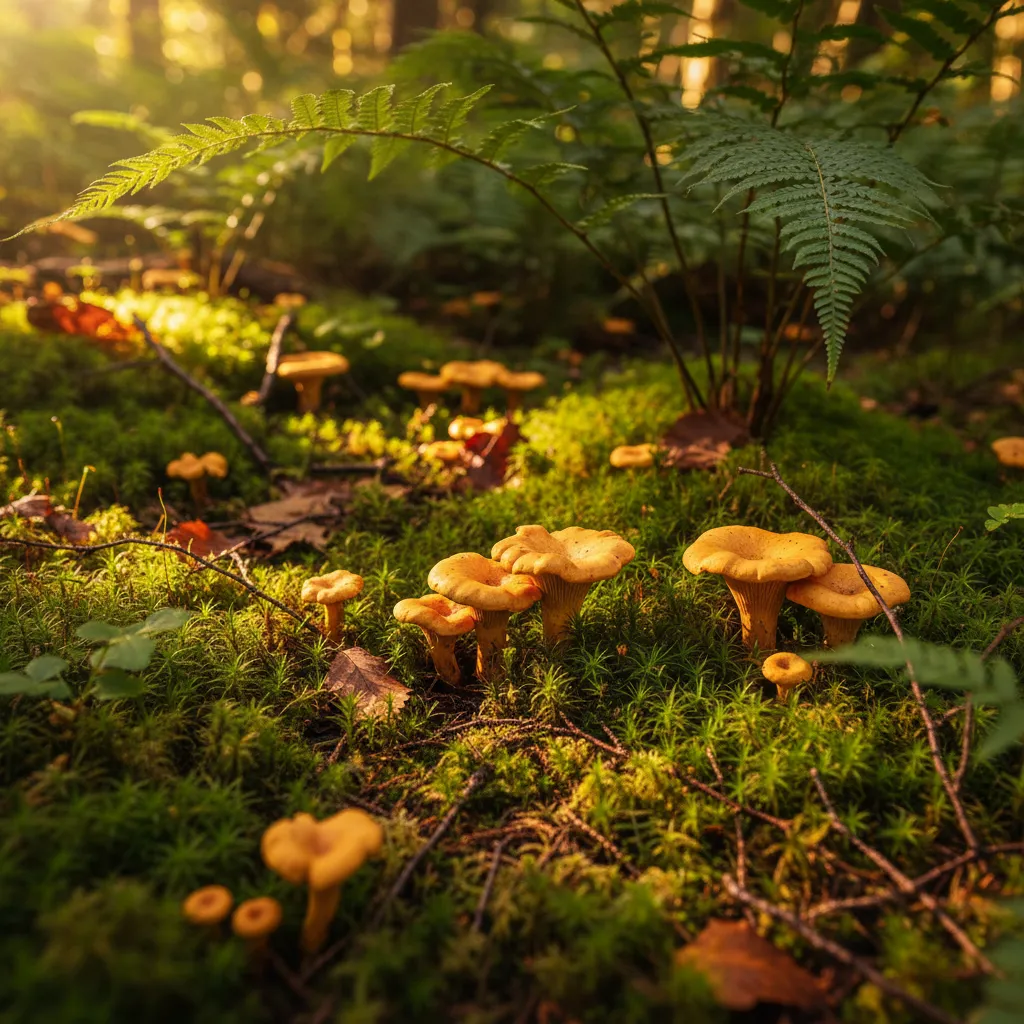
Best species: Golden chanterelles (September-November), white chanterelles, hedgehog mushrooms, lobster mushrooms (August-September), cauliflower mushrooms.
Access: Crown land is scattered throughout the island. Logging roads provide access to remote areas — many are active, so watch for truck traffic. The areas around Lake Cowichan, Port Renfrew, and Holberg are particularly productive and accessible.
Coordinates (general areas):
- Port Renfrew area: 48.55°N, 124.42°W
- Lake Cowichan area: 48.82°N, 124.05°W
- North Island (Holberg area): 50.64°N, 128.03°W
Sunshine Coast
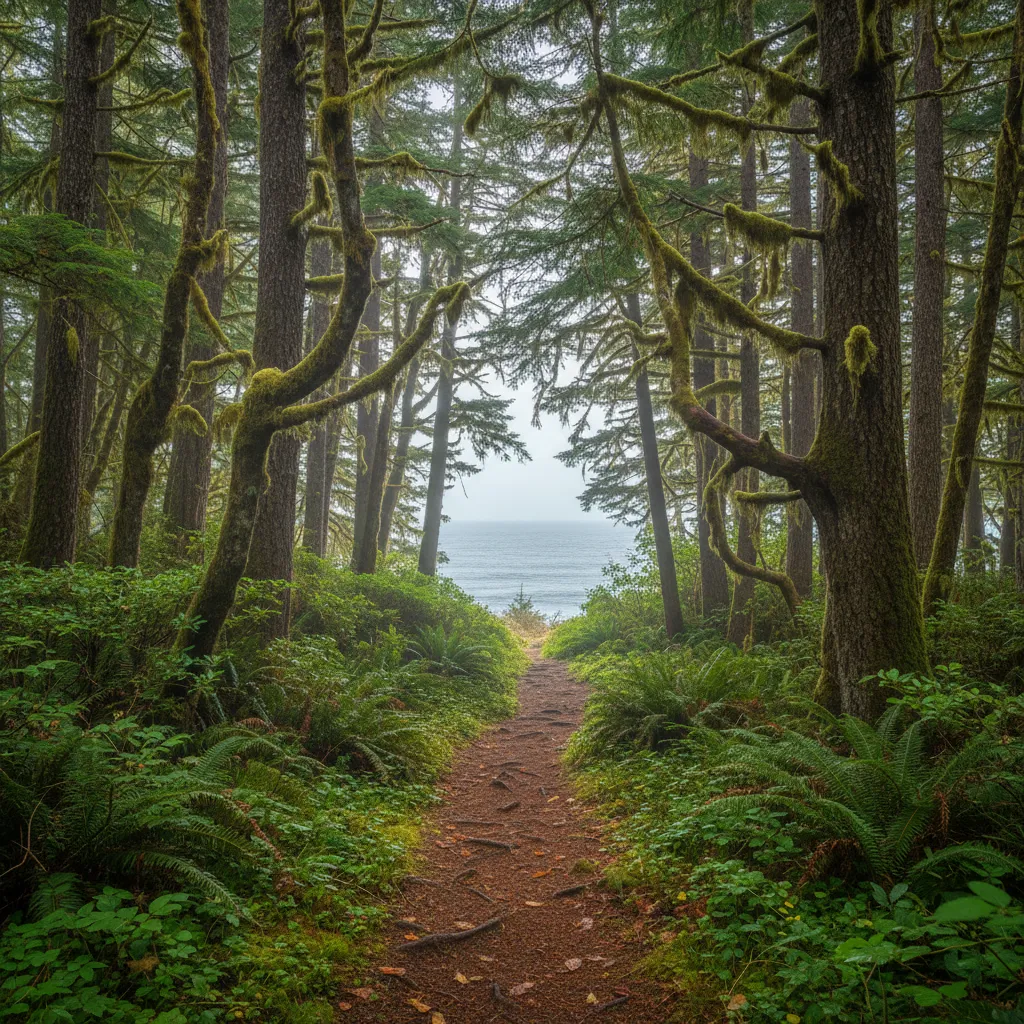
The Sunshine Coast — Gibsons, Sechelt, and Powell River — combines coastal rainforest with excellent crown land access. Less crowded than Vancouver Island and surprisingly productive.
Best species: Chanterelles, hedgehogs, lobster mushrooms, boletes, and excellent spring morel habitat in recently burned areas.
Access: BC Ferries from Horseshoe Bay to Langdale (Gibsons) or Earls Cove to Saltery Bay (Powell River). Forest service roads off Highway 101 lead to productive crown land.
Coordinates:
- Sechelt area forests: 49.48°N, 123.77°W
- Powell River backcountry: 49.87°N, 124.55°W
Whistler and Sea-to-Sky
The elevation gradient from Squamish to Pemberton creates diverse habitat spanning coastal rainforest to subalpine zones. Higher elevations produce species you won't find at sea level.
Best species: Chanterelles (lower elevations), king boletes / porcini (higher elevations, rare but present), lobster mushrooms, and excellent spring morel habitat.
Access: Forest service roads off Highway 99 and the Pemberton Valley area. Callaghan Valley and the Brandywine area are productive. Crown land is extensive in the backcountry.
Coordinates:
- Callaghan Valley: 50.14°N, 123.18°W
- Pemberton backcountry: 50.32°N, 122.82°W
Fraser Valley
The forests east of Vancouver — Mission, Harrison, Chilliwack, and Hope — offer accessible foraging within 1-2 hours of the city. The mix of Douglas fir, western red cedar, and hemlock supports good chanterelle and hedgehog habitat.
Best species: Chanterelles (October-November), hedgehog mushrooms, oyster mushrooms on fallen alder, and honey mushrooms.
Access: Forest service roads off Highway 7 (Lougheed Highway) and Highway 1. The Harrison Lake area and Chilliwack River Valley are productive. Watch for active logging.
Coordinates:
- Harrison area: 49.30°N, 121.78°W
- Chilliwack River Valley: 49.08°N, 121.42°W
Interior BC (Kamloops, Okanagan, Kootenays)
BC's Interior is different from the coast — drier, with pine and fir forests that support a distinct set of species. This is pine mushroom territory.
Best species: Pine mushrooms / matsutake (September-November, the most commercially valuable wild mushroom in BC), king boletes, morels (spring, especially in recent burn areas), chanterelles (at higher elevations).
Access: Extensive crown land and forest service road networks throughout the Interior. The areas around Revelstoke, Nelson, and the North Thompson Valley are particularly productive.
Pine mushroom notes: Pine mushrooms (Tricholoma murrillianum) grow in association with lodgepole pine, Douglas fir, and hemlock. They're BC's most commercially important wild mushroom, with significant exports to Japan. Commercial pickers have harvested pine mushrooms in the Interior and North Coast for decades. If you're foraging recreationally, be aware that you may encounter commercial pickers in prime areas.
Coordinates:
- Revelstoke area: 51.00°N, 118.20°W
- Kootenay Lake area: 49.68°N, 116.90°W
Haida Gwaii
The remote archipelago off BC's north coast is world-class foraging territory, though getting there requires commitment. The ancient temperate rainforests support exceptional chanterelle, hedgehog, and lobster mushroom populations, and the islands are far less picked-over than mainland and Vancouver Island sites.
Best species: Chanterelles (prolific), hedgehog mushrooms, lobster mushrooms, oyster mushrooms on alder. Some of the largest individual chanterelle specimens in BC have come from Haida Gwaii.
Access: BC Ferries from Prince Rupert to Skidegate, or flights to Sandspit or Masset. Crown land access is extensive, but always be mindful that Haida Gwaii is the traditional territory of the Haida Nation. Respect cultural sites and harvesting protocols.
Coordinates:
- Graham Island forests: 53.88°N, 132.12°W
- Moresby Island: 52.75°N, 131.65°W
Species by Season
BC's foraging season is long — roughly April through December — thanks to the mild coastal climate.
Spring (April - June)
Morels (Morchella species) — The big spring prize. Natural morels appear in riparian areas and disturbed ground throughout the province. But the real morel bonanza happens in wildfire burn areas — the year after a significant forest fire, the burned ground can produce staggering quantities of morels. Commercial morel camps set up in Interior BC burn zones each spring. Check BC Wildfire Service maps from the previous summer to identify promising burn areas.
Oyster mushrooms — Wild Pleurotus species fruit on dead alder and cottonwood from spring through fall. Common throughout the coast.
Dryad's Saddle / Pheasant Back — Large polypore on hardwood stumps, appearing in May and June. Young specimens are edible.
Summer (July - August)
Lobster mushrooms (Hypomyces lactifluorum) — Bright orange parasitized Russula mushrooms. Found in coastal and interior forests from July through September. One of BC's most distinctive and delicious wild mushrooms.
Chicken of the woods (Laetiporus species) — Bright orange shelf mushroom on hardwoods. Less common in BC than in eastern Canada but found throughout the southern coast and Interior. For detailed identification and cooking guidance, see our chicken of the woods guide.
Boletes — Various species, including occasional king boletes (Boletus edulis complex) at higher elevations. The Okanagan and Kootenays produce the best bolete foraging in BC.
Fall (September - December)
This is the main event. BC's fall mushroom season is one of the most productive in the world.
Golden chanterelles (Cantharellus formosus) — The Pacific golden chanterelle is BC's most popular edible wild mushroom. It fruits prolifically from September through November (sometimes into December in mild years) in Douglas fir forests throughout the coast. A single foraging trip can yield several kilograms. The aroma is fruity and floral, the texture is firm, and the flavour is delicate and peppery.
White chanterelles (Cantharellus subalbidus) — Less common than golden chanterelles but prized for their firm texture and mild flavour. Found in similar habitats.
Hedgehog mushrooms (Hydnum repandum and H. umbilicatum) — Cream to orange-coloured mushrooms with teeth (spines) instead of gills on the underside. Excellent eating, easy to identify, and common in coastal forests alongside chanterelles. One of the safest wild mushrooms for beginners — no toxic look-alikes.
Pine mushrooms / Matsutake (Tricholoma murrillianum) — BC's most commercially valuable species. Found in Interior and North Coast forests from September through November. Distinctive spicy-cinnamon aroma, firm white flesh, and a flavour prized in Japanese cuisine. Commercially harvested and exported to Japan for decades.
Cauliflower mushroom (Sparassis crispa) — Large, ruffled, cauliflower-like fungus growing at the base of conifers. Spectacular eating when young. Found throughout BC's coastal and Interior forests.
Honey mushrooms (Armillaria species) — Prolific fall mushrooms in dense clusters on dead and dying trees. Common throughout BC. Always cook thoroughly.
Winter (December - March)
BC's mild coastal winter allows some foraging even in the coldest months.
Velvet shank (Flammulina velutipes) — The wild ancestor of enoki mushrooms. Grows on dead hardwood in clusters through fall and winter, tolerating freezing temperatures. Found throughout the Lower Mainland and Vancouver Island.
Turkey tail (Trametes versicolor) — Available year-round on dead hardwood. Too tough to eat fresh but excellent dried and brewed as tea. Read about turkey tail mushroom benefits.
Oyster mushrooms — Wild oysters may fruit on dead alder and cottonwood through mild coastal winters.
Essential Gear for BC Foraging
BC's forests are wet, dense, and sometimes remote. Gear up accordingly.
Rain gear. This isn't optional. BC's fall foraging season coincides with the rainy season. A good waterproof jacket and pants are essential. Your feet will get wet — waterproof boots help, but accept that wet feet are part of the BC foraging experience.
A GPS device or phone with offline maps. BC's forest service road networks are complex, and cell service is nonexistent in most foraging areas. Download offline maps (Gaia GPS, Avenza Maps, or Google Maps offline) before you leave. A physical compass is good backup.
A sturdy wicker foraging basket or mesh bag. Never plastic bags. Airflow keeps mushrooms fresh and allows spores to disperse as you walk.
A good knife. An Opinel No. 8 is the classic forager's knife — the carbon steel blade takes a razor edge, and the twist-lock keeps it safe in your pocket.
A field guide. Mushrooms of British Columbia by Andy MacKinnon and Kem Luther is the definitive regional guide. All That the Rain Promises and More by David Arora is a beloved Pacific Northwest classic that's highly relevant to BC.
Bear spray. BC's forests are bear country, particularly in fall when bears are feeding heavily before hibernation. Carry bear spray and make noise on the trail.
A first aid kit. Forest service roads are remote. Help may be far away. Carry basics including a whistle and emergency blanket.
Brush and paper bags. For cleaning and separating species in the field. Keeping different species separate prevents cross-contamination of debris and makes identification easier at home.
Opinel No. 8 Folding Knife
The forager's classic. The carbon steel blade holds a keen edge for clean cuts at the mushroom base, and the Virobloc twist-lock keeps it safely closed in your pocket between finds.
View on Amazon.ca →When you buy through our links, it supports our mycology research at no extra cost to you.
Sustainable Foraging Practices
BC's wild mushroom populations are not inexhaustible, and sustainable harvesting is essential to ensure future seasons remain productive.
Take only what you'll use. The chanterelle flush is exciting, but harvesting 20 pounds when you'll eat 5 is wasteful. Wild mushrooms are a shared resource.
Use a knife. Cut mushrooms at the base rather than pulling them from the ground. This minimizes disturbance to the mycelium and soil.
Carry a mesh bag or basket. This allows spores to disperse as you walk through the forest, helping replenish mushroom populations.
Don't rake the duff. Some commercial harvesters rake the forest floor to find buried pine mushrooms. This damages the mycelial network and the forest floor ecosystem. Pick what's visible on the surface or pushing through the duff naturally.
Rotate your spots. Don't return to the same patch every week. Give areas time to produce new fruit bodies.
Respect closures. If an area is closed for ecological, cultural, or safety reasons, stay out. Temporary closures exist for a reason.
Share knowledge carefully. The foraging community debates this endlessly, but the general consensus is: share knowledge about species and techniques freely, share specific GPS coordinates carefully. Oversharing "honey holes" can lead to overharvesting of productive sites.
Getting Started
If you're new to foraging in BC, here's a practical starting path:
Join a club or foray. The Vancouver Mycological Society, South Vancouver Island Mycological Society, and Sunshine Coast Mycological Society all run regular forays led by experienced identifiers. This is the fastest and safest way to learn.
Start with easy species. Chanterelles, hedgehog mushrooms, and lobster mushrooms are all distinctive, delicious, and relatively safe for beginners. Save the more challenging identifications for later.
Get a good field guide. No app replaces a physical book when you're deep in the bush with no cell service.
Go with experienced people. Your first several trips should be with someone who knows what they're doing. Offer to drive, bring lunch, and carry the heavy basket — experienced foragers love to teach when you show genuine interest and respect.
Start close to home. You don't need to drive to Tofino for your first foray. The forests within an hour of Vancouver, Victoria, or any BC city produce excellent mushrooms.
British Columbia's forests offer some of the finest mushroom foraging anywhere in the world. The diversity of species, the vastness of the accessible land, and the sheer productivity of the Pacific coast rainforest ecosystem make this province a forager's paradise. Go slow, learn carefully, forage responsibly, and enjoy one of the most rewarding ways to connect with BC's extraordinary natural landscape.
If the off-season has you missing fresh mushrooms, you can grow gourmet species year-round at home. Browse our grow kits and spawn to keep the harvest going. And if you're also interested in foraging in eastern Canada, check out our mushroom foraging in Ontario guide.