
When your mushroom grows start producing real volume, you need a reliable way to preserve your harvest. Air drying works in a pinch, but it's slow, inconsistent, and depends heavily on your ambient humidity. Here in Canada, where indoor humidity can swing wildly between seasons, a dehydrator gives you consistent results every time.
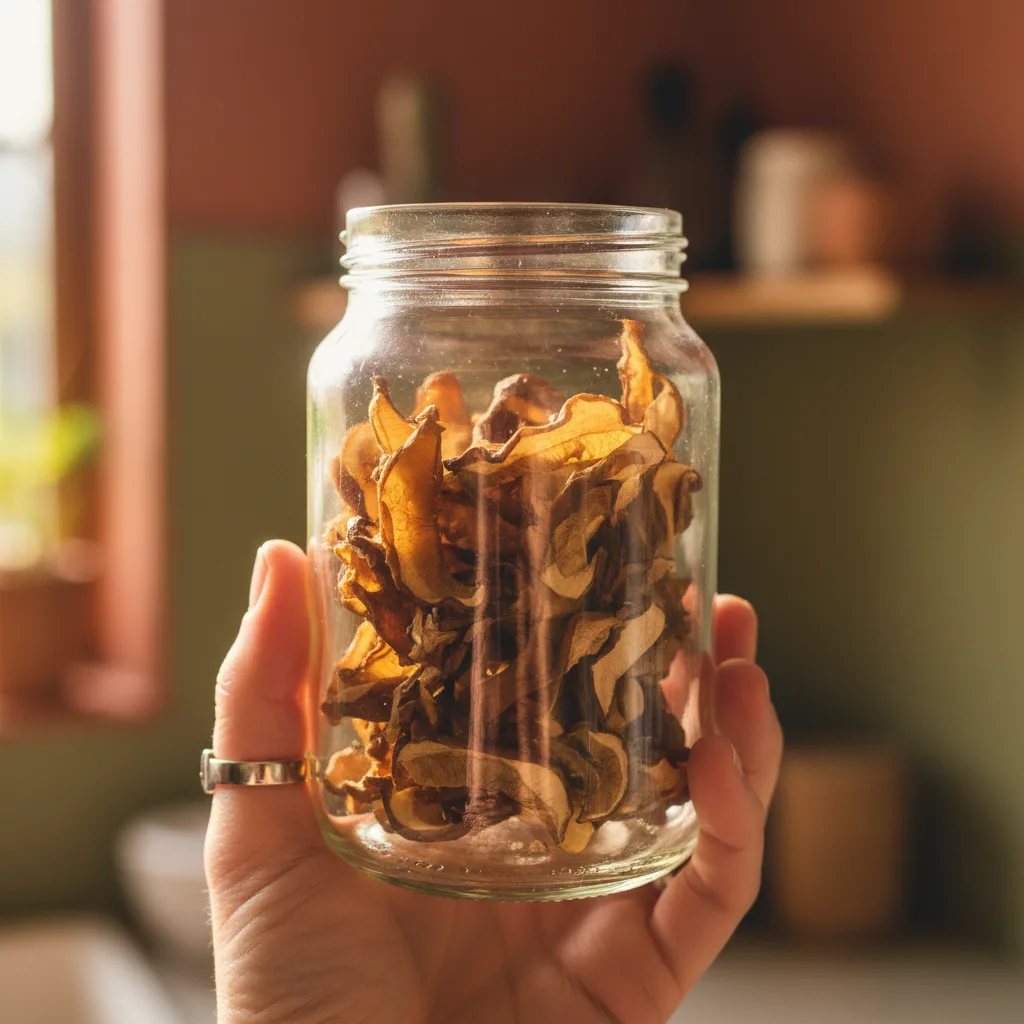
The goal is simple: get your mushrooms cracker-dry. That means no flex, no bend, no sponginess. When you snap a dried mushroom in half, it should break cleanly. At that moisture level (roughly 5-10%), properly stored mushrooms last indefinitely, and they're ready to be used in cooking, ground into powder, or processed however you need. Use our wet-to-dry weight calculator to estimate how much dried mushroom you'll get from a fresh harvest.
We dry mushrooms weekly, sometimes daily during peak flushes, and we've tested each of these dehydrators through multiple growing seasons. Here's what we've found.
This post contains affiliate links. When you buy through our links, it supports our mycology work at no extra cost to you.
Quick Verdict
The Myco Labs 350W is our pick for most mushroom growers. It was literally designed for this purpose, with extra tall trays that fit whole mushrooms. If you're drying at commercial volume, the Excalibur 3900B gives you the most drying space. And if you're just getting started and want something affordable, the COSORI 5-Tray does the job without asking much of your budget.
Comparison at a Glance
| Feature | Myco Labs 350W | Excalibur 3900B | COSORI 5-Tray |
|---|---|---|---|
| Tray Count | 5 | 9 | 5 |
| Drying Space | ~5 sq ft | 15 sq ft | ~5.1 sq ft |
| Wattage | 350W | 600W | 350W-450W |
| Airflow | 360-degree circular | Horizontal (rear) | Rear-mounted fan |
| Temp Range | 35-74C (95-165F) | 41-74C (105-165F) | 35-80C (95-176F) |
| Best For | Most mushroom growers | Commercial volume | Budget / starters |
Excalibur 3900B 9-Tray Dehydrator
The gold standard for commercial-volume drying. 15 square feet of tray space, horizontal airflow for even drying, and a track record that spans decades. Worth the investment if you're drying at scale.
When you buy through our links, it supports our mycology research at no extra cost to you.
Our Pick: Myco Labs 350W Mushroom Dehydrator
This is the only dehydrator on the market that was designed by mushroom growers, for mushroom growers. And that shows in one key design decision: the extra tall trays.
Standard dehydrator trays are typically 2-3 cm tall. That's fine for apple slices or beef jerky, but mushrooms are three-dimensional. A cluster of oyster mushrooms or a thick lion's mane fruit body doesn't lay flat. With standard trays, you either cut your mushrooms down (which works but adds prep time) or remove trays to create space (which wastes capacity).
The Myco Labs trays are tall enough to fit whole mushroom clusters without cutting. That sounds like a small thing until you're processing 2 kg of fresh oysters at 11 PM and you just want to load the trays and go to bed.
What We Like
Extra tall trays. The defining feature, and it matters more than you'd think. Whole mushrooms dry more evenly than cut pieces in many cases, and not having to slice everything saves real time during processing.
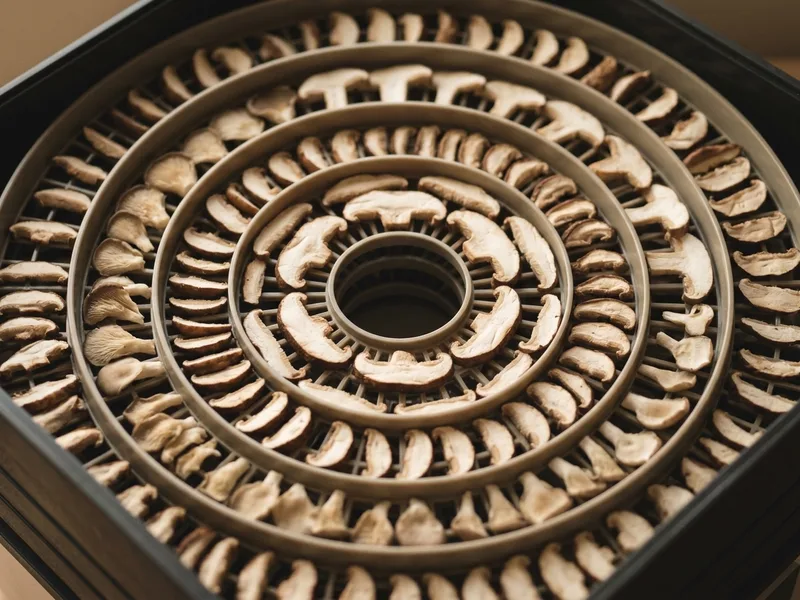
360-degree airflow. Instead of blowing from the back or bottom, the Myco Labs circulates air around all trays evenly. In practice, this means you don't need to rotate trays during drying, which you definitely do with a stacked bottom-up airflow design.
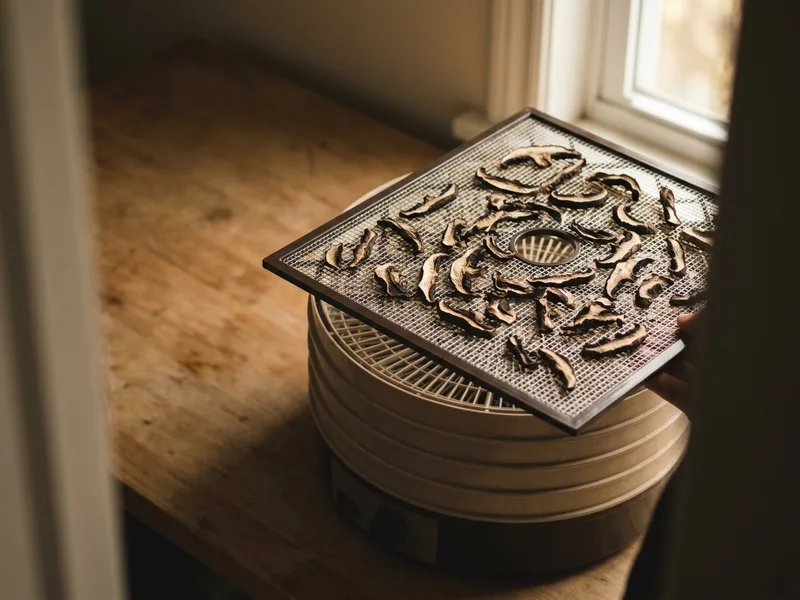
Temperature range. The adjustable knob covers 35-74C (95-165F), which is the full range you need. We typically dry mushrooms at 57C (135F), which gets most species cracker-dry in 6-10 hours depending on thickness and starting moisture.
BPA-free and dishwasher safe. Easy cleanup matters when you're using the dehydrator multiple times a week.
What Could Be Better
5 trays only. If you're drying serious volume, 5 trays fills up fast during a big flush. You'll be running multiple batches. For hobby growers this is fine, but commercial operations will want the Excalibur.
No timer. You need to check on your mushrooms and turn it off manually. It's not a big deal since mushrooms can sit in a running dehydrator longer than needed without harm, but a timer would be a nice addition.
Premium Pick: Excalibur 3900B 9-Tray
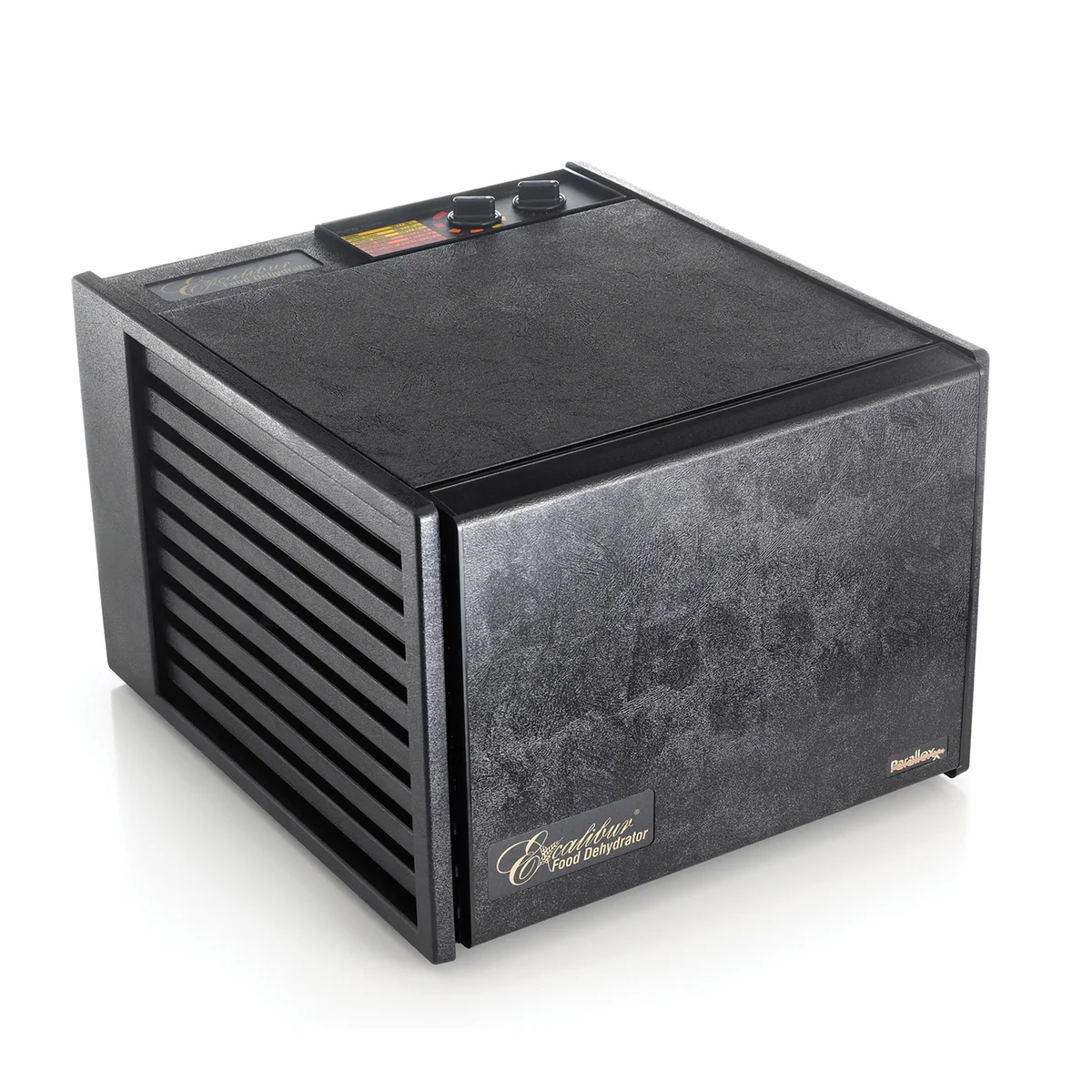
If you're drying at scale, the Excalibur is the industry standard for a reason. 15 square feet of drying space across 9 trays means you can process an entire week's harvest in a single run. This is the dehydrator you'll find in most small commercial mushroom farms.
What We Like
Massive capacity. 15 square feet is a lot of drying space. During peak season, when we're pulling multiple flushes from several monotubs and a Martha tent, the Excalibur handles everything in one batch.
Horizontal airflow. The fan is in the rear panel, pushing air horizontally across all trays simultaneously. This is more even than vertical (bottom-up) airflow designs, and it means you don't need to rotate trays. Every tray gets the same treatment.
Removable trays. Each tray slides out independently, so you can check specific trays without disturbing others. You can also remove trays entirely to create taller spaces for larger mushrooms.
Temperature control. The adjustable thermostat gives you precise control. The Excalibur holds its set temperature accurately, which matters for consistent results batch after batch.
What Could Be Better
Size. The 3900B is a large appliance. It takes up significant counter space, and in a small kitchen or lab, that's a real consideration. Make sure you have a dedicated spot for it before ordering.
Investment level. This is a premium dehydrator. For a hobby grower drying a few hundred grams a week, it's more capacity than you need. The Myco Labs or COSORI will serve you better at that scale.
No timer on the base model. Like the Myco Labs, the 3900B doesn't have a timer. The 3926TB model adds a digital timer, but it's a step up in cost.
COSORI 5-Tray Stainless Steel Dehydrator
Best budget dehydrator for mushroom growers. Digital controls with a built-in timer, stainless steel trays, and a compact footprint. You'll outgrow it eventually, but it's a great place to start.
When you buy through our links, it supports our mycology research at no extra cost to you.
Budget Pick: COSORI 5-Tray Dehydrator
If you're just getting started or drying modest quantities, the COSORI is a solid entry point. It's well-built for a budget dehydrator, has digital controls (including a timer, which neither of the others has in their base models), and it dries mushrooms effectively.
What We Like
Digital controls with timer. Set your temperature, set your timer, and walk away. The COSORI shuts off automatically when done. For someone who doesn't want to babysit the dehydrator, this is a genuine advantage over more expensive models.
Compact footprint. The 5-tray design takes up much less counter space than the Excalibur. If you're working in a small kitchen, this matters.
Good temperature range. The COSORI reaches up to 80C (176F), which is actually higher than both the Myco Labs and Excalibur. You won't usually need temperatures that high for mushrooms, but it gives you headroom.
Stainless steel trays. Easy to clean and more durable than plastic mesh. A nice touch at this level.
What Could Be Better
Standard tray height. Unlike the Myco Labs, the COSORI has standard-height trays. You'll need to slice larger mushrooms to fit, or remove trays to create clearance.
You'll outgrow it. If your mushroom growing expands (and it probably will), the COSORI's capacity becomes limiting. This is a great starter dehydrator, but plan on upgrading if you scale up.
Bottom-to-top airflow bias. While the rear fan improves on simple bottom-up designs, there's still some variation between top and bottom trays. You may want to rotate trays midway through longer drying sessions.
Beyond a dehydrator
A dehydrator drives water off with warm air, which shrinks and toughens the mushroom. There is one machine that does not.
How to Choose
How much are you drying? If you're growing a few grow kits or a single monotub, the COSORI handles your volume. If you're running a Martha tent and multiple tubs, the Myco Labs is the sweet spot. If you're drying for market or running a small farm, the Excalibur gives you the capacity you need.
How much prep work do you want to do? If you don't want to slice mushrooms before drying, the Myco Labs extra tall trays save you that step. With the COSORI or Excalibur, plan on some knife work for larger species.
Do you want a timer? Only the COSORI has one in its base configuration. If walking away and forgetting about it matters to you, that's a real advantage. Though honestly, mushrooms aren't damaged by extra time in the dehydrator -- they just get more dry, which is what you want anyway.
Tips for Drying Mushrooms
Regardless of which dehydrator you choose, these tips apply:
Temperature matters. We dry at 57C (135F) for most species. Higher temperatures dry faster but can affect flavor and texture. Lower temperatures take longer but preserve more delicate aromatics, which matters for species like shiitake.
Slice for consistency. Even if your trays fit whole mushrooms, slicing thick pieces to uniform thickness ensures everything dries at the same rate. A thick cap surrounded by thin ones will still be flexible when the thin ones are cracker-dry.
Don't overload. Mushrooms should be in a single layer with space between pieces. Stacking or overlapping means uneven drying and potential moisture pockets.
Test for doneness. Bend a piece. If it flexes at all, it needs more time. A properly dried mushroom snaps cleanly. If you're drying lion's mane, tear a piece apart and check the interior. Lion's mane can feel dry on the outside while retaining moisture in the core.
Store immediately. Once dried, move mushrooms to airtight containers or vacuum-sealed bags right away. Dried mushrooms are hygroscopic, meaning they pull moisture from the air. In a Canadian winter, your house might be dry enough that this doesn't matter for a few hours. In summer, it matters fast.
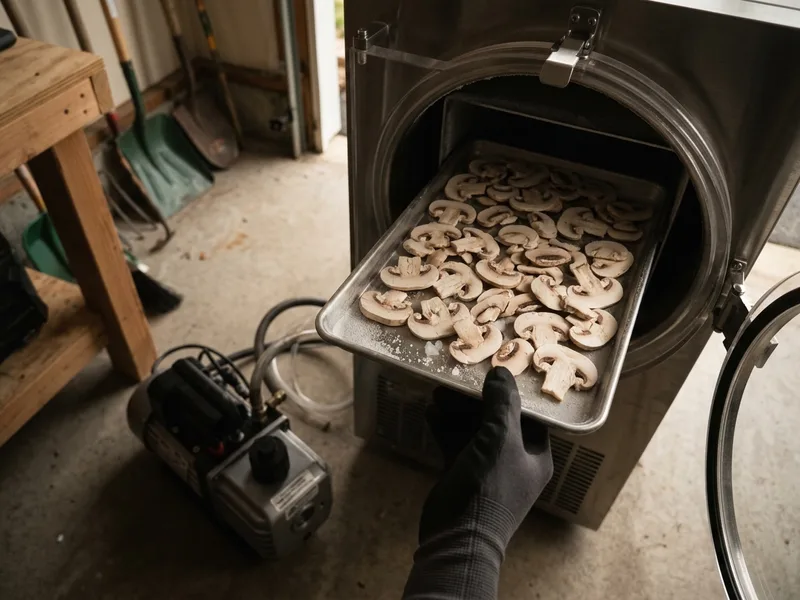
Harvest Right Home Freeze Dryer
Freeze drying removes water by sublimation rather than heat, so the mushroom keeps its shape, colour and cell structure and rehydrates close to fresh. A dehydrator cannot do that, which is why restaurants pay a premium for freeze-dried. It is a serious purchase, it runs for a day or more per batch and it needs a dedicated spot, so it only makes sense if you are selling rather than stocking a pantry.
When you buy through our links, it supports our mycology research at no extra cost to you.
Drying Times & Temperatures by Species
Every species dries a little differently. These are the settings we use week in, week out, with the doneness cue that tells you a batch is actually finished:
| Species | Temperature | Time | Doneness Cue |
|---|---|---|---|
| Oyster (sliced or small clusters) | 57C / 135F | 4-6 hours | Snaps cleanly with zero flex |
| Lion's mane (sliced ~1 cm) | 57C / 135F | 6-10 hours | Tear a piece: interior must be dry, not spongy |
| Shiitake (whole caps) | 57C / 135F | 8-12 hours | Cap cracks rather than bends |
| Chestnut | 57C / 135F | 6-8 hours | Stems snap like dry twigs |
| Chaga (chunks under 2.5 cm) | 49C / 120F | 10-24 hours | Rock-hard all the way through |
| Turkey tail | 57C / 135F | 4-8 hours | Brittle and cracker-dry edge to edge |
Times assume a single layer with airflow between pieces and typical fresh-harvest moisture. Humid summer kitchens push everything toward the long end of the range. When in doubt, give it another hour: slightly over-dried is harmless, while a moisture pocket ruins the jar.
From Dried Mushrooms to Powder
Once your mushrooms are cracker-dry, powder is the most space-efficient way to keep them. A jar of powder takes a fraction of the shelf space of whole dried caps, and it dissolves straight into soups, broths, sauces, and coffee, so nothing sits forgotten at the back of the pantry.
Our process:
- Break dried pieces down by hand into chunks your grinder can handle.
- Grind in a blade coffee grinder in short pulses. Small batches grind finer and keep the motor from heating the powder.
- Sieve through a fine mesh strainer, then re-grind whatever doesn't pass. Two passes gets most species to a smooth, even powder.
- Jar it immediately. Powder pulls moisture from the air even faster than whole dried mushrooms. Airtight glass jars in a cool, dark cupboard keep the flavour sharp for a year or more.
If you'd rather skip the grinding and sieving, we sell the finished result: our Lion's Mane Powder 60g and Chaga Powder 60g are ground to a consistent fineness that home blade grinders struggle to match, and the 5 Mushroom Powder Variety Pack lets you cook with five species without running five drying batches.
What to dry: grow your own
A dehydrator earns its keep fastest when you have a steady supply of fresh mushrooms coming in. Our ready-to-fruit grow kits produce multiple flushes from a single block, which is exactly the surplus-then-nothing rhythm a dehydrator solves. If you're new to growing, the week-by-week growing timeline shows when those flushes actually arrive so you can plan your drying days around them.
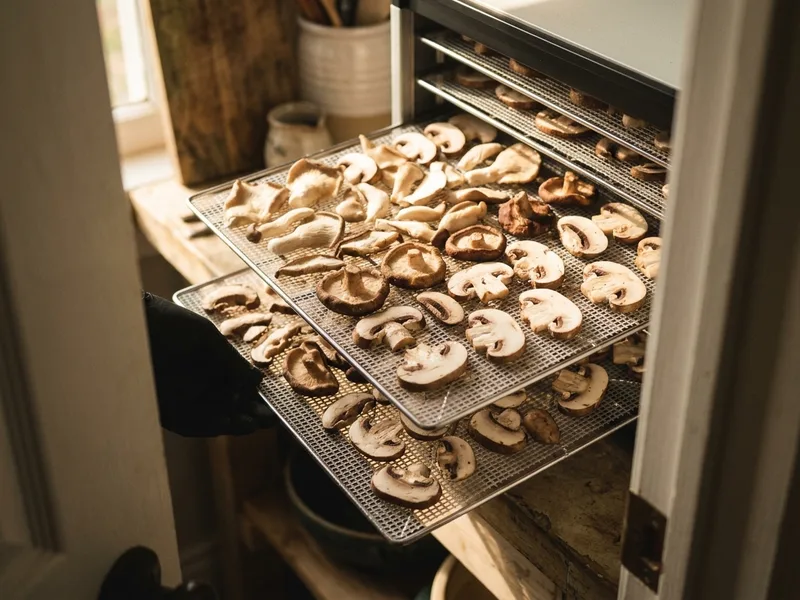
Myco Labs 350W Mushroom Dehydrator
Designed specifically for mushroom growers with extra tall trays that fit whole mushrooms. The 360-degree airflow dries evenly without tray rotation. This is the dehydrator we recommend to every mushroom grower.
When you buy through our links, it supports our mycology research at no extra cost to you.
Frequently Asked Questions
How long does it take to dehydrate mushrooms?
At 57C (135F), most mushrooms take 6-10 hours depending on thickness and species. Thin oyster mushroom slices can be done in 4-5 hours. Thick shiitake caps can take 10-12 hours. Check periodically and remove pieces as they finish.
Can I dry mushrooms in the oven instead?
You can, but it's harder to control. Most ovens don't go below 77C (170F), which is higher than ideal. You also don't get the air circulation that a dehydrator provides, leading to uneven drying. If you're only drying occasionally and don't want to buy a dehydrator, prop the oven door open slightly and use the lowest setting. But for regular drying, a dehydrator is worth the investment.
What's the best temperature for drying mushrooms?
57C (135F) is our standard. Some growers go as low as 49C (120F) for delicate species like enoki, and as high as 63C (145F) when they want faster results. Avoid going above 71C (160F) as it can affect the texture and nutritional profile.
How do I know my mushrooms are fully dry?
The snap test. Bend a piece: any flex at all means it needs more time. A finished mushroom breaks cleanly, like a cracker. For thick or dense species such as lion's mane, tear a piece open and check the centre, because the outside can feel dry while the core is still spongy. If the interior looks darker or feels cool and damp, keep drying.
How long do dried mushrooms last in a jar?
Stored cracker-dry in an airtight jar in a cool, dark cupboard, dried mushrooms keep for a year or more with no real loss of flavour, and they remain usable well beyond that. The two failure modes are moisture (jar opened in a humid kitchen, mushrooms not fully dry going in) and light. A pantry shelf beats a windowsill, and tossing in a food-safe desiccant packet is cheap insurance.
Do I need to slice mushrooms before drying?
Not always, but slicing helps. Thin, uniform slices dry faster and more evenly than whole fruit bodies. Small oyster clusters and thin-capped species can go in whole, especially in tall-tray dehydrators like the Myco Labs. Thick lion's mane or dense shiitake caps should be sliced to about 1 cm so the centre finishes at the same time as the edges.
Related Guides
- Most Profitable Mushrooms to Grow in Canada
- Essential Mushroom Growing Equipment Guide
- How to Grow Oyster Mushrooms
- How to Grow Lion's Mane
- How to Grow Shiitake Mushrooms
- Browse Spawn
Have a mushroom-growing question? Ask Dr. MycoTek for AI help with your grow. Sign in to use your free monthly allowance.