
Quick answer: A mushroom kit can produce more than one harvest, but the number and size vary. A flush is one crop of mushrooms. For Nature Lion boxed oyster, chestnut and Lion’s Mane kits, rest the block about one week after picking, then give it an eight-hour soak before resuming care.
What Is a Flush?
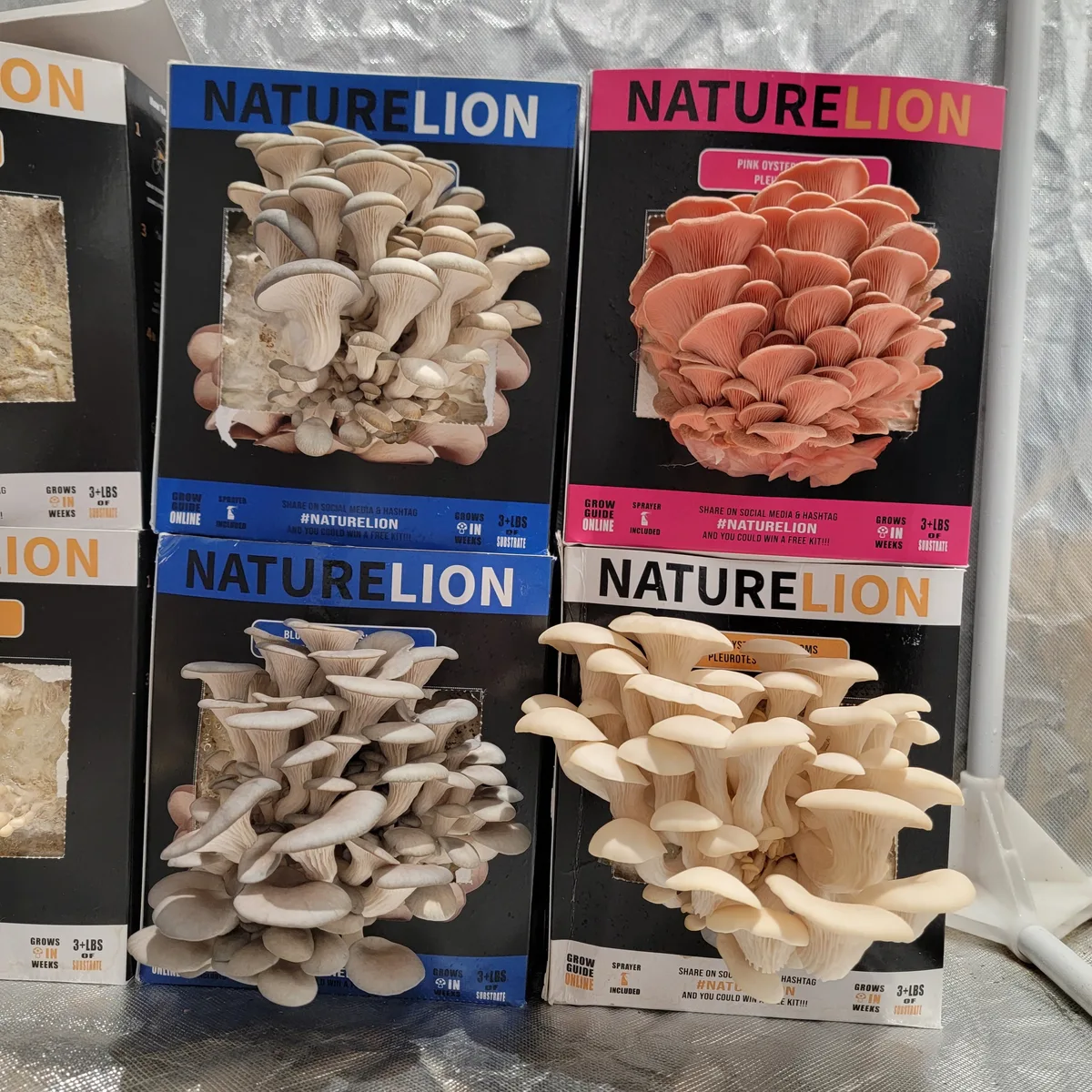
A flush begins with tiny mushrooms, called pins, and ends when you pick that crop. The same block may produce another crop after resting and taking up more water. Do not judge the kit only by how large one cluster looks in a product photo.
The first crop is often larger than later crops. Block size, mushroom variety, room conditions and daily care all affect the result. Two or three harvests can be possible, but a fourth crop or a particular total weight is not guaranteed.
Harvest Before Restarting the Kit
Pick by the mushroom’s appearance, rather than a fixed date:
| Mushroom | When to pick | How to remove it |
|---|---|---|
| Oyster | Largest cap edges still curve slightly downward, before flattening or turning up | Support the cluster at its base and gently twist it free, or cut the attachment with a clean knife |
| Chestnut | Caps have opened but remain rounded, before flattening | Support the cluster and gently twist it off, or cut at the base |
| Lion’s Mane | Firm white cluster with hanging teeth roughly 6–12 mm (¼–½ inch) long | Support the cluster and cut its attachment, avoiding pressure on the teeth |
| Shiitake | Firm opened caps with rims still curled underneath | Cut ready mushrooms individually; follow the supplier’s separate restart routine |
Remove bits of the growing block from the harvest, refrigerate the mushrooms and cook thoroughly before eating. Our harvest guide includes species photos and more detail.
Nature Lion’s Second-Harvest Routine
These steps apply to Nature Lion boxed oyster, chestnut and Lion’s Mane kits. Use the original maker’s instructions for another brand, a larger commercial block or a shiitake kit.
1. Rest for about one week
Remove loose mushroom pieces from the opening after harvesting. Let the block rest for about a week before soaking. Keep it away from direct sun and drying heat. You do not need to restart it the day you pick the first crop.
2. Soak for eight hours
Use a clean container and clean water. Keep the cardboard box out of the water and allow water to reach the block. After eight hours, let excess water drain away before weighing it.
Do not add salt, sugar, fertiliser or other ingredients to the soaking water. The aim is to replace water, not feed the block or treat a suspicious patch.
3. Check the weight
A fully hydrated Nature Lion block should weigh about 3–3.5 lb (1.4–1.6 kg). Weigh the drained block without the cardboard box or soaking container. Water left in the container does not count toward the block’s weight.
This target is for our boxed kits. Another maker’s block may start at a different size and need a different target.
4. If it has not absorbed enough water, help water reach inside
The white mycelium covering can keep water from soaking into the growing material. If the block has not taken up enough water after the first eight-hour soak:
- Gently scratch its surface with a clean fork, or poke a few holes around the block so water can penetrate deeper.
- Soak again, then drain and check its weight again.
- Do this between crops, before new mushrooms develop. Do not scrape or puncture growing mushrooms.
If the block still will not take up water, send us photos and its weight so we can help. Do not keep soaking a block that has a spreading suspicious patch or unusual slime; ask for advice first.
5. Return to the original daily care
For oysters and chestnuts, resume gentle misting at the growing opening 2–3 times a day, following the misting guide. Keep the surface damp without puddles. Once mushrooms appear, avoid soaking them or pushing plastic flaps over the cluster.
For Lion’s Mane, also use the included tent with a few slits. Drape it loosely, mist the inside 2–3 times daily, and once mushrooms are growing, take the tent off for 1–2 hours once a day before replacing it.
Pick the next crop using the same cap or tooth signs as the first. You do not need to wait for it to equal the size of your first harvest.
Why Is My Second Flush Not Appearing?
The block has not taken up enough water
Check the drained block weight against the target above. A quick surface mist is not the same as rehydrating the block between crops. If the surface repels water, use the gentle scratching or hole-making step before soaking again.
Conditions have changed
A heater, fan or air-conditioning vent can dry the growing opening. A different room may also be warmer or cooler. Return to a suitable spot and check the temperature guide, together with your kit’s own instructions.
The block needs time
A rest period is normal. A second crop is not guaranteed to arrive a set number of days after soaking. Take a dated photo and check for change without repeatedly recutting the block. The growing stages guide explains what new growth looks like.
Something looks wrong
Keep a kit with a suspicious spreading patch apart from other grows. Do not scrape away mould and assume that makes it suitable for another harvest. Use our mould-or-mycelium guide and contact us with photos.
When Is a Kit Finished?
A block may eventually stop producing worthwhile crops, even with consistent care. It may shrink or begin to crumble after several harvests. These signs alone do not prove that a block is finished: consider its harvest history, water uptake and condition together.
If it has rested, rehydrated and resumed care without progress, ask us whether another attempt makes sense. We can use the mushroom variety, start date, number of harvests, block weight and photos to help you decide.
What Can I Do With a Spent Block?
For a finished, otherwise healthy block, remove the plastic and add the growing material to compost. You can also experiment with an outdoor oyster bed using suitable clean woody material, but another harvest is uncertain. See spent mushroom substrate uses for options.
Do not use a suspect or contaminated block to start another indoor grow. Follow advice from the maker and local disposal guidance instead of breaking it apart in your growing space.
Your Next Grow
Try another variety from the grow-kit collection, or read the home-growing guide before preparing your own grow. Combining spawn and substrate adds preparation and clean-handling steps; it is not simply a larger version of opening a kit.
For detailed care, choose the oyster guide or Lion’s Mane kit guide. If preserving a large harvest, the wet-to-dry weight calculator helps estimate dried yield.
Frequently Asked Questions
Can I soak a Nature Lion Lion’s Mane block?
Yes. Use the one-week rest and eight-hour soak described above, then check the drained block reaches about 3–3.5 lb. Once new mushrooms grow, mist the tent walls rather than drenching the mushroom.
Should I make new holes every day?
No. Gentle scratching or a few holes are a way to help a rested block absorb water if the first soak has not worked. They are not a daily care step and should not disturb developing mushrooms.
Will the next harvest be as large as the first?
It may be smaller. Judge the mushroom’s readiness by cap shape or teeth, not the weight of your previous crop. Keep harvest notes or an optional photo diary to compare crops.
Do other kits use the same soak?
Not necessarily. Manufacturers use different block sizes and preparation methods. Use the instructions for the kit you bought; Nature Lion’s weight and soak routine are not universal.
If your block is genuinely finished rather than resting, our range of Canadian grow kits covers what to buy next.
References and Help
The Nature Lion restart routine above was confirmed by our kit producer. For harvest background, see North Spore’s kit FAQ, GroCycle’s chestnut guide and Field & Forest’s shiitake harvest guide. Cornell Small Farms explains the broader cultivation process.
Need help? Email info@naturelion.ca with photos, the mushroom variety, harvest date and drained block weight.