
Mushroom coffee is easy to get wrong in exactly one way: treating it like a supplement instead of a cup of coffee. Brew it carelessly and you get a muddy, gritty mug that confirms every skeptic's suspicion. Brew it properly and it's simply a good cup of coffee with a rounder, earthier depth.
This guide covers every practical way to brew mushroom coffee at home — pre-blended grounds, adding mushroom powder to your own beans, and cold brew — with the ratios that actually work. If you're starting from zero and want the background first, read what is mushroom coffee, then come back here for the brewing.
The Two Starting Points
Everything below depends on which of these you're holding:
Pre-blended mushroom coffee — ground coffee that already has mushroom powder mixed in at the roaster. Our mushroom coffee blends are Canadian-roasted arabica blended with lion's mane, chaga, or turkey tail powder. Brew it like regular ground coffee — the blending work is already done, and the ratios are consistent bag to bag.
Mushroom powder + your own coffee — you buy mushroom powder separately and add it to whatever you already brew. More flexible, slightly more technique involved, and the rest of this guide covers the details.
Both routes make a good cup. Pre-blended is the easier daily driver; powder-plus-coffee suits people attached to a specific roast.
The Golden Ratio
For adding mushroom powder to brewed coffee, start here:
1/2 teaspoon (about 1 g) of mushroom powder per 250 ml cup.
That's the ratio that disappears into the coffee instead of dominating it. You can work up to a full teaspoon per cup once you know you like it, but starting stronger is the number one reason people decide mushroom coffee "tastes weird." Chaga is the mildest and most coffee-compatible of the powders; lion's mane is gently earthy; turkey tail is the most assertive, so start it at the low end.
For pre-blended grounds, use your normal coffee dose — around 2 tablespoons (10-12 g) per 250 ml of water — and adjust to taste exactly as you would with any new bag of coffee.
Here is the same thing as a table, because the right dose shifts a little with the method you are using.
| Method | Mild (per 250 ml) | Standard | Bold | Where the powder goes | Texture notes |
|---|---|---|---|---|---|
| Drip machine | 0.5 g | 1 g | 1.5 g | Stirred into the finished cup | Cleanest of the lot. The paper filter keeps fines out of the brew. |
| Pour-over | 0.5 g | 1 g | 1.5 g | Stirred into the finished cup | Same clean body as drip, slightly brighter. The powder never touches the filter. |
| French press | 0.5 g | 1 g | 1.5 g | Stirred into the poured cup | Fullest body of the hot methods. The mesh lets fines through, so sediment settles at the bottom. |
| Cold brew | 1 g | 2 g | 3 g | Hot paste added at serving, never to the cold steep | Ice and milk flatten flavour, so cold drinks take more. Powder clumps straight in cold water. |
| Stirred into brewed coffee | 0.5 g | 1 g | 2 g | Paste in the mug first, then top up | Smoothest with a frother. An unfrothed cup can leave a trace of grit. |
Grams are mushroom powder, not coffee. If you are brewing a pre-blended bag, the powder is already in the grounds and there is nothing to measure.
Method 1: Drip Machine or Pour-Over (Pre-Blended)
The simplest route, and the one we recommend for a daily cup.
- Dose like regular coffee. 2 tablespoons of blended grounds per 250 ml of water. A kitchen scale makes this repeatable: 1:16 coffee-to-water by weight.
- Use water just off the boil — 93-96°C. If your kettle doesn't have temperature control, boil it and wait 30 seconds.
- Brew normally. Paper filters catch any fine mushroom powder that would otherwise end up in the cup, which is why filtered methods produce the cleanest-tasting mushroom coffee.
- Drink it black first. Before you add anything, taste what the blend actually does — most people notice a rounder, less acidic cup rather than anything "mushroomy."
| Drip machine | Pour-over | |
|---|---|---|
| Blended grounds | 15-16 g per 250 ml, about 2 heaping tbsp | 15-16 g per 250 ml |
| Grind | Medium | Medium-fine |
| Water | 250 ml per cup | 250 ml per cup |
| Water temperature | 93-96 °C, the machine handles it | 93-96 °C |
| Brew time | 4-5 minutes, one machine cycle | 2:30 to 3:00 total pour |
| If adding your own powder | 1 g stirred into the finished cup | 1 g stirred into the finished cup |
Method 2: French Press
French press works, with one adjustment: the metal mesh lets fine particles through, so expect a slightly fuller-bodied, more rustic cup.
- Use a coarse grind and the same 1:16 ratio.
- Steep 4 minutes, then press slowly.
- Pour it all out when you're done pressing. Coffee (mushroom or otherwise) left sitting on the grounds keeps extracting and turns bitter.
- If sediment bothers you, let the poured cup rest 30 seconds — the fines settle to the bottom.
| French press | |
|---|---|
| Blended grounds | 30-32 g per 500 ml press, a 1:16 ratio |
| Grind | Coarse |
| Water | 500 ml |
| Water temperature | 93-96 °C |
| Steep time | 4 minutes, then press slowly |
| If adding your own powder | 1 g per 250 ml, stirred into the poured cup |
Method 3: Stirring Powder Into Brewed Coffee
The zero-equipment method: brew your regular coffee however you always do, then add mushroom powder to the cup.
- Add the powder to the mug first, then pour a splash of hot coffee over it and stir into a smooth paste. This one step prevents the floating-powder problem entirely.
- Top up the mug, stirring as you pour.
- A milk frother is the pro move. Ten seconds with a $15 handheld frother fully disperses the powder and adds a little texture to the cup. This is the single best piece of gear for powder-route mushroom coffee.
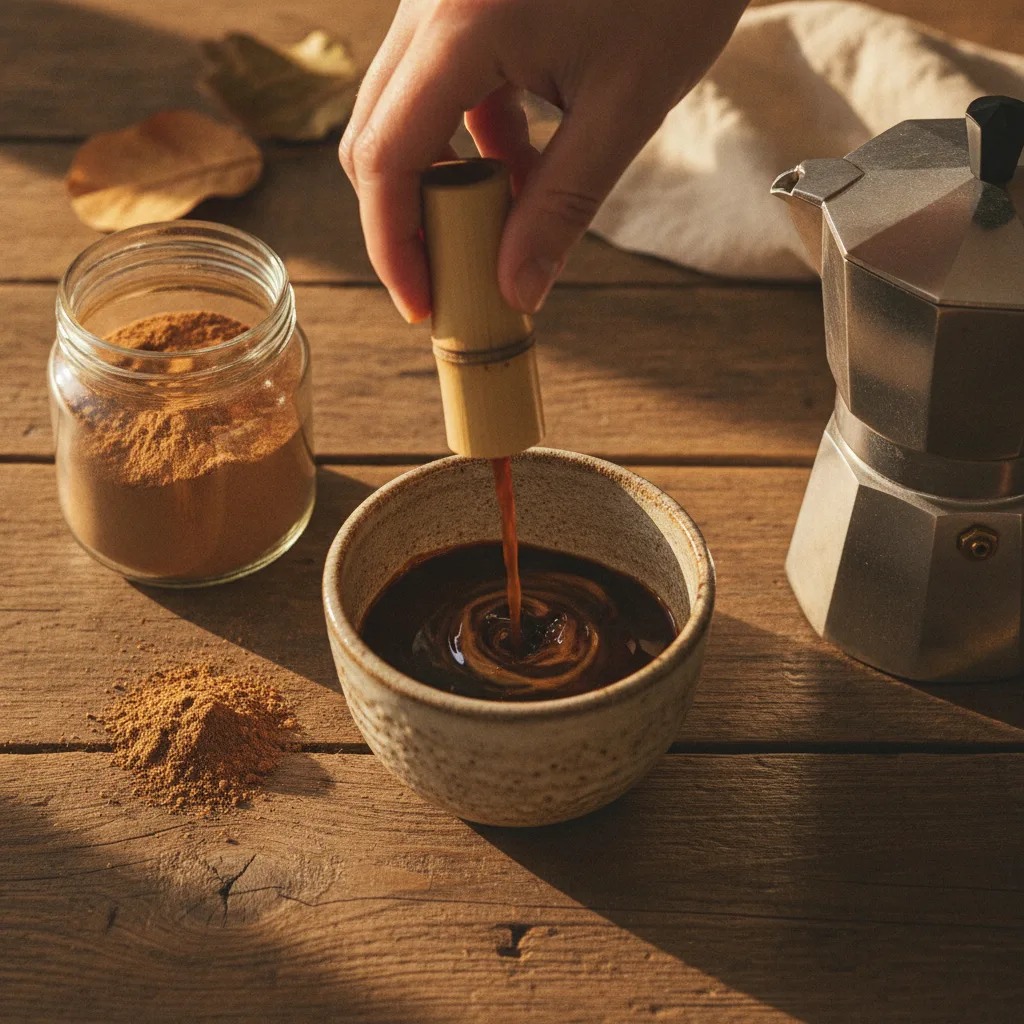
Hot-water-extracted powders dissolve noticeably better than raw ground mushroom, which tends to sit on the surface no matter how long you stir. Ours are hot-water extracted for exactly this reason.
| Stirred into brewed coffee | |
|---|---|
| Mushroom powder | 1 g standard, 0.5 g mild, 2 g bold, per 250 ml |
| Brewed coffee | 250 ml, any method you already use |
| Liquid temperature | 85 °C or hotter when you make the paste |
| Paste splash | 15-20 ml of the hot coffee |
| Stir time | 20 seconds with a spoon, 10 seconds with a frother |
Method 4: Cold Brew
Mushroom coffee cold brews beautifully — the long steep mellows the earthy notes even further.
- Combine coarse-ground blended coffee with cold water at a 1:8 ratio in a jar (for concentrate).
- Steep 14-18 hours in the fridge.
- Strain through a paper filter for the cleanest result.
- Dilute the concentrate 1:1 with water or milk over ice.
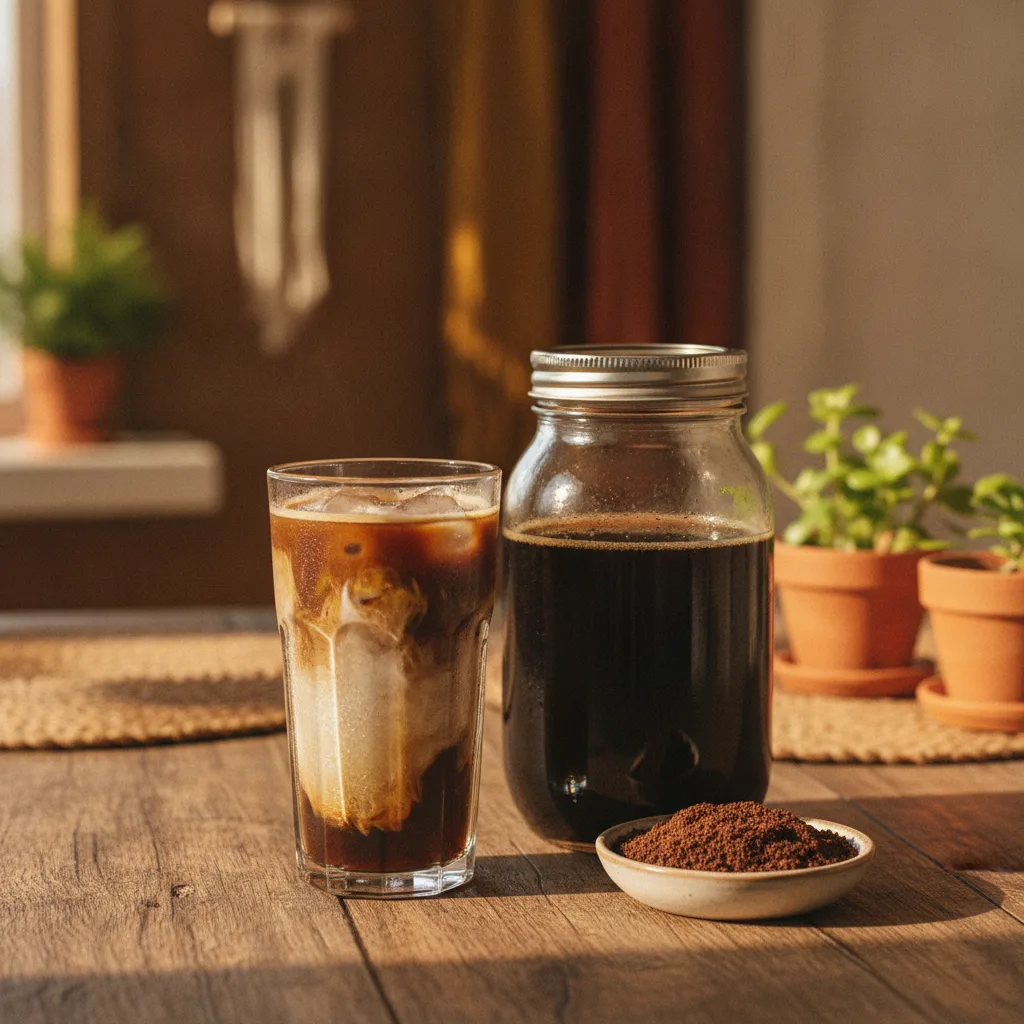
If you're using powder instead of pre-blended grounds, add it when serving (paste method, above) rather than to the cold steep — powder extracts poorly in cold water.
| Cold brew | |
|---|---|
| Blended grounds | 125 g per 1 L of cold water, a 1:8 concentrate |
| Grind | Coarse |
| Water temperature | Cold, straight from the fridge |
| Steep time | 14-18 hours in the fridge |
| Straining | Paper filter for the cleanest result |
| Dilution | 1:1 concentrate to water or milk, over ice |
| If adding your own powder | 2 g per 250 ml of finished drink, as a hot paste at serving |
Making It Taste Great
A few honest notes on flavour, because "does it taste like mushrooms?" is the first question everyone asks:
- A good blend shouldn't taste like mushrooms. It tastes like coffee with a slightly deeper, earthier base and less acidic bite. If a cup tastes strongly fungal, the ratio is too high — cut it in half.
- Milk and oat milk are natural partners. The creaminess rounds out the earthy notes. Frothed milk over a strong mushroom brew makes an excellent latte.
- Cinnamon, cocoa, and vanilla all work. A pinch of cinnamon in the grounds before brewing is the classic move.
- Sweeten last. Taste the finished cup first — the lower acidity means many people use less sweetener than they do with regular coffee.
- Keep the bag sealed and cool. Mushroom powder is hygroscopic; a clumpy bag means moisture got in. Airtight container, cupboard, not the fridge.
Where to Start if You Have Not Bought Any Yet
All three of our coffees are $25 a bag, all three are roasted in Canada, and all three brew exactly like ordinary ground coffee in the gear you already own.
- Chaga Mushroom Coffee, $25. The closest of the three to a plain cup of coffee. If you want the smaller change, or someone else in the house drinks your coffee and you would rather they did not notice anything new, start here.
- Lion's Mane Coffee, $25. Gently earthy, a touch rounder than the chaga blend, and our most-ordered coffee. A safe default if you are not sure.
- Shyne Turkey Tail Coffee Latte, $25. The most different of the three, and the one built for milk rather than black. Start it at the mild end of the table above and work up.
Prefer the roast you already buy? A 60 g pouch of single-mushroom powder is $25 and goes into whatever is in your grinder today. Chaga is the easiest one to add to a coffee you already like.
Once your cart reaches $25 before shipping and tax, the site adds a free Lion's Mane Coffee sample to the order on its own, so your first bag brings a second coffee to try with it.
What a cup actually costs
A 60 g pouch is $25, which works out to about 42 cents of mushroom powder in a cup at the 1 g starting ratio in the table above, and about 83 cents at a full 2 g serving. That is 60 cups a pouch at the starting ratio, or 30 at a 2 g serving. The coffee you brew it into is on top of that either way.
Still deciding whether this is for you? What is mushroom coffee covers the basics, and if you would rather skip coffee altogether, the mushroom tea guide uses the same powders with the same paste trick.
Common Mistakes
- Too much powder on day one. Start at half a teaspoon. You can always add more tomorrow.
- Cold liquid. Mushroom powder disperses in hot liquid and clumps in cold. For iced drinks, make the paste with hot water first, then ice it.
- Boiling the powder on the stove. Unnecessary for extracted powders — they're already water-soluble. Just brew and stir.
- Expecting instant-coffee convenience from raw powder. If your powder never fully dissolves, it's likely raw ground mushroom rather than an extract. Check the label.
Frequently Asked Questions
How much mushroom powder should I put in coffee?
Start with 1/2 teaspoon (about 1 g) per 250 ml cup and adjust from there. Up to a full teaspoon per cup works once you're used to the flavour. With pre-blended mushroom coffee, no measuring is needed — dose it like regular ground coffee at roughly 2 tablespoons per cup.
Can you brew mushroom coffee in a regular coffee maker?
Yes. Pre-blended mushroom coffee grounds work in any drip machine, pour-over, French press, AeroPress, or moka pot exactly like regular ground coffee. Paper-filtered methods give the cleanest cup. The only thing to avoid is putting loose mushroom powder in the filter basket of a drip machine — it can slow the flow; stir powder into the brewed cup instead.
Does mushroom coffee taste like mushrooms?
Not when it's blended properly. A well-made cup tastes like slightly smoother, earthier coffee with less acidic bite — most first-timers say they wouldn't have known without being told. Strong fungal flavour means the powder ratio is too high or the powder is raw ground mushroom rather than an extract.
Can you make mushroom coffee iced?
Absolutely. Either cold brew pre-blended grounds (1:8 concentrate, 14-18 hours in the fridge) or brew hot, make a powder paste with the first splash, and pour it over ice with milk. Powder added directly to cold liquid will clump, so always disperse it in something hot first.
How many grams of mushroom powder per cup of coffee?
One gram per 250 ml cup is the standard dose, which is roughly half a teaspoon. Go to 0.5 g if you want it barely noticeable, and up to 2 g once you know you like the flavour. Cold drinks take a little more than hot ones because ice and milk flatten the taste, so 2 g per 250 ml is a better starting point for iced coffee. Pre-blended bags need no measuring at all.
Can you put mushroom powder in the filter basket with the coffee grounds?
It is better not to. Fine powder in a drip basket slows the flow through the filter and some of it stays behind in the paper, so the dose in the cup is lower than the dose you measured and inconsistent cup to cup. Brew the coffee on its own, then stir the powder into the finished cup as a paste. If you want the powder pre-mixed with the grounds, buy a pre-blended bag where the roaster has done it properly.
Why does my mushroom coffee taste muddy or gritty?
Three usual causes. The dose is too high, so halve it and work back up. The powder went into cold or lukewarm liquid and clumped instead of dispersing, so make the paste with the first splash of hot coffee. Or the powder is raw ground mushroom rather than a hot-water extract, which never fully dissolves no matter how long you stir. Check the label. A paper-filtered brew with the powder stirred into the finished cup is the cleanest combination.
Ready to try it? Our mushroom coffee is roasted in Canada and blended with mushrooms we know from root to cup — and if you'd rather build your own blend, the mushroom powders pair with whatever's already in your grinder.
Have a mushroom-growing question? Ask Dr. MycoTek for AI help with your grow. Sign in to use your free monthly allowance.