
Quebec has the deepest mushroom-foraging culture in Canada. The tradition runs three ways: an unbroken Indigenous knowledge tradition, a French-Canadian rural practice that's been continuous since the 1600s, and a wave of Eastern European and Southeast Asian immigrant communities — Polish, Romanian, Ukrainian, Vietnamese, Cambodian — that arrived in Montréal and brought their own foraging traditions with them. The result is the Cercle des mycologues de Montréal, founded in 1950, the oldest and largest mycological society in Canada.
The province is also enormous and ecologically diverse: the boreal forest of the north, the Laurentian forest of the mid-belt, the maple-beech hardwoods of the Estrie and Outaouais, the salt-air mixed forests of the Gaspé, and the cottonwood-elm bottomlands of the St. Lawrence valley. This is one of the most rewarding provinces in Canada to learn to forage.
This guide covers where you can legally forage in Quebec, what's in season month by month, the regional differences across the province, and the toxic lookalikes you need to know before harvesting.
Quebec Foraging Calendar
What's fruiting in Quebec — tap a month to see the species.
October in Quebec
11 species fruiting
Chicken of the Woods
Laetiporus sulphureus
Bright orange shelves on hardwoods (oak, cherry, maple) through southern Quebec. Young, soft edges only.
View this species on Dr. MycoTek →Giant Puffball
Calvatia gigantea
Pasture and field edges, especially through the Eastern Townships. Pure white inside is essential — yellow or olive means past edible.
View this species on Dr. MycoTek →Hedgehog Mushroom
Hydnum repandum
Mixed forests through the Laurentians, Mauricie, and Gaspé. Spines instead of gills — no deadly lookalikes. Safe for new foragers.
View this species on Dr. MycoTek →Hen of the Woods (Maitake)
Grifola frondosa
★ Peak season right now
Massive ruffled clusters at the base of mature oaks. Estrie, Outaouais, and the St. Lawrence valley south of Montréal. Returns to the same tree year after year.
View this species on Dr. MycoTek →King Bolete (Porcini / Cèpe)
Boletus edulis
Spruce, fir and birch forests across the Laurentians, Saguenay and Côte-Nord. The 'cèpe' of European tradition. Spongy pores, never gills.
View this species on Dr. MycoTek →Lion's Mane
Hericium erinaceus
★ Peak season right now
Waterfall-shaped fruit on living and dead hardwood. Beech, maple, and oak across southern Quebec. No deadly lookalikes.
View this species on Dr. MycoTek →Saffron Milk Cap
Lactarius deliciosus
Pine plantations and natural pine forests. Bleeds orange-red latex when cut. Strong Eastern European tradition in Montréal and Sherbrooke immigrant communities.
View this species on Dr. MycoTek →Shaggy Mane
Coprinus comatus
★ Peak season right now
Lawns, gravel road edges, disturbed soil. Eat the same day — they liquify into black ink within hours.
View this species on Dr. MycoTek →Wild Oyster Mushroom
Pleurotus ostreatus
★ Peak season right now
Fallen aspen, maple, and beech throughout the season. Cool fall flushes produce the best texture.
View this species on Dr. MycoTek →Chaga
Inonotus obliquus
Year-round on living birch — Quebec's boreal forest holds vast birch stands and excellent chaga populations. Easiest spotting after leaf-fall.
View this species on Dr. MycoTek →Honey Mushroom
Armillaria mellea group
★ Peak season right now
Big clusters at the base of dying hardwoods. Must be cooked very thoroughly. Confirm against the deadly Galerina marginata on the same wood.
View this species on Dr. MycoTek →Year at a glance
The Legal Framework
Quebec's land-tenure system is uniquely structured. Understanding the difference between Crown land, ZECs, wildlife reserves, provincial parks, and national parks is essential before you head into the bush.
Public Land ("Terres publiques" / Crown Land)
Approximately 92% of Quebec is public Crown land, administered by the Ministère des Ressources naturelles et des Forêts. Personal-use harvesting of non-timber forest products — including mushrooms — is generally permitted on Crown land without a permit.
Key rules:
- Personal use does not require a permit. Commercial harvesting requires a permis de récolte de produits forestiers non ligneux from the ministry.
- Forest tenure agreements cover much of the boreal Crown land. Foraging is generally compatible with active forestry, but watch for active logging operations.
- Leave no trace.
ZECs (Zones d'Exploitation Contrôlée)
Quebec has 86 ZECs — Crown-land zones managed by non-profit user associations for hunting, fishing, and forest activities. Most ZECs permit personal-use foraging, sometimes with a small access fee for road maintenance. Check with the specific ZEC office before your trip.
Wildlife Reserves (Réserves fauniques)
Wildlife reserves are administered by SÉPAQ (Société des établissements de plein air du Québec). Most permit personal-use mushroom foraging. Réserve faunique des Laurentides, Réserve faunique Mastigouche, and Réserve faunique de Matane are particularly accessible from Montréal and Quebec City.
Provincial Parks ("Parcs nationaux du Québec")
Quebec's provincial parks are also administered by SÉPAQ and are confusingly called "parcs nationaux" — they are provincial, not federal. SÉPAQ parks generally prohibit the removal of natural objects, including mushrooms. Notable examples: Parc national du Mont-Tremblant, Parc national de la Jacques-Cartier, Parc national du Bic, Parc national de la Gaspésie.
The good news: adjacent Crown land and surrounding wildlife reserves usually offer similar habitat without the prohibitions.
National Parks (Parks Canada)
Forillon, La Mauricie, and Mingan Archipelago strictly prohibit foraging.
Private Land
Permission required. Quebec's Code civil applies.
Indigenous Territory
Quebec encompasses the traditional territory of 11 First Nations plus Inuit and Métis communities. The province includes both the Paix des Braves / Cree-Quebec Agreement territory and Inuit Nunavik. Respect Indigenous harvesting rights and protocols. If on a reserve, you need permission from the band council.
Six Foraging Regions
Laurentians (Laurentides)
The mid-elevation forest north of Montréal — Saint-Donat, Mont-Tremblant, Sainte-Agathe, the upper Lièvre River. Mix of yellow birch, sugar maple, balsam fir, hemlock, and white spruce. Some of the most productive chanterelle and lobster mushroom country in eastern Canada.
Best species: Golden chanterelles (July–September), lobster mushrooms, king boletes, hedgehogs, honey mushrooms, lion's mane, chaga.
Mauricie
The Saint-Maurice river valley between Trois-Rivières and La Tuque. Boreal-Laurentian mixed forest, vast Crown land, fewer foragers than the Laurentians.
Best species: Same as the Laurentians, plus more black morels in burn areas and more boreal species (birch boletes, slippery jack) at higher latitudes.
Eastern Townships (Estrie)
The Appalachian hills south of Montréal — Magog, Sherbrooke, Sutton, Lac-Mégantic. Sugar maple, American beech, yellow birch, oak, hickory. The most Carolinian-influenced foraging in Quebec.
Best species: Hen of the woods on mature oaks, lion's mane on beech, chicken of the woods, black trumpets in beech-maple stands, lobster mushrooms.
St. Lawrence Lowlands & Outaouais
The flat agricultural belt along the river and the Ottawa River corridor. Cottonwood, elm, silver maple, butternut. Best in spring — this is morel country.
Best species: Yellow morels (the spring 'morille' tradition), oysters on cottonwood, dryad's saddle, occasional hen of the woods in remaining mature oak stands.
Saguenay-Lac-Saint-Jean & Côte-Nord
The boreal forest north of Quebec City along the lower St. Lawrence. White spruce, black spruce, balsam fir, yellow birch. Vast Crown land, low foraging pressure.
Best species: Black morels in burn areas, king boletes, birch boletes, slippery jack, hedgehogs, chaga in the boreal birch.
Gaspé Peninsula
The salt-air mixed forest of eastern Quebec. Balsam fir, white birch, yellow birch on the higher slopes; mixed hardwoods at lower elevations along the coast. Cool, wet, productive.
Best species: Chanterelles, hedgehogs, lobster mushrooms, king boletes, lobster mushrooms. The Gaspésie wildlife reserve is particularly accessible.
What to take with you
Foraging needs very little kit, and the three things that matter each do a different job: carry the find without crushing it, cut it without damaging what is left behind, and clean it dry.
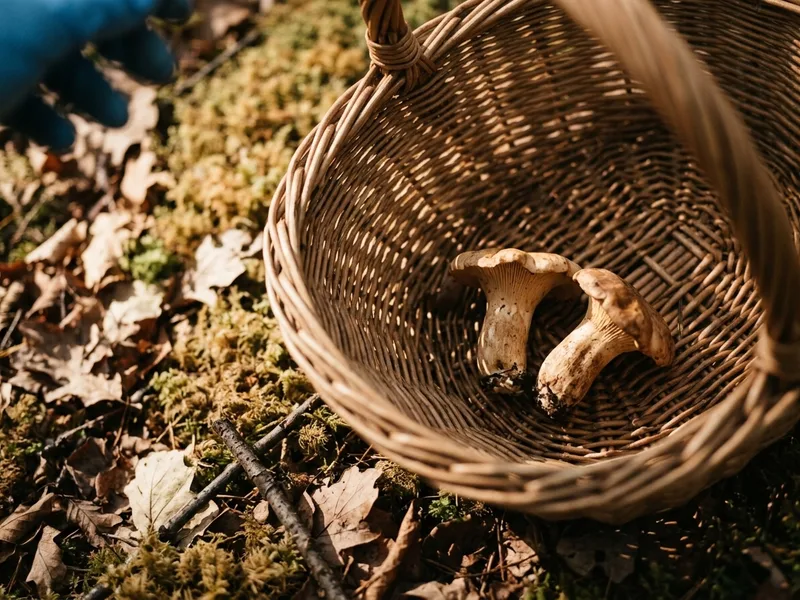
Wicker Foraging Basket
An open weave lets spores drop back through as you walk, which a plastic bag does not, and it stops a soft cap being crushed under everything picked after it. Size it to the walk, not the best day you have ever had.
When you buy through our links, it supports our mycology research at no extra cost to you.
Where to Forage Near Québec's Cities
The six regions above tell you what grows where. This section is about access: which specific blocks of land you can actually reach from each city, and what the rule is when you get there.
Montréal and the Montérégie
Montréal is the hardest major Canadian city to forage inside and one of the easiest to forage out of. Almost all of the island's woodland is municipal parkland, and open Crown land is about ninety minutes up the highway.
Start with what the island is genuinely good for, which is learning rather than harvesting. Parc du Mont-Royal and the Grands parcs network, including Bois-de-Liesse, Bois-de-Saraguay, Parc-nature de l'Île-de-la-Visitation and Cap-Saint-Jacques, hold mature sugar maple, beech, oak and old river bottomland, and they fruit well in a wet September. They are also city parkland, and Montréal's park by-laws prohibit damaging or removing vegetation. No mushroom exemption is written into them. Treat every park on the island as photograph-and-learn territory: record the find on iNaturalist, note the tree it came off, leave it standing. Bois-de-Saraguay is a protected natural heritage site on top of that, so the bar there is higher still. If you want a definite answer for a specific park, ring the borough office rather than reading silence as permission.
Parc national d'Oka, forty minutes west, is not a federal park despite the name. It is a parc national du Québec run by SÉPAQ, so the no-removal rule set out in the Legal Framework section above applies to it exactly as it does to Mont-Tremblant. Parc national du Mont-Saint-Bruno, on the south shore, is the same. Off the island and still closed.
The Montérégie hills tempt every Montréal forager and mostly do not pay out. Mont Saint-Hilaire is the Gault Nature Reserve, owned by McGill University and run as a research reserve, where collecting requires research authorisation and is not open to the public. Mont Saint-Grégoire, Rougemont and Rigaud are largely private orchard and woodlot country. The maple and beech ridges there are genuinely productive, especially for black trumpets, but access is a conversation with a landowner rather than a parking lot. Ask, and ask well before the season rather than on the morning you want to walk.
The actual picking is north and east. Crown land, the terres publiques that make up most of the province, starts in the Lower Laurentians once you are past Saint-Jérôme, and personal-use harvest there needs no permit. ZEC territories put controlled-access Crown land within roughly ninety minutes of the city, several of them in the Laurentides and Outaouais. They charge a modest road-maintenance fee and their rules differ enough from one territory to the next that ringing the ZEC office first is worth the call. The Réseau Zec Québec directory lists all 86 territories with contact details.
What that drive gives you, by month: golden chanterelles from early July on mossy slopes under yellow birch and balsam fir, running through September; black trumpets in the beech and maple stands through August; lobster mushrooms and king boletes from late July; and honey mushrooms taking over stumps and buried roots in October. Take a spore print of the honey mushrooms before any of them reach the kitchen.
Québec City and Charlevoix
Québec City has the best foraging access of any city in the province, and it is essentially one road. Route 175 north drops you into the Réserve faunique des Laurentides within about forty-five minutes of downtown.
The distinction that matters here is the one the Legal Framework section sets out, and it catches visitors constantly: a réserve faunique and a parc national du Québec are both run by SÉPAQ and follow opposite rules. Wildlife reserves generally permit personal-use harvesting. Provincial parks generally prohibit the removal of natural objects, mushrooms included. Same operator, same style of signage, opposite answer.
That makes the Réserve faunique des Laurentides the workhorse: a very large block of black spruce, balsam fir and yellow birch on high ground, cut through by service roads, with enough territory that the picking pressure spreads out. Its spruce-fir floor is king bolete country, the mossy mixed edges carry golden chanterelles from mid-July, and hedgehogs follow in September. Register at the reception post on the way in, ask about active logging and road closures, and confirm the current harvesting rules for the sector you are heading into, because they can change from one year to the next.
Parc national de la Jacques-Cartier, on the same road and closer to town, is closed to picking. The glacial valley is worth the trip on its own, but bring a camera rather than a basket. The same applies in Charlevoix to Parc national des Grands-Jardins and Parc national des Hautes-Gorges-de-la-Rivière-Malbaie.
Charlevoix itself is the interesting ground. The hills climb fast off the St. Lawrence, and the forest shifts from maple and birch at the river to a boreal spruce-fir taiga on the summits inside about thirty kilometres, so one day trip can cross two forest types and two fruiting windows. Crown land and ZEC territory sit behind the ridge line, north of the Route 138 villages. Expect chanterelles and hedgehogs on mossy conifer ground and boletes wherever the spruce opens out. The higher ground runs a week or two behind the shoreline, which is useful: a flush you missed at the river may still be coming in above it.
The local club is the Cercle des mycologues amateurs de Québec, listed with the others in the Community and Resources section below. For a beginner in this region it is the fastest way to learn which sectors of the Réserve are fruiting in a given week, and that is knowledge no map will give you.
The Gaspé and Bas-Saint-Laurent
The eastern end of the province has the longest foraging autumn in Québec. Salt air off the Gulf softens the first frosts and the cool, wet mixed forest keeps producing after the Laurentians have shut down. Hedgehogs and winter chanterelles here run well into November.
Access splits the same way it does everywhere else, and the east makes the split unusually clean. The Réserve faunique de Matane and the Réserve faunique de Dunière are the two to know. Both are SÉPAQ wildlife reserves, both are gravel-road accessible off the Matane and Matapédia valleys, and both sit in exactly the balsam fir, white birch and yellow birch mix that produces. Personal-use harvest is generally permitted on wildlife reserves. Register at the gate, ask about sector rules and logging activity, same as in the Laurentides.
Closed, and worth knowing before you drive: Parc national de la Gaspésie, which sits in the middle of the peninsula ringed by the two reserves above, Parc national du Bic in the Bas-Saint-Laurent, Parc national du Lac-Témiscouata inland, and Forillon National Park at the tip, which is Parks Canada and falls under the federal prohibition already noted above. Gaspésie catches people out more than any of them, because the road in from Matane runs through harvestable reserve land and then crosses into the park without the forest changing at all. Know where that boundary is before you are standing on it.
Between and behind all of it is Crown land, and the Bas-Saint-Laurent interior has a great deal of it, along with ZEC territories in the Matapédia valley. This is working forest: expect logging roads, active cuts, and a mosaic of private woodlot and public land that is not obvious from the ground. Carry the ministry's land-tenure map on your phone and check which you are on before you fill a basket.
Species and timing for the region: chanterelles from late July through September on the mossy fir slopes, lobster mushrooms and king boletes in August, hedgehogs from September, and the winter chanterelle carrying wet mossy conifer ground and rotting wood into November. The Chic-Chocs run two to three weeks behind the coast, so elevation buys you a second attempt at a season you missed at sea level.
Species by Season
Spring (April - June)
Yellow Morels (Morchella esculenta) — "Morilles" — Old orchards, dying elms, and cottonwood flats throughout the St. Lawrence valley and Outaouais. The spring morel tradition in rural Quebec is generational; many old-time foragers in the Eastern Townships and along the Richelieu have family morel patches passed down for decades.
Black Morels (Morchella angusticeps) — Mixed-wood forests in the Laurentians and northern Quebec. The year after a major Côte-Nord or Abitibi wildfire produces remarkable burn-morel flushes. Quebec's wildfire dashboard (SOPFEU) lists previous summer's burns.
Dryad's Saddle / Polypore Écailleux (Cerioporus squamosus) — Polypore on dead hardwoods (elm, maple, beech). Young, cucumber-scented specimens only.
Wild Oyster Mushrooms (Pleurotus ostreatus) — Spring flushes on fallen aspen, cottonwood, and maple. If you can't get out, you can grow oysters year-round at home with a grow kit or grain spawn.
Summer (July - August)
Golden Chanterelles (Cantharellus cibarius) — "Chanterelles communes" — The Laurentians and Mauricie produce world-class chanterelle harvests. Mossy slopes in mixed coniferous-deciduous forest, especially under yellow birch and balsam fir. False gills + apricot scent.
Black Trumpets (Craterellus cornucopioides) — "Trompettes-des-morts" — Dark, funnel-shaped, easy to miss on the leaf litter. Beech-maple forests in the Estrie and Outaouais hold the densest patches.
Chicken of the Woods (Laetiporus sulphureus) — Bright orange shelves on hardwoods. Young, soft edges only.
Lobster Mushroom (Hypomyces lactifluorum) — "Champignon-homard" — Bright orange parasite that consumes Russula hosts. Firm, seafood-flavoured. Common in mid-elevation Quebec forests.
King Bolete / Cèpe (Boletus edulis) — Spruce, fir, and birch forests across the Laurentians, Saguenay, and Côte-Nord. The European 'cèpe' tradition. Confirm against bitter bolete.
Fall (September - November)
This is Quebec's main season — the fall mushroom show at the Cercle des mycologues de Montréal each September draws thousands.
Saffron Milk Cap (Lactarius deliciosus) — "Lactaire délicieux" — Pine forests across southern Quebec. Bleeds orange-red latex when cut. The traditional Eastern European species — Polish and Romanian foragers in Montréal know it cold.
Hen of the Woods / Maitake (Grifola frondosa) — "Polypore en touffe" — Massive ruffled clusters at the base of mature oaks. Estrie, Outaouais, and the St. Lawrence valley south of Montréal. Returns to the same tree year after year — note your spots.
Lion's Mane (Hericium erinaceus) — "Hydne hérisson" — On living and dead hardwood. No deadly lookalikes.
Hedgehog Mushroom (Hydnum repandum) — "Hydne sinué" — Mixed forests through the Laurentians, Mauricie, and Gaspé. Spines, not gills — no deadly lookalikes.
Honey Mushrooms (Armillaria group) — "Armillaires couleur de miel" — Clusters on dying hardwoods. Cook thoroughly. Confirm against the deadly Galerina marginata.
Shaggy Mane (Coprinus comatus) — "Coprin chevelu" — Lawns, gravel road edges, disturbed soil. Eat the same day you pick.
Giant Puffball (Calvatia gigantea) — "Vesse-de-loup géante" — Pasture edges in the Eastern Townships. Pure white inside is essential.
Winter and Year-Round
Chaga (Inonotus obliquus) — "Chaga" — Quebec's boreal birch holds excellent chaga populations. Year-round, easiest after leaf-fall. Harvest sparingly.
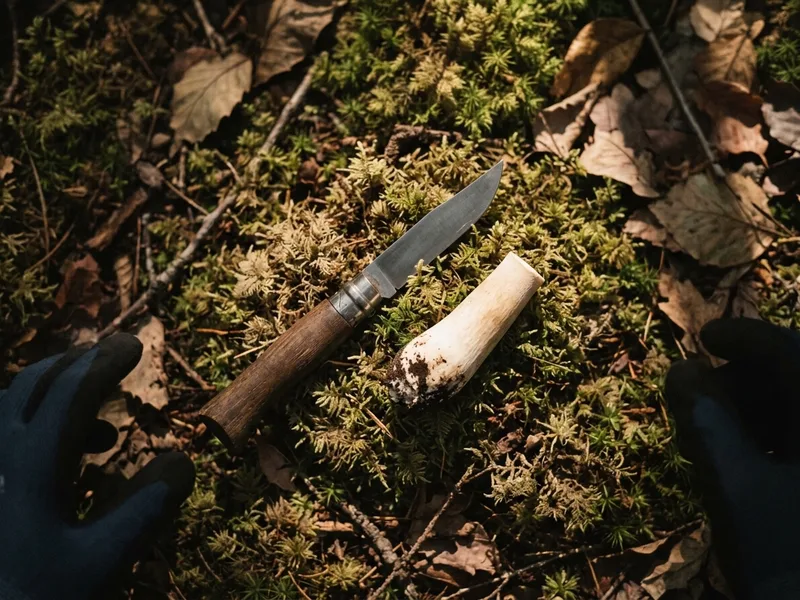
Opinel No. 08 Mushroom Knife
A curved blade cuts the stem cleanly at the base instead of tearing the mycelium out with it, and the boar bristle brush is set into the handle so cleaning happens in the field rather than at the sink.
When you buy through our links, it supports our mycology research at no extra cost to you.
Edible Mushrooms of Québec: Identification Chart
A quick-reference chart for the province's most-foraged edible species, with the French name you will hear on a foray and see in Champignons du Québec. Confirm every find against multiple features and a regional field guide; this table is a starting point, not a green light.
Download the free printable chart (PDF) – 8.5x11, made to print and tuck into your foraging basket.
| Species | Nom français | Latin name | Habitat and host trees | Season in Québec | Unmistakable field mark |
|---|---|---|---|---|---|
| Golden chanterelle | Girolle, chanterelle commune | Cantharellus cibarius group | Mossy slopes under yellow birch and balsam fir, Laurentians and Mauricie | Jul – Sep, peak Aug | Blunt forking false gills running down the stem, plus an apricot smell |
| Black trumpet | Trompette-des-morts | Craterellus fallax | Beech and sugar maple leaf litter, Estrie and Outaouais | Jul – Sep, peak Aug | Thin grey-black funnel, hollow to the base, with no true gills |
| King bolete | Cèpe | Boletus edulis group | Spruce, fir and birch, Laurentians, Saguenay and Côte-Nord | Jul – Oct, peak Sep | Fine white netting on a thick pale stem; flesh never stains blue when cut |
| Lobster mushroom | Champignon homard | Hypomyces lactifluorum | Mixed mid-elevation forest floor, often near hemlock and spruce | Late Jul – Sep | Hard pimpled orange crust over dense white flesh, with no gills at all |
| Hedgehog | Pied-de-mouton, hydne sinué | Hydnum repandum, H. umbilicatum | Mossy conifer and mixed forest, Laurentians, Mauricie and Gaspé | Sep – Nov | Soft spines hanging under the cap instead of gills |
| Honey mushroom | Armillaire couleur de miel | Armillaria group | Clusters on dying hardwood, stumps and buried roots | Sep – Oct | White spore print and a ring on the stem |
| Shaggy mane | Coprin chevelu | Coprinus comatus | Lawns, gravel road edges and disturbed soil, province-wide | Aug – Oct | Tall shaggy white cylinder whose gills dissolve into black ink |
| Giant puffball | Vesse-de-loup géante | Calvatia gigantea | Pasture edges and field margins, Estrie and the St. Lawrence lowlands | Aug – Oct | Pure uniform white flesh with no cap outline when sliced top to bottom |
| Oyster mushroom | Pleurote | Pleurotus ostreatus, P. pulmonarius | Dead and dying aspen, cottonwood and maple along the St. Lawrence | May – Nov, flushing after rain | Gills running down a short off-centre stem; white to lilac spore print |
| Lion's mane | Hydne hérisson | Hericium erinaceus, H. americanum | Wounds on living hardwood and fallen beech and maple, Estrie | Sep – Oct | Cascading white spines with no cap, gills or pores |
| Maitake / hen of the woods | Polypore en touffe | Grifola frondosa | Base of mature oaks, Estrie, Outaouais and the St. Lawrence valley | Sep – Oct | Grey-brown spoon-shaped fronds all rising from one branching base |
| Morel, black and yellow | Morille | Morchella spp. | Yellow: dying elm and cottonwood bottomland along the St. Lawrence. Black: burn areas and mixed wood, Laurentians, Côte-Nord and Abitibi | May – Jun | One hollow chamber from tip to base when sliced lengthwise |
| Winter chanterelle | Chanterelle en tube | Craterellus tubaeformis | Wet mossy conifer ground, bog edges and rotting wood | Sep – Nov | Hollow yellow-brown stem under a small brown funnel cap |
| Birch bolete | Bolet raboteux | Leccinum scabrum group | Under white and yellow birch, boreal north and the Laurentians | Jul – Oct | Tall stem covered in dark scabby tufts, pores white to grey |
| Aspen bolete | Bolet orangé | Leccinum insigne, L. aurantiacum group | Under trembling aspen and birch, Mauricie and the boreal north | Jul – Sep | Brick-orange cap over a scabby stem; cut flesh darkens to grey, then near black |
| Chicken of the woods | Polypore soufré | Laetiporus sulphureus | Living and dead hardwood, especially oak and maple, Estrie and the Outaouais | Jun – Sep | Bright orange shelves with a sulphur-yellow pore surface and no gills |
| Wood ear | Oreille de Judas | Auricularia americana | Dead conifer and hardwood branches in damp shaded stands | May – Oct, after rain | Rubbery, gelatinous, ear-shaped flap with a veined inner surface |
| Matsutake | Matsutaké, tricholome à gros voile | Tricholoma magnivelare | Sandy soil under jack pine and spruce, boreal north and sandy terraces | Sep – Oct | Spicy cinnamon smell, a cottony ring, and no volva at the base |
The two habits that matter most in Québec: slice every puffball and every young white button vertically, because destroying angels grow here, and take a spore print of anything gilled growing on wood before honey mushrooms go in the basket.
Grow these at home when the season ends
Foraging is seasonal and weather-dependent in a way nothing else about cooking is. A dry June moves chanterelle season by a fortnight, a warm October ends it early, and from December through May the Québec woods give you chaga and very little else. A kit fruits on a kitchen counter in any month, including February.
Several species on the chart above grow reliably indoors in a couple of weeks: the Lion's Mane Kit and the Blue Oyster Kit both fruit with nothing more than a daily misting. Browse all grow kits and grain spawn, or read the companion guides for New Brunswick and Nova Scotia, which cover the Acadian forest east of here.
Québec's Deadly Look-alikes at a Glance
Four of these five can kill you and the fifth will put you in hospital. Read this table before the chart above, not after. French names are given alongside the English, because that is what the signage and the club forays use.
| Toxic Species | Season | Where It Grows in Québec | What It Gets Mistaken For | The Feature That Separates Them | Risk |
|---|---|---|---|---|---|
| Destroying angel / amanite vireuse (Amanita virosa, A. bisporigera) | Jul – Oct | Mixed and hardwood forest province-wide, and on lawns near hardwoods; the most commonly met amatoxin mushroom in Québec | Puffball buttons; any young white gilled mushroom | Pure white throughout, with free gills, a skirt-like ring, and a sac-like volva buried at the base; white spore print. Dig the whole stem up, and slice every white button top to bottom | DEADLY – amatoxins; symptoms are delayed 6 to 24 hours |
| Death cap / amanite phalloïde (Amanita phalloides) | Aug – Oct | An introduced European species, increasingly found in southern Québec under oaks and chestnuts in urban and suburban settings, especially around Montréal and Québec City | Gilled mushrooms picked from lawns, boulevards and park plantings | Greenish to bronze cap over white free gills, with both a ring and a sac-like volva at the base; white spore print. Photograph it in place and report it rather than picking it | DEADLY – amatoxins; responsible for most fatal mushroom poisonings worldwide |
| Deadly galerina / galère marginée (Galerina marginata) | Aug – Nov, and again through winter thaws | Small clusters on dead conifer and hardwood, often the same mossy logs that carry honey mushrooms and velvet foot | Honey mushrooms; velvet foot; any small brown mushroom on wood | A rusty-brown spore print, where honey mushroom and velvet foot both print white; a ring on the stem, and no dark velvety stem base | DEADLY – amatoxins; the mistake most likely to be fatal in Québec |
| Jack-o'-lantern / clitocybe lumineux (Omphalotus illudens) | Jul – Oct | Dense clusters on hardwood stumps and buried roots through southern Québec | Chanterelles; chicken of the woods | Sharp true gills rather than blunt forking ridges, and tight clusters growing from wood rather than single mushrooms from soil | Poisonous – severe gastrointestinal illness |
| False morel / fausse morille (Gyromitra esculenta) | Apr – Jun, overlapping morel season | Sandy soil under conifers and on disturbed ground across the province | True morels | A brain-like wrinkled cap rather than a pitted honeycomb, and an interior that is solid or chambered rather than one hollow chamber from tip to base | DEADLY – gyromitrin; there is no reliable home preparation |
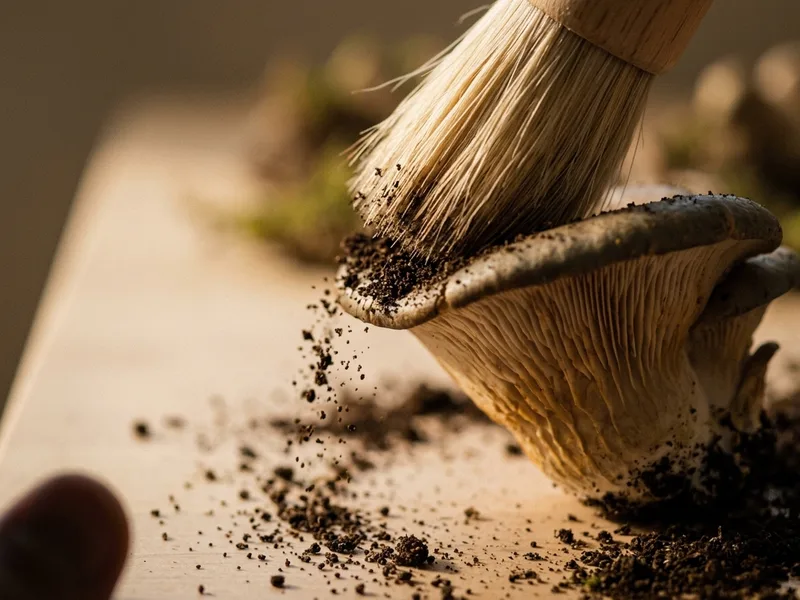
Redecker Natural Pig Bristle Mushroom Brush
Soft enough to take soil off a cap without tearing the skin. Mushrooms absorb water, so brushing dry beats rinsing every time, and anything you plan to dry has to be cleaned this way.
When you buy through our links, it supports our mycology research at no extra cost to you.
Toxic Look-alikes Every Quebec Forager Must Know
False Morel / Fausse morille (Gyromitra esculenta) — Brain-like cap (not honeycomb), solid or chambered inside (true morels are completely hollow). Contains gyromitrin — there is no safe home preparation. Don't eat false morels.
Destroying Angel / Amanite vireuse (Amanita virosa and A. bisporigera) — All-white mushroom with a cup-like volva at the base and a ring on the stem. White spore print. Found throughout Quebec's mixed forests. Causes irreversible liver failure.
Death Cap / Amanite phalloïde (Amanita phalloides) — Introduced European species, increasingly found in southern Quebec (especially around Montréal and Quebec City) under oaks and chestnuts in urban and suburban habitats. Greenish-yellow cap, white gills, volva, ring. Responsible for the majority of fatal mushroom poisonings worldwide.
Galerina marginata — Small brown mushroom in clusters on dead wood, often on the same logs where honey mushrooms appear. Same amatoxins as the death cap and destroying angel. Has killed people who confused it with honey mushrooms or with Psilocybe species.
Jack-O'-Lantern / Clitocybe lumineux (Omphalotus illudens) — Orange clusters on hardwood stumps. Sometimes mistaken for chanterelles or chicken of the woods. Has true gills (not pores or false gills), grows from wood, glows faintly in the dark. Causes severe gastrointestinal poisoning.
A French-English Foraging Glossary
Québec's trail signage, club forays and field guides run in French, and the standard provincial reference, Pomerleau's Champignons du Québec, has no English edition. These are the terms you will actually meet on a sign, in a club email, or in an identification key.
| French | English | Note |
|---|---|---|
| champignon | mushroom | |
| chanterelle / girolle | golden chanterelle | both names are used in Québec, often interchangeably |
| cèpe | king bolete / porcini | the European name, carried over by French and Eastern European foragers |
| bolet | bolete | any pored, spongy-undersided mushroom in the group |
| morille | morel | morille noire is the black morel, morille blonde the yellow |
| amanite | Amanita | the genus that contains the province's deadly species |
| vesse-de-loup | puffball | |
| pied-de-mouton | hedgehog mushroom | literally "sheep's foot", after the spines |
| trompette-des-morts | black trumpet | literally "trumpet of the dead", from its colour, not its edibility |
| terres publiques | Crown land / public land | about 92% of the province; personal-use picking needs no permit |
| réserve faunique | wildlife reserve | run by SÉPAQ; personal-use harvest generally allowed |
| parc national du Québec | provincial park | run by SÉPAQ despite the name; removing natural objects is prohibited |
| récolte | harvest | as in permis de récolte, the commercial harvesting permit |
| cueillette | picking, gathering | cueillette de champignons is the activity itself |

Growing Gourmet and Medicinal Mushrooms
Most people who forage for a season start wondering whether they can grow the same species deliberately. This is the standard cultivation reference, with substrate, spawn and fruiting conditions worked through species by species. A different book from a field guide and worth owning alongside one.
When you buy through our links, it supports our mycology research at no extra cost to you.
Community and Resources
Quebec's mycological community is the strongest in Canada. Get involved.
- Cercle des mycologues de Montréal (CMM) — Founded in 1950, the largest and oldest mycological society in Canada. Forays, workshops, identification clinics, annual fall mushroom show. Bilingual French/English. mycomontreal.qc.ca
- Cercle des mycologues amateurs de Québec — Quebec City's mycological club.
- Société de mycologie de l'Estrie — Eastern Townships club, very active.
- Mycoquébec.org — Online identification resource maintained by Quebec mycologists, with a searchable species database.
- iNaturalist — Strong Quebec participation. Filter the feed by region to see what's currently fruiting.
Sustainable Foraging in Quebec
- Take only what you'll use — wild mushrooms are a shared resource.
- Leave a third behind so the patch keeps producing.
- Don't rake the duff — disturbs the mycelium that produces next year's flush.
- Cut, don't pull — minimal disturbance to the mycelial network.
- Vary your spots within a season.
- Respect ZEC and wildlife reserve closures — temporary closures exist for good reasons.
Edible and Medicinal Mushrooms of New England and Eastern Canada
A photographic key to the species you will actually meet in eastern Canada, organised by what the mushroom looks like rather than by taxonomy. The regional focus is the point: a guide written for another continent shows you the wrong look-alikes.
When you buy through our links, it supports our mycology research at no extra cost to you.
Getting Started in Quebec
- Join the Cercle des mycologues de Montréal — even from outside Montréal, the resources are unmatched. Weekly forays from May through October.
- Start with the foolproof species — chanterelles, hedgehogs, lion's mane, hen of the woods, shaggy manes, giant puffballs. All have no deadly lookalikes when properly identified.
- Get a regional field guide. Champignons du Québec (Pomerleau) is the classic French-language reference. Mushrooms of Northeast North America by George Barron is the standard English-language guide for Quebec habitat.
- Use Mycoquébec.org and iNaturalist to confirm IDs and see what's currently fruiting in your region.
- Three independent confirmations before eating any new species.
Frequently Asked Questions
Do I need a permit to forage mushrooms on Crown land in Québec?
No, not for personal use. Roughly 92% of Québec is public Crown land, the terres publiques, and personal-use harvesting of non-timber forest products, mushrooms included, is generally permitted there without a permit. Commercial harvesting is a different matter and requires a permis de récolte de produits forestiers non ligneux from the Ministère des Ressources naturelles et des Forêts. Crown land is not the same thing as a park or a wildlife reserve, so confirm which one you are standing on before you start picking.
Can you pick mushrooms in SÉPAQ parks in Québec?
No, not in a parc national du Québec. Despite the name these are provincial parks rather than federal ones, and they generally prohibit removing natural objects, mushrooms included: Mont-Tremblant, Jacques-Cartier and Gaspésie are all closed to picking. SÉPAQ also runs the réserves fauniques, the wildlife reserves, and those follow the opposite rule, with personal-use harvesting generally allowed. That makes Réserve faunique des Laurentides and Réserve faunique de Matane two of the most accessible places to pick in the province, so read carefully which of the two you are entering.
When does chanterelle season start in the Laurentians?
Typically early to mid-July, roughly a fortnight after a good soaking rain, with the peak running through August and into September. Rainfall matters more than the calendar: a dry June pushes the whole season back, a wet one pulls it forward. Once the golden chanterelle finishes, the winter chanterelle takes over the wet mossy conifer ground and rotting wood, carrying the season through October and into November.
Can I sell the mushrooms I forage in Québec?
Not without a commercial harvesting permit. Personal use on Crown land needs no paperwork, but the moment you sell what you pick you need a permis de récolte de produits forestiers non ligneux from the Ministère des Ressources naturelles et des Forêts. Selling to restaurants or at a public market adds food-handling and labelling obligations under Québec's food regulations, administered by MAPAQ, on top of the harvesting permit. Sort out both before you take an order.
How do I join the Cercle des mycologues de Montréal?
Membership is open to the public and you sign up through the club directly at mycomontreal.qc.ca. Founded in 1950, the CMM is the oldest and largest mycological society in Canada and runs bilingually in French and English. Membership brings forays through the season, workshops, identification clinics where an experienced mycologist will name what you carried in, and the annual fall mushroom show. For a beginner it is the single fastest route from reading a field guide to identifying with confidence.
If the off-season has you missing fresh mushrooms, you can grow gourmet species year-round at home. Browse our grow kits, grain spawn, and growing supplies. And see our companion guides for Ontario, Manitoba, Saskatchewan, Alberta, and British Columbia.