
You can grow mushrooms in a closet, a spare bathroom, or on a kitchen counter. People do it all the time. But the moment you try to scale beyond a single grow kit or monotub, you run into the same problem everyone hits: controlling humidity without turning your living space into a tropical swamp.
That's where a dedicated fruiting tent comes in. It gives you an enclosed space where you can maintain 85-95% relative humidity, dial in fresh air exchange, and keep temperatures stable, all without your walls growing mold or your partner filing for divorce. Whether you're fruiting oyster mushrooms, lion's mane, or shiitake blocks, a proper fruiting environment is the difference between consistent harvests and frustrating dry-outs.
We've tested purpose-built mushroom Martha tents and repurposed cannabis grow tents for fruiting. Both work, but they work differently. Here's what we've learned.
This post contains affiliate links. When you buy through our links, it supports our ongoing mycology research at no extra cost to you.
Quick Verdict
For most home growers, a purpose-built mushroom Martha tent like the one from North Spore or the budget-friendly options on Amazon is the easiest path. They're designed for the vertical shelf layout mushroom growers need, they have port holes for humidifier lines, and they come sized for a corner of a room rather than taking over your basement. If you want more space and already have a grow tent from another hobby, a VIVOSUN S336 3x3 works exceptionally well as a walk-in fruiting chamber with some simple modifications. Outgrowing that, the 4x4 is the step up that still fits a spare room, and a 4x8 buys you two independent climate zones in one footprint. Jump to the size ladder if you already know you need something bigger.
AC Infinity CLOUDLAB 866 Grow Tent (60"x60"x80")
A 5x5 in the heavier 2000D construction, which is the combination that makes sense if you are committing to one serious chamber rather than several cheap ones. Square rather than long, so it wants to sit out in a room instead of against a wall. At this size plan the humidification and air handling before you buy the tent, because they will cost more than it does.
When you buy through our links, it supports our mycology research at no extra cost to you.
Martha Tent vs Grow Tent vs Custom Build
There are three main approaches to creating a fruiting environment. Each has tradeoffs.
Martha Tent (Purpose-Built Mushroom Tent)
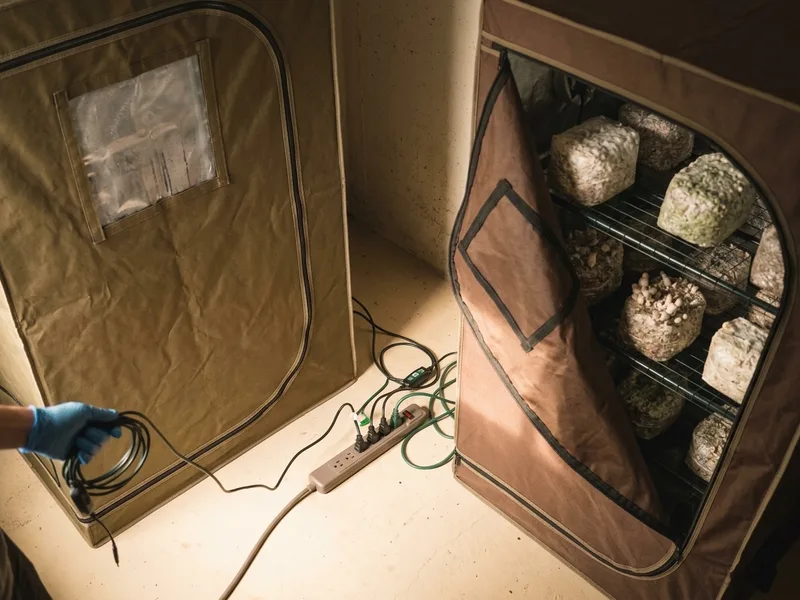
The "Martha tent" gets its name from the Martha Stewart branded portable closets that early mushroom growers repurposed as fruiting chambers. Today, the term refers to any vertical shelf greenhouse or tent designed specifically for mushroom cultivation.
Pros: Compact footprint (usually 27" x 19" x 63"), built-in wire shelving for fruiting blocks and trays, zippered clear panels for monitoring, and port holes sized for humidifier tubing. Most can be set up in 15 minutes.
Cons: Limited interior space means you max out around 8-12 fruiting blocks depending on the model. The clear plastic covers on cheaper models degrade under constant humidity after 6-12 months. Not enough room to walk inside for maintenance.
Best for: Home growers running 4-12 fruiting blocks at a time, apartment growers with limited space.
Cannabis-Style Grow Tent (Repurposed)
Standard grow tents built for indoor cannabis or hydroponic growing make excellent mushroom fruiting chambers. They're built from heavy 600D Oxford fabric with reflective mylar interiors, have multiple port holes for ducting, and come in sizes from 2x2 to 10x10.
Pros: Much more interior space, extremely durable construction, light-tight (helpful for controlling fruiting triggers on some species), excellent port hole placement for fans and humidifiers, and a massive aftermarket of compatible accessories.
Cons: They're designed for plants, not mushrooms, so you'll need to add your own shelving. The reflective mylar interior retains heat, which can be an issue if your ambient temperature is already warm. The rectangular footprint takes up more floor space than a vertical Martha setup.
Best for: Growers scaling beyond 12 blocks, anyone wanting walk-in access, and people who already own a grow tent from other growing.
Custom Build (DIY)
Some growers build fruiting chambers from scratch using PVC pipe and plastic sheeting, or by converting a small closet with vapor barriers and humidification.
Pros: Fully customizable to your space and needs. Can be extremely cheap if you have materials on hand.
Cons: Time-intensive to build properly, usually looks rough, and if you don't seal it correctly, you'll fight humidity loss constantly. Most growers who start with a DIY build end up buying a tent within a few months.
Best for: Experienced growers with specific space requirements or those who genuinely enjoy the build process.
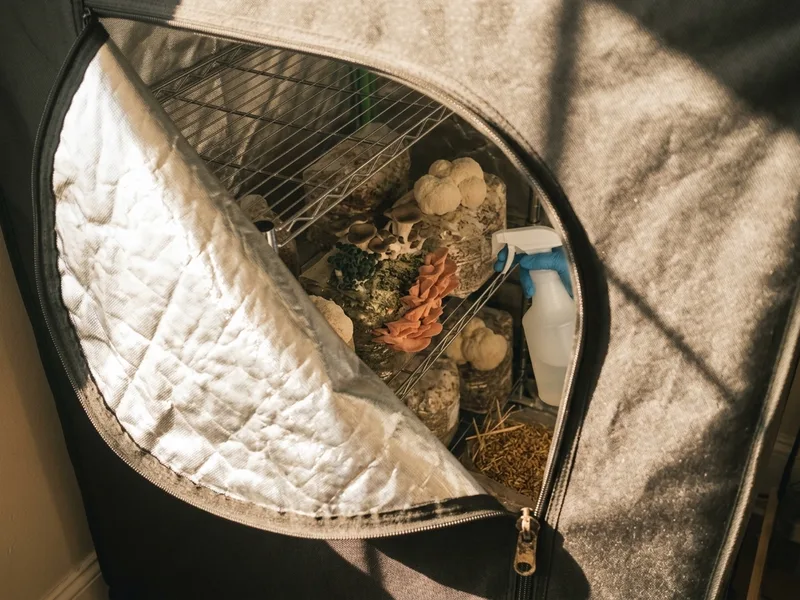
Mushroom Grow Tent - Martha Tent for Mushroom Growing
Purpose-built mushroom Martha tent with sturdy racks, 4" vent ports, and 600D waterproof Oxford fabric cover. Fits fruiting blocks, trays, and grow kits in a compact 65" x 27.5" x 20" footprint.
When you buy through our links, it supports our mycology research at no extra cost to you.
What to Look for in a Mushroom Fruiting Tent
Not all tents are equal, and the features that matter for mushrooms are different from what matters for cannabis or tomatoes. Here's what to prioritize.
Size and Layout
For a Martha-style tent, you want at least 4-5 shelves of usable rack space. Each shelf should accommodate standard fruiting blocks (roughly 10" x 18") with enough vertical clearance between shelves for mushroom clusters to grow without hitting the shelf above. Six to eight inches of clearance per shelf is minimum for oyster mushrooms; lion's mane clusters need more like ten inches.
For a grow tent you're converting, 3x3 feet (36" x 36" x 72") is the sweet spot. It's large enough to set up wire shelving inside with room to reach in and harvest, but small enough that a single ultrasonic humidifier can maintain humidity throughout the space.
Zipper Quality
This matters more than you'd think. Your tent is going to be at 85-95% humidity constantly. Cheap zippers corrode, stick, and eventually fail. Look for SBS or YKK brand zippers, and double-stitched zipper flaps that prevent moisture from escaping through the seam.
Port Holes and Ventilation
You need at least two port openings: one for your humidifier line or tubing, and one for fresh air exchange. Good grow tents have 4" circular ports with drawstring closures. Mushroom-specific Martha tents sometimes have these built in; cheaper greenhouse-style tents often don't, which means you'll be cutting holes yourself.
Material and Construction
For grow tents: 600D Oxford fabric with mylar interior is the standard. Anything less than 600D will wear through quickly in a high-humidity environment. The mylar interior helps distribute light evenly and makes the tent easy to wipe down between grows.
For Martha tents: look for PVC-coated shelving (bare metal rusts fast in humidity) and a cover material that's either 600D fabric or thick greenhouse-grade plastic. The thin clear plastic on budget greenhouse shelves from hardware stores will yellow and crack within months.
Observation Window
Being able to check on your mushrooms without opening the tent and dropping humidity is genuinely useful. Good tents have a clear window panel, sometimes with a separate zip closure. You'll use it more than you expect, especially when you're waiting for pins to form.
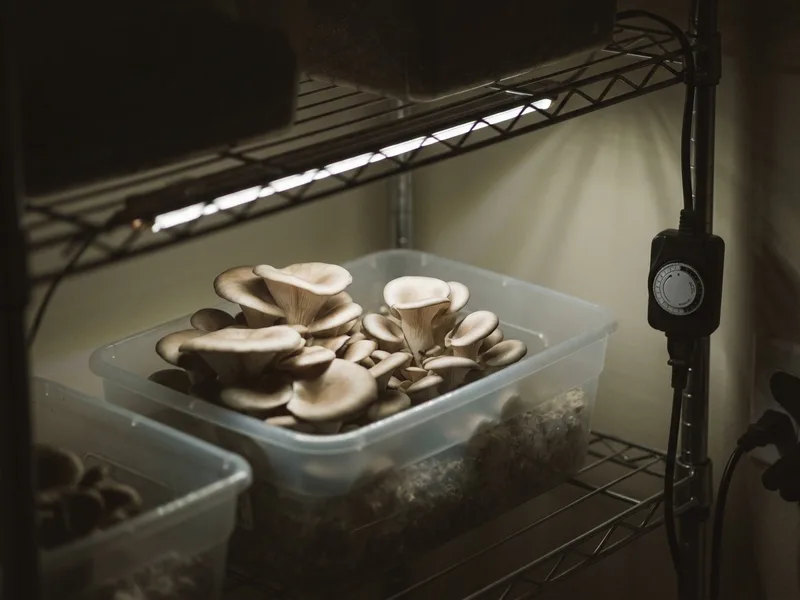
Mushroom Grow Tent with LED Grow Light & Timer
All-in-one mushroom fruiting tent with 6500K LED grow light, timer, 4" vent ports, and 600D waterproof fabric. Great for growers who want a complete setup out of the box.
When you buy through our links, it supports our mycology research at no extra cost to you.
Our Picks
Best Martha Tent: Mushroom Grow Tent by North Labs
This is a purpose-built mushroom Martha tent that gets the fundamentals right. It measures roughly 65" x 27.5" x 20", which gives you a tall, narrow footprint that fits in a corner or against a wall. It includes multiple wire racks that can accommodate fruiting blocks, trays, and standard mushroom grow kits.
The tent features 4" vent ports for running humidifier lines, fan ducting, or sensor cables. The cover is a proper 600D waterproof Oxford fabric rather than the flimsy clear plastic you see on cheap greenhouse shelves. It zips fully closed to maintain humidity, and the overall construction is solid enough to last through many growing seasons.
What we appreciate most is that it's designed by people who actually grow mushrooms. The shelf spacing accommodates real fruiting blocks, the vents are positioned where you actually need them, and the dimensions work with standard cultivation equipment rather than fighting against it.
Best Tent with Grow Light: Mushroom Grow Tent with T8 Light & Timer
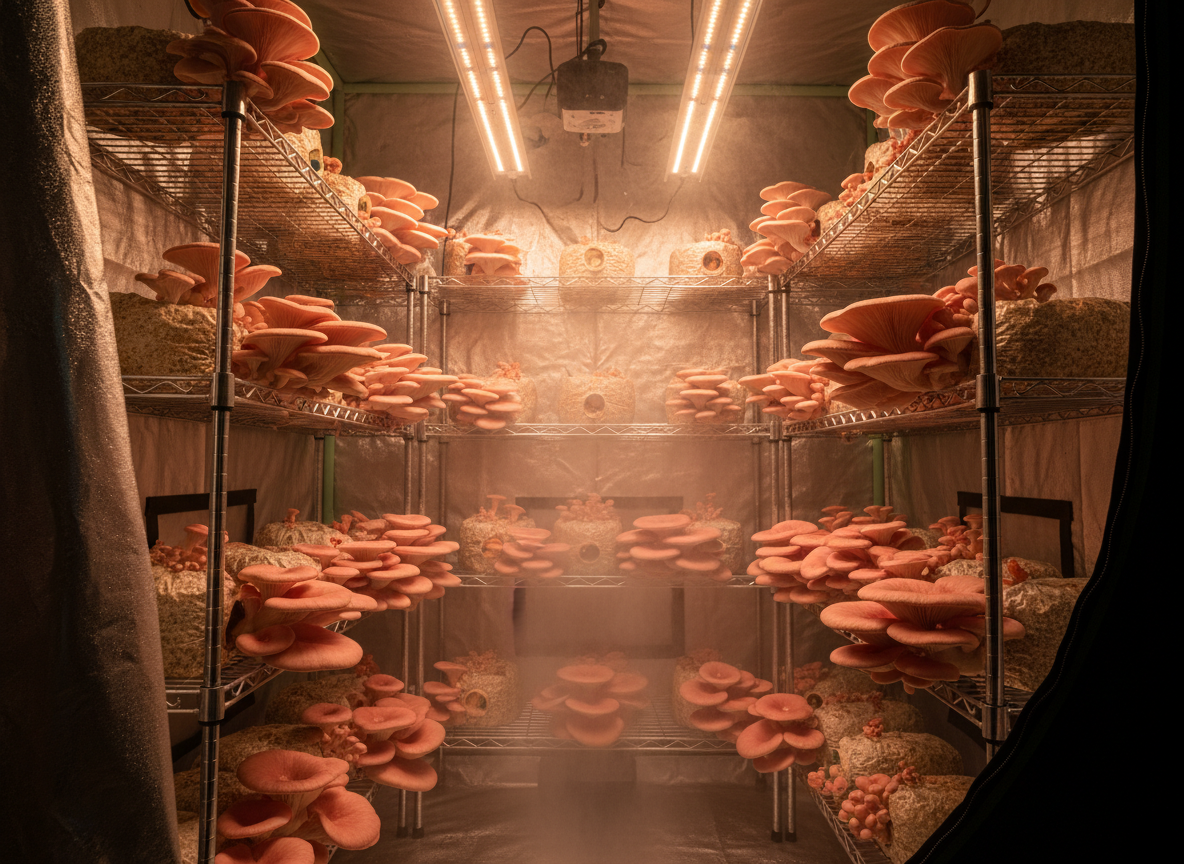
If you want an all-in-one setup, this tent comes with a built-in T8 6500K full spectrum grow light on a 12-hour timer. Mushrooms don't photosynthesize like plants, but they do use light as a directional trigger for fruiting. A consistent light cycle helps pins form evenly and encourages upward growth rather than the sideways stretching you get in complete darkness.
The tent is built with 600D waterproof Oxford fabric with a reflective interior, and includes a monitoring window so you can check humidity and pin formation without opening the enclosure. It has 4" vent ports for accessories, and the overall build quality is a step above the budget greenhouse options.
The included timer is a nice touch. Setting a 12-on/12-off cycle manually with a separate timer is easy enough, but having it integrated means one less thing to set up.
Best Grow Tent (Repurposed): VIVOSUN S336 3x3 Grow Tent
If you want more space or you're scaling up, a standard 3x3 grow tent is hard to beat. The VIVOSUN S336 measures 36" x 36" x 72", which gives you 9 square feet of floor space and 6 feet of vertical height. That's enough room for a full wire shelving unit inside, plus a humidifier on the floor, and you can still reach in to harvest comfortably.
The construction is 600D Oxford fabric with 100% reflective mylar interior. The mylar serves double duty for mushrooms: it distributes ambient light evenly across all your blocks (reducing the directional stretching you get with a single light source), and it makes the interior easy to wipe down and sanitize between grows.
The VIVOSUN has multiple port holes (4", 6", and 8" options) with drawstring closures, which makes routing humidifier lines and fan ducting straightforward. The observation window lets you monitor conditions without opening the tent. The metal frame supports up to 100 lbs from the top cross-bars, so you can hang lights or a small oscillating fan if needed.
The main downside is that you'll need to buy wire shelving separately. A standard 4-tier chrome wire shelf from any hardware store fits perfectly inside.
Budget Pick: Mini Greenhouse Martha Tent
If you're just getting started and want to test the Martha tent approach without a big investment, the compact greenhouse-style Martha tents on Amazon are a reasonable entry point. These come with built-in wire shelving, a zippered clear cover, and enough rack space for 4-8 fruiting blocks depending on their size.
These budget options typically measure around 27" x 19" x 63" and use a lighter-weight plastic cover rather than 600D fabric. The tradeoff is durability. The covers on these tents start degrading after 6-12 months of constant humidity exposure, and the wire shelving can rust if it isn't PVC-coated. But as a first fruiting chamber to learn the ropes, they work.
One tip: if you go this route, replace the plastic cover early with a custom-cut piece of 6 mil greenhouse plastic or a shower curtain liner. That alone extends the life significantly.
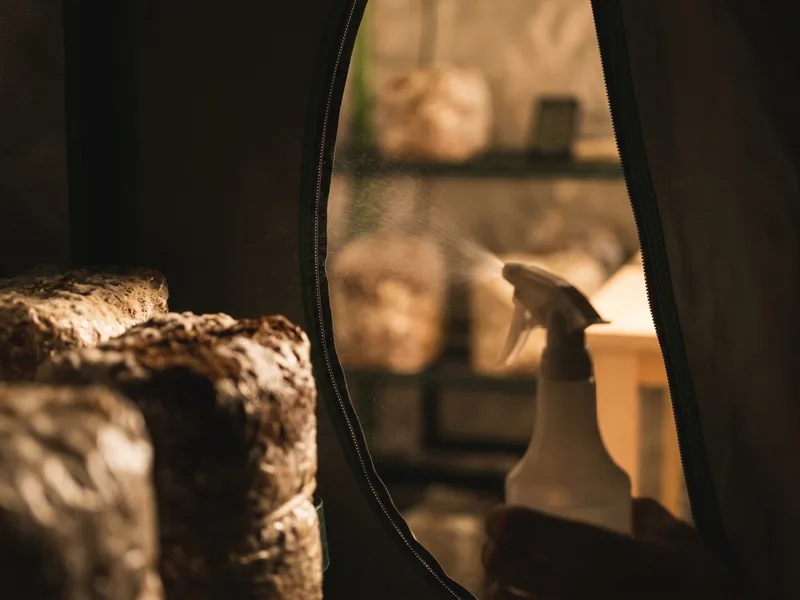
VIVOSUN S336 3x3 Grow Tent (36"x36"x72")
Heavy-duty 600D grow tent with reflective mylar interior, multiple port holes, observation window, and room for a full wire shelving unit. The best option when you need more fruiting space than a Martha tent provides.
When you buy through our links, it supports our mycology research at no extra cost to you.
Scaling Up: 4x4, 4x8 and Multi-Tent Setups
A Martha tent tops out around 8-12 blocks and a 3x3 around 18. Past that you are choosing between one larger tent and several small ones, and the two paths behave very differently.
Start with the ladder. These are planning figures for 5 lb fruiting blocks on wire shelves with enough spacing to pin properly, not the absolute maximum you could cram in.
| Tent | Volume | Blocks | Monotubs | Humidifier output | Air changes/hr |
|---|---|---|---|---|---|
| Martha (27x19x63") | 19 ft³ | 4-12 | 1-2 | 3-6 L/day | 4-6 |
| 3x3 (36x36x72") | 54 ft³ | 12-18 | 4 | 6-10 L/day | 4-6 |
| 4x4 (48x48x80") | 107 ft³ | 20-30 | 6-8 | 10-16 L/day | 4-6 |
| 5x5 (60x60x80") | 167 ft³ | 35-45 | 9-12 | 16-20 L/day | 4-6 |
| 4x8 (96x48x80") | 213 ft³ | 45-60 | 12-16 | 20+ L/day, or two units | 4-6 |
Bigger Is Harder, Not Easier
This is the part most size guides skip. Every problem a fruiting chamber has gets worse with volume.
Humidity becomes the expensive part. A 3 L ultrasonic unit that holds a Martha tent at 90% will not hold a 4x8. Once you pass a 4x4 you are refilling a reservoir daily, which is when growers start plumbing a humidifier to a float valve or a small reservoir tub. The tent stops being the costly item somewhere around the 4x4 mark.
Temperature stratifies. An 80 inch tent has a real gradient from floor to ceiling, and mylar holds heat. Blocks on the top shelf can sit several degrees warmer than the bottom, which shows up as uneven pinning across shelves that look identical.
Condensation pools. More surface area means more water running down the walls and collecting in the tray. A 4x8 needs a floor tray that actually drains or gets emptied, or you grow bacteria in the bottom.
Heating a big tent through a Canadian winter costs real money. A 4x8 in an unheated basement is a much larger volume to hold at 18-24°C than a Martha in a spare room.
If you are not already running a Martha or a 3x3 successfully, a 4x8 will not fix anything. It will multiply whatever is currently going wrong.
Fresh Air Exchange Does Not Scale the Way You Expect
Mushrooms need far more fresh air than plants, so sizing a fan off a hydroponics chart gets you the wrong answer in an interesting way: the fan is almost always far too big, not too small.
A 4x4 at six air changes an hour needs roughly 11 CFM. A 4x8 needs about 21. A basic 4 inch inline fan moves somewhere near 200 CFM. Even heavily throttled, it will strip the humidity out of a tent in minutes if you let it run.
So at every size above a Martha, the fan is not the constraint. Control is. That means a speed controller and a repeat cycle timer at minimum, and a CO2 monitor once the tent is large enough that you cannot judge the air by eye. See the fresh air exchange guide for how to set the cycle.
The 4x4: The Real Step Up
For most growers outgrowing a Martha, this is the size that makes sense. It roughly triples your block count, still fits in a spare room or a basement corner, and accepts standard 4 inch ducting and off-the-shelf shelving without modification.
The 4x8: Two Zones in One Footprint
A 4x8 is the most useful large tent for mushrooms, and not because of the block count. It is long rather than square, so you can run it as two independent halves: one end colonising or holding blocks, the other end fruiting. That solves the single biggest scheduling problem in a one-tent operation, which is needing two sets of conditions at once.
It also fits against a wall, where a 5x5 usually needs to sit out in the room.
One Big Tent or Several Small Ones?
Once you are past a 4x4, running two tents usually beats running one large one, for reasons that have nothing to do with capacity.
Two tents give you two climates. Shiitake wants a cooler shock and a drier finish than oyster. Lion's mane wants higher humidity and gentler air than either. One tent means one set of conditions and a compromise for everything in it.
Two tents contain a contamination problem. A green mould outbreak in a single 4x8 can reach every block you own. In a two-tent setup you lose half at worst, and you have somewhere clean to move the survivors.
Two tents let you clean properly. You can empty, scrub and dry one completely while the other keeps producing. With one tent, a full reset means shutting down.
The case for one large tent is simpler: one humidifier, one controller, one fan, one set of running costs, and far less floor space than two tents plus the gap between them.
When a Tent Stops Being the Answer
Somewhere past a 5x5 or a pair of 4x4s, tents stop making sense. The fabric is the problem: it holds water, it cannot be washed down properly, and it wears out on a schedule.
At that point growers move to a sealed room with a vapour barrier, a washable floor, and a dedicated humidifier and exhaust, or to an insulated shipping container or walk-in cooler shell. That is a different project with different economics, and almost none of it comes from Amazon. If you are seriously weighing it, the honest signal is simple: when you are replacing tent covers more than once a year, or running three or more tents to get the climates you need, the room is cheaper.
Essential Accessories
A tent alone doesn't fruit mushrooms. You need three more pieces to make the system work.
Ultrasonic Humidifier
This is the single most important accessory. Mushrooms need 85-95% relative humidity during fruiting, and without active humidification, your tent will dry out within hours. A cool-mist ultrasonic humidifier is the standard choice. You want one with a large enough reservoir that you're not refilling it every few hours. A 4-6 liter capacity is the sweet spot for most Martha tent setups.
Run the humidifier output into the tent through one of the port holes using flexible ducting or a simple PVC pipe. Don't put the humidifier inside the tent. The water reservoir becomes a contamination vector, and the electronics don't appreciate constant 90%+ humidity.
Humidity Controller
Running your humidifier 24/7 will create too much moisture and lead to pooling water, bacterial contamination, and mushrooms that are waterlogged rather than properly hydrated. A humidity controller with a probe sensor lets you set a target humidity (typically 90%) and the controller turns the humidifier on and off automatically to maintain that level.
This is a non-negotiable piece of equipment. Manual humidity management is possible but exhausting, and the $30-40 cost of a controller pays for itself immediately in saved time and improved results.
Small Fan for Fresh Air Exchange
Mushrooms produce CO2 as they grow and need fresh air exchange (FAE) to fruit properly. High CO2 levels cause long, leggy stems and small caps on oyster mushrooms, and can stall pinning entirely on other species. A small USB fan or a 4" inline duct fan on a timer provides the air exchange you need.
The simplest setup is a small fan on a cycle timer, set to run for 2-3 minutes every hour. This pulls fresh air into the tent through one port while pushing stale, CO2-heavy air out through another. More sophisticated setups use an inline fan with speed control, but a basic approach works fine for home-scale grows.
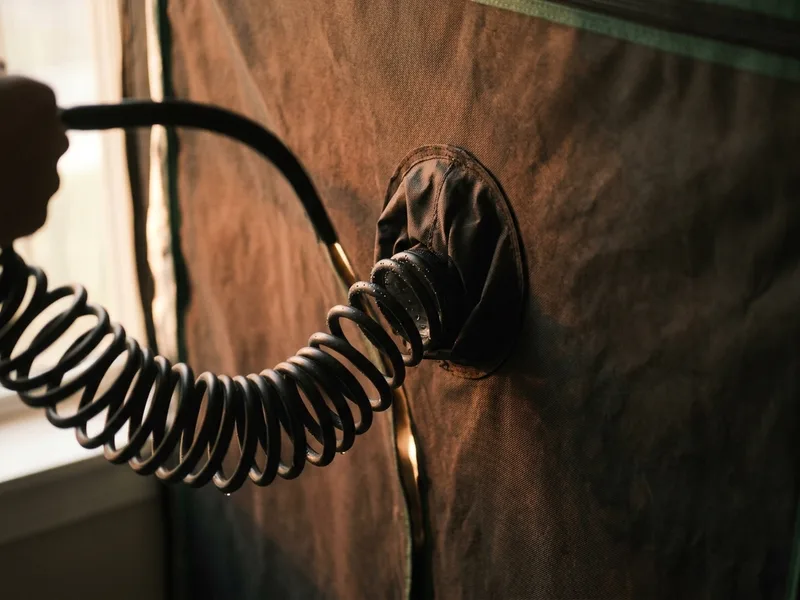
Mushroom Grow Tent - Budget Martha Tent
Affordable entry-level Martha tent with built-in wire racks, compact footprint, and zippered cover. A practical starting point for growers testing the Martha approach before investing in a premium setup.
When you buy through our links, it supports our mycology research at no extra cost to you.
How to Set Up a Mushroom Fruiting Tent
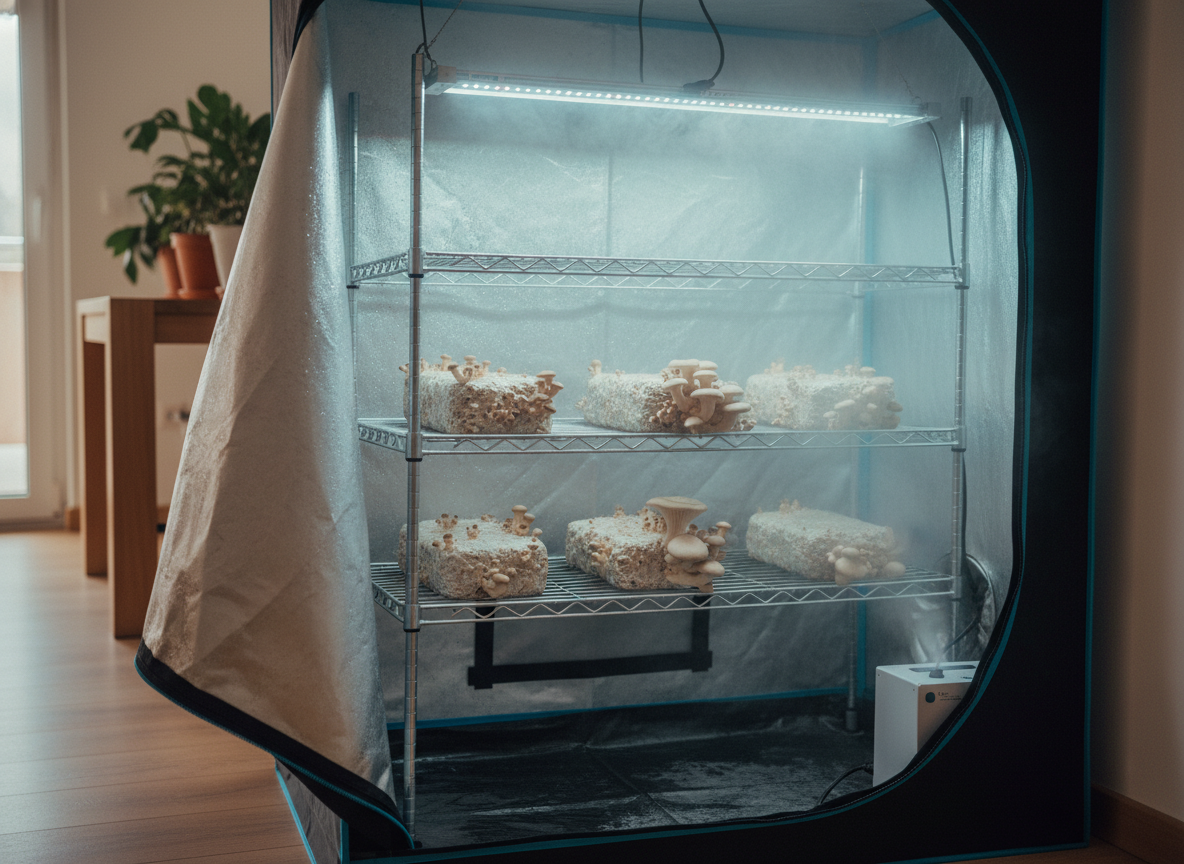
Here's the basic process to go from an empty tent to a working fruiting chamber.
Step 1: Assemble the tent. Follow the manufacturer's instructions. For Martha tents, this usually means assembling the wire shelving frame and draping the cover over it. For grow tents, connect the metal frame poles, hang the fabric shell, and install the floor tray.
Step 2: Position your shelving. If using a grow tent, place a wire shelving unit inside. Leave 3-4 inches of clearance on each side for air circulation, and make sure the bottom shelf is high enough to fit your humidifier output line underneath.
Step 3: Set up humidification. Place your humidifier outside the tent. Run the output tube through a port hole into the tent, positioned so the mist disperses across the bottom shelf and rises through the racks. Connect the humidifier to your humidity controller and place the controller's probe sensor at mid-height inside the tent, away from the direct mist output.
Step 4: Set up fresh air exchange. Position a small fan at one port hole, set on a cycle timer. A simple approach: fan on for 3 minutes every 60-90 minutes. This gives you adequate FAE without crashing your humidity too far. You'll fine-tune this based on your species and ambient conditions.
Step 5: Add lighting. If your tent doesn't include a light, a simple LED strip or clip-on grow light set to 12 hours on / 12 hours off provides the fruiting trigger most species need. It doesn't need to be intense. Indirect ambient light from a nearby window works for some growers, but a dedicated light gives more consistent results.
Step 6: Calibrate before loading. Run the system empty for 24 hours. Monitor humidity, temperature, and airflow. You want to see your humidity holding steady at 85-90% without pooling water on the shelves or floor. Adjust your humidifier output and FAE timer until you hit a stable equilibrium.
Step 7: Load your fruiting blocks. Place your colonized grain spawn bags or fruiting blocks on the shelves with space between them for air circulation. Open or cut the bags according to the species requirements and let the tent do its work.
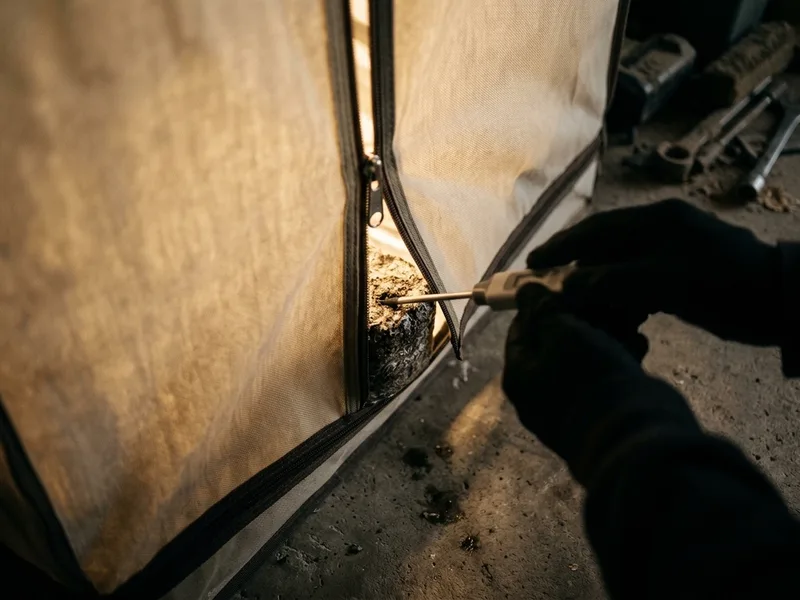
VIVOSUN S448 4x4 Grow Tent (48"x48"x80")
The same line as the S336 above, one size up. Observation window, removable floor tray, and enough port holes to run a humidifier line and ducting without cutting anything. The 600D fabric is the weak point under constant 90% humidity rather than the frame, so expect to replace the cover before the poles. At this price that is an acceptable trade.
When you buy through our links, it supports our mycology research at no extra cost to you.
What Mushrooms Work Best in a Fruiting Tent?
Almost any gourmet or medicinal mushroom species fruits well in a tent environment, but some are particularly well-suited:
Oyster mushrooms (all varieties) are the easiest and most forgiving. They fruit fast, tolerate a range of humidity levels, and produce dramatic clusters that make the tent worth every penny.
Lion's mane benefits from the controlled humidity more than almost any other species. This mushroom dries out quickly in open air but produces beautiful, dense pom-pom formations in a properly humidified tent.
Shiitake blocks fruit well on tent shelves, especially when you can control the temperature drop that triggers pinning by placing the tent in a cooler room.
King oyster (Pleurotus eryngii) appreciates the lower CO2 levels that a well-ventilated tent provides, producing the thick, meaty stems this species is prized for.
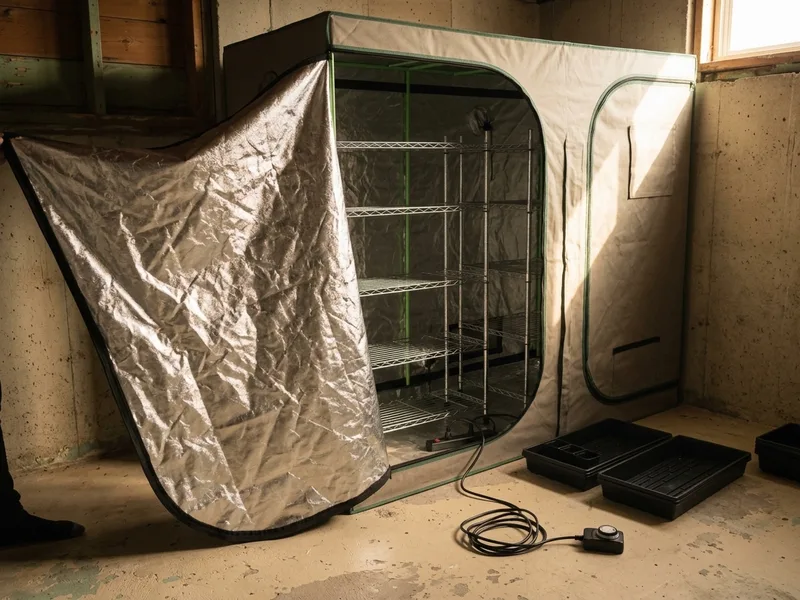
AC Infinity CLOUDLAB 844 Grow Tent (48"x48"x80")
Worth the premium specifically because of what humidity does to tents. The 2000D canvas and 1 inch poles are built to a different standard than budget tents, and the sealed seams and heavier zippers are the parts that fail first in a fruiting chamber. If your tent lives at 90% humidity year round rather than seasonally, this is the one that is still usable in three years.
When you buy through our links, it supports our mycology research at no extra cost to you.
Start Growing
If you're ready to set up your first fruiting tent, you'll need something to put in it. Our mushroom grow kits are fully colonized and ready to fruit. They're the fastest way to fill a new tent with mushrooms and start learning how your specific environment performs. We also carry grain spawn for growers who want to produce their own fruiting blocks from scratch.
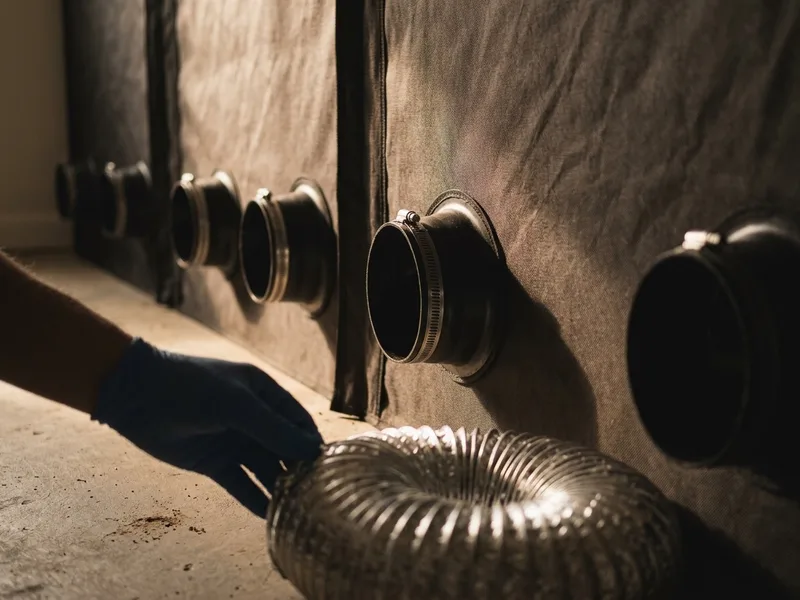
VIVOSUN S848 4x8 Grow Tent (96"x48"x80")
Roughly 45-60 blocks, or a fruiting half and a holding half. Budget for two humidifiers or one large plumbed unit, because a single portable reservoir will not hold this volume overnight. Two people make assembly much easier; the poles at this span are awkward alone.
When you buy through our links, it supports our mycology research at no extra cost to you.
Related Guides
- Best Humidity Controllers for Mushroom Growing
- How to Use Mushroom Grow Bags
- Best Mushrooms for Beginners in Canada
- How to Make Mushroom Spawn at Home
- Essential Mushroom Growing Equipment Guide
- Browse Grow Kits
- Browse Spawn
Have a mushroom-growing question? Ask Dr. MycoTek for AI help with your grow. Sign in to use your free monthly allowance.