
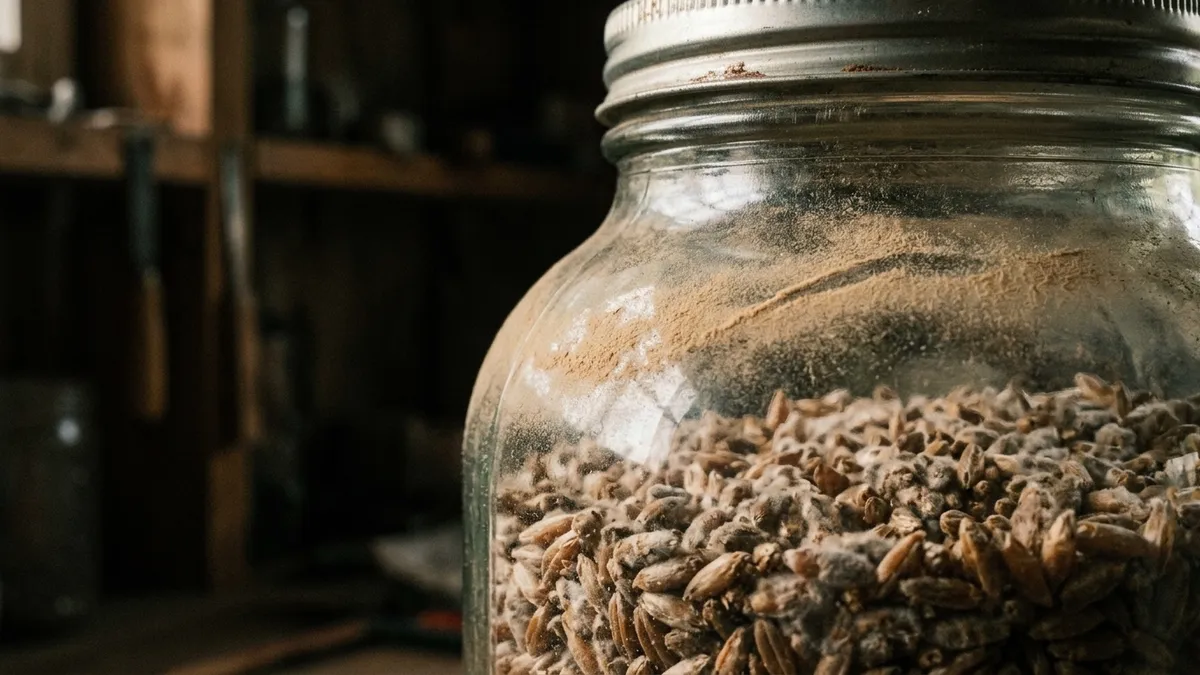
If a spawn jar has developed a fine tan dust that was not there last week, look closer before you decide it is contamination. If the dust moves, they are grain mites, and you have a room problem rather than a jar problem.
Grain mites are about 0.4mm long, pearly and translucent, with long hairs. At arm's length a heavy population reads as brown powder collecting around the lid or drifted along the top of the grain. Under any magnification it resolves into thousands of slow-moving bodies.
They matter far more than their size suggests, for a reason that is not obvious: mites eat mycelium, but the damage they do by carrying mould spores from one container to another is worse than the damage they do by feeding.
Confirming It Is Mites
Four signs, in the order they usually appear.
The dust that moves. Tan or beige powder around the lid, on the jar shoulder, or on the shelf underneath. Watch a patch for thirty seconds under a bright light. Mite dust shifts and shimmers. Spore dust does not.
A sweet, stale, faintly minty smell. Tyrophagus putrescentiae is the mould mite, the same species that gets into stored cheese and pet food. A heavy infestation smells distinctly sweet and dirty at once. Growers describe it as old gym socks, or mint gone wrong.
Colonisation that stalls and never restarts. The mycelium goes patchy and grey instead of advancing, then sits. A jar that stops and stays stopped is more often mites than a bad shake.
Tracks on agar. On a plate, mites carve visible trails through the mycelium, and mould blooms along those trails a few days later. That is the clearest confirmation you will get, and it also shows you exactly what they do.
Mites, or Something Else
Three things get mistaken for mites often enough to be worth a side by side look.
| What you see | Does it move | Smell | Where it gathers | What it means | What to do |
|---|---|---|---|---|---|
| Fine tan or beige powder, shimmering under a bright light | Yes, a slow drift over thirty seconds | Sweet, stale, faintly minty | Lid threads, jar shoulder, the shelf underneath | Grain mites | Bin the jar sealed, treat it as a room problem |
| Pale grey or white dust, sharp-edged flecks | No | None, or faintly of damp grain | Settled evenly through the grain, not concentrated at the lid | Uncolonised substrate dust, vermiculite fines or cracked grain hulls | Nothing, cosmetic only |
| Powdery patch, white at first, turning green, blue-green or grey in two to four days | No | Musty, mushroomy, sometimes sharp and sour | One spreading patch with a defined edge, often at an injury or the inoculation point | Trichoderma or another mould in its early stage | Bin the jar sealed, review sterile technique |
| Small pale worm-like larvae, or slender dark flies on the glass | Yes, obvious wriggling or flight | Sour, wet | In the top layer of moist grain, flies on the lid and walls | Fungus gnats | Sticky cards and a dry surface layer, see the gnat guide |
If the dust sits at the lid rather than through the grain and it shifts while you watch, the identification is made. If it wriggles instead, you have fungus gnats.
Where They Came From
Almost always the grain, and almost always before you ever opened the bag.
Rye, wheat, millet and birdseed routinely arrive with a small mite population already in them. Grain is a living food sitting in a warm warehouse, and mites are its normal fauna. Sterilising kills whatever is in the jar, which is why the problem usually appears weeks later, after mites walk back in from somewhere else in the room.
The other common sources:
- Pet food, flour, dry pasta and birdseed stored in the same space. Any of these can host a colony indefinitely.
- Spent or contaminated material kept indoors instead of removed. An infested bin is a breeding reservoir.
- Cardboard, which holds enough organic dust in its flutes to support them.
- Cultures or spawn from another grower, which is why new material should sit apart from everything else for a few weeks.
Why They Spread So Fast
A generation takes roughly two weeks at room temperature, faster when it is warm and humid, which describes every part of a grow space. One female produces several hundred eggs. That compounding is why growers consistently report the same arc: one odd jar, then a shelf, then the whole lab inside a month.
They also move. Mites crawl along shelving, across benches, and up the outside of jars to the filter patch. Nothing about a closed lid stops a 0.4mm animal that can walk.
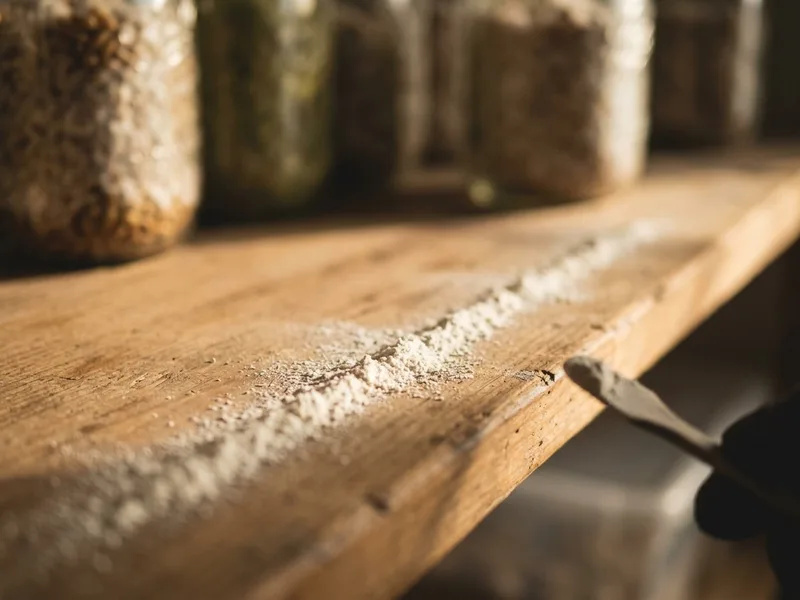
Food-Grade Diatomaceous Earth
A thin line dusted along shelf edges, shelf legs and the floor beneath your racks. It works mechanically rather than chemically: the microscopic silica fragments abrade a mite's waxy outer layer and it dries out, so there is nothing for them to develop resistance to. Two real limits. It only works dry, which makes it useless inside a fruiting chamber, and food grade does not mean safe to breathe. Wear a mask while dusting, because the airborne powder is a respiratory irritant.
When you buy through our links, it supports our mycology research at no extra cost to you.
The Part Nobody Wants to Hear
You cannot save an infested jar.
There is no treatment that kills mites inside colonised grain and leaves the mycelium alive. Mites get into the grain itself, under the lid threads, and into the filter patch. Anything strong enough to reach them there kills the culture, and anything gentle enough to spare the culture does not reach them.
So the job is containment, not rescue. Deciding that early is what keeps a one-jar problem from becoming a one-room problem.
- Do not open infested containers indoors. Opening a jar to inspect or empty it broadcasts mites across the room. Bag it sealed, as it is.
- Get it out of the building the same day. Not into a bin in the garage. Out.
- Strip the area. Porous things that were in contact go: cardboard, unsealed wood offcuts, old filter material.
- Vacuum and wipe. Physical removal does more here than disinfectant. Alcohol kills bacteria and fungal spores on a surface; it is not a miticide and should not be relied on as one.
- Leave the space empty for a few weeks if you possibly can. With nothing to eat, the population collapses. This is the single most effective step and it costs nothing.
Making the Room Hostile
Once the infested material is gone, the goal is a dry barrier between wherever mites still are and wherever your jars sit.
Dust it where mites walk, not where you work clean. The point is to make the approach to your shelving lethal, not to coat the shelving itself.
Stopping the Next Batch
Prevention here is unusually cheap, and it is almost entirely about how grain enters the building.
Freeze incoming grain. Three to four days in a domestic freezer kills mites and eggs. This is free, it takes no skill, and it removes the single largest source of the problem. If you do one thing from this guide, do this one.
Store grain sealed. A woven poly sack or a folded paper bag is not a barrier to something this small. A gasketed container is.
Keep food out of the grow space. Pet food, birdseed and flour in the same room will undo everything else.
Quarantine anything that comes from another grower for a few weeks, away from your working shelves.
Skip the grain step entirely. Most mite outbreaks trace back to bulk grain sitting in a hobby space, being handled, stored and rehydrated over weeks. Buying ready-to-use grain spawn removes that exposure completely, because the grain never sits in your building uncooked. For anyone running a few grows a year rather than a production schedule, that is usually both cheaper and less risky than keeping a sack of rye on hand.
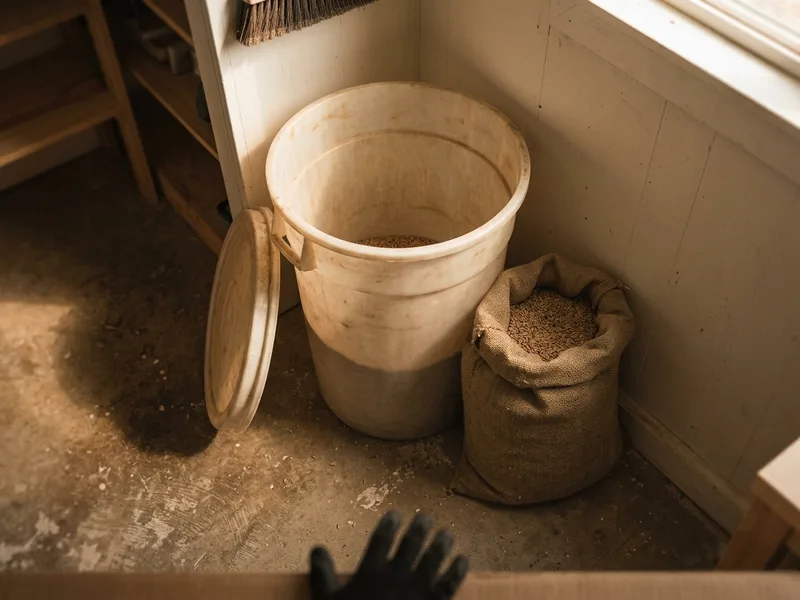
Airtight Grain Storage Vault
Decant grain into a sealed container the day it arrives, ideally after its stint in the freezer. A double-gasket lid keeps mites from getting in and, just as importantly, keeps any survivors from getting out into the rest of the room. Sold for pet food, which is the same storage problem at the same scale and usually cheaper than anything labelled for grain.
When you buy through our links, it supports our mycology research at no extra cost to you.
Prevention by Stage
Mites get one entry point per stage, and each stage has a tell when the control failed.
| Stage | The risk | The control | The tell it failed |
|---|---|---|---|
| Buying grain | Mites are already living in the sack, feed-store and bulk-bin rye most of all | Buy sealed, buy small, or start from grain that arrived sterile | Dust at the seam of a new sack, or a sweet stale smell when you open it |
| Storing grain | A paper sack in a warm room is a breeding site, and it sits metres from your cultures | Freeze 48 to 72 hours on arrival, then sealed food-grade buckets in a cool dry room away from active work | Powder in the bucket lid groove, or grain that smells sweet before it is cooked |
| Sterilising | Sterilisation kills what is in the jar and does nothing about the room it cools in | Full cycle, then cool sealed, in a clean room with no open grain nearby | Jars that stall in week one with no visible mould |
| Inoculating | Mites ride in on hands, sleeves and tools, and they walk in under a loose lid | Still air box or flow hood, filter lids seated properly, no open grain on the bench | Tracks carved through mycelium on agar plates |
| Incubating | One infested jar seeds every jar on the shelf within a fortnight | Inspect weekly under a bright light, isolate new jars from old, keep shelves bare and wipeable | Dust on the shelf under a jar, before the jar itself looks wrong |
| The room | Spilled grain, cardboard and old substrate keep a population alive between batches | Hard surfaces, no cardboard, spills cleaned same day, spent blocks out the same day they finish | Recurrence in a batch made with fresh grain and clean technique |
Two of those rows disappear if raw grain never enters the building. Ready-made grain spawn deletes the buying and storing stages, and pre-made sterile substrate does the same at the bulk stage.
Sourcing and Storing Grain in Canada
Most Canadian growers buy rye from a feed store or a bulk bin, and that is the usual entry route. A sack of rye is not a sterile input. It is stored food, and mites are part of its normal fauna long before it reaches you. A bag that sat in a warm barn through a summer is the likeliest single source of a room infestation, and nothing at the pressure cooker changes that. Sterilisation resets the jar. It does not un-infest the room the grain walked into.
If you are new to grain work, read how grain spawn is actually made before you buy a sack, because the quantity you need is far smaller than the quantity a feed store sells. Twenty kilos bought to run three jars leaves nineteen kilos in your space for a year, which is precisely the condition mites want. Buy small, buy sealed, or start from grain that arrived sterile.
Freeze it before it comes inside. Forty-eight to seventy-two hours in a chest freezer kills mites and eggs, and it is the cheapest control on this page. An unheated Canadian garage at well below zero does the same work for nothing. Freeze the sack unopened, as it arrived, and do not open it in the grow room.
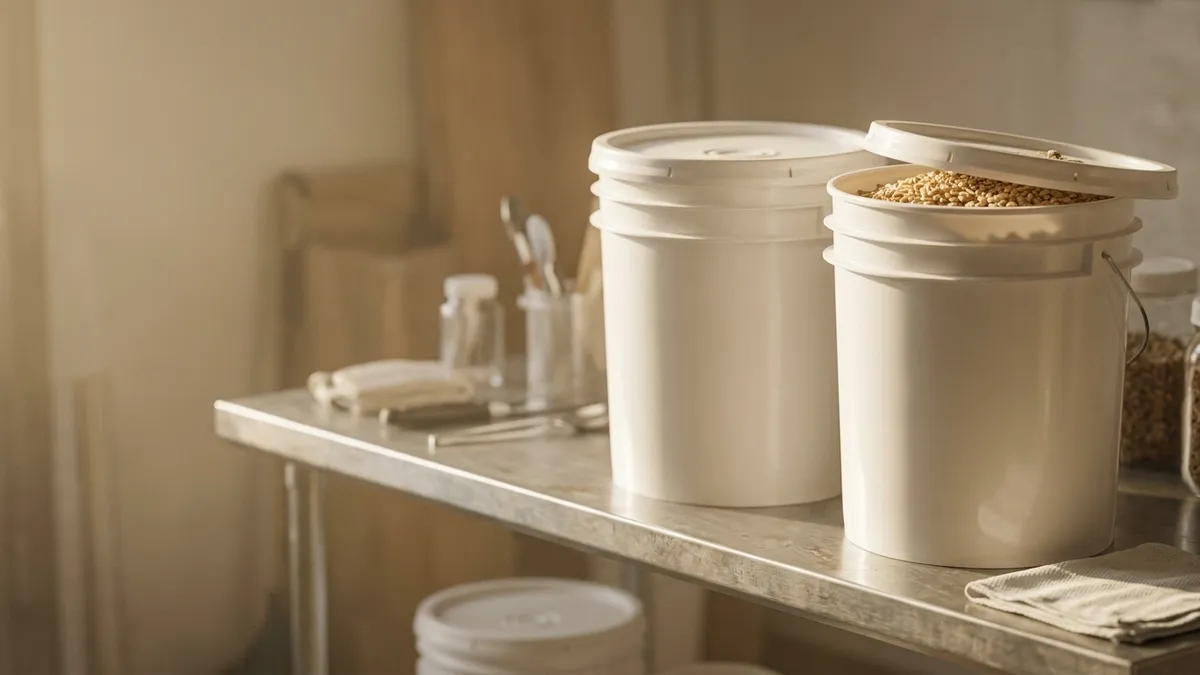
Then get it out of paper. Paper breathes, tears at the seam and leaves a dust trail along the shelf. Woven poly is no better. Food-grade buckets with a gasket lid stop traffic both ways: nothing walks in, and nothing the freezer missed walks out. Decant the day it arrives. The same discipline applies to colonised grain, covered in our notes on spawn storage and shelf life.
Cool and dry matters as much as sealed. A mite population builds far faster at twenty-two degrees than at ten, so an unheated basement beats a cupboard above a radiator. Warm sealed grain is still a breeding site, just a tidier one.
Keep grain out of the room where cultures live. A shelf of rye above a shelf of colonising jars is a bridge, not storage. A different room if you have one, the far end of the space if you do not.
A thin line of food-grade diatomaceous earth along shelf edges and legs is worth dusting under a grain store as well as under your racks. It only works dry, and it is a respiratory irritant, so wear a mask.
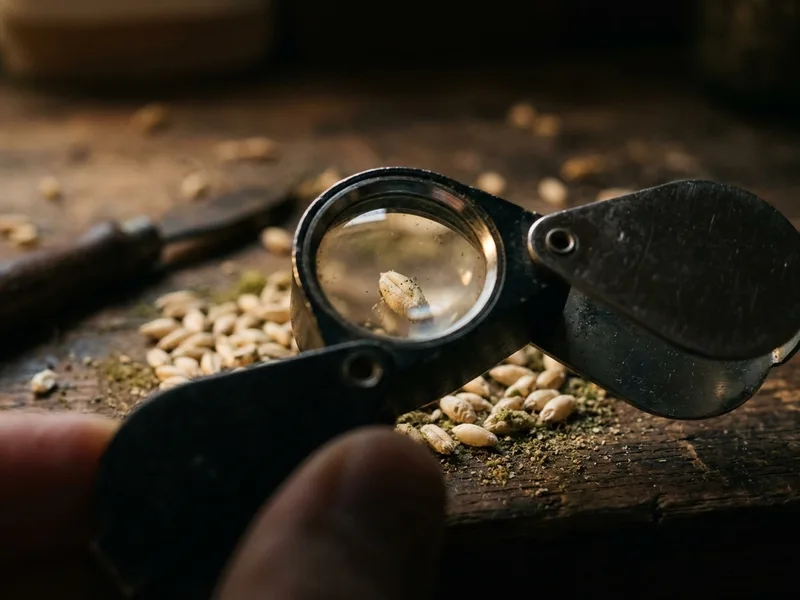
Illuminated 30x/60x Loupe
At 0.4mm, mites are the edge of what an unaided eye resolves, and the decision they force is expensive: an infested jar gets binned. A folding loupe with its own light settles it in seconds, and it is the same tool that tells you whether a patch on an agar plate is mycelium or something else. There is no reason to spend more than a few dollars here.
When you buy through our links, it supports our mycology research at no extra cost to you.
What Does Not Work
- Hydrogen peroxide. Does not kill mites. It is a surface disinfectant.
- Wiping everything with isopropyl. Useful housekeeping, not a control measure.
- Permethrin strips and household insecticides. Do not use these near a food crop you intend to eat, and they will not reach mites inside grain anyway.
- Raising humidity or temperature. Both favour the mites over you.
- Trying to rescue the jar. Covered above, and worth repeating because the attempt is how the problem spreads.
Frequently Asked Questions
Are grain mites harmful to people?
They are a recognised allergen rather than a toxin. Prolonged handling of heavily infested material is a known cause of contact dermatitis in grain and food workers, and inhaled mite debris is an asthma trigger for susceptible people. Practically: wear gloves and a mask when you are bagging infested material, and do not stand over it breathing the dust.
Can I eat mushrooms from a tub that had mites?
We would not. The concern is not the mites themselves, it is what they carry. By the time a tub is visibly infested it has almost certainly been seeded with mould and bacteria from wherever the mites came from.
Will pressure sterilising kill them?
Yes, completely, inside the jar. That is also why sterilising is not a solution on its own. It resets the jar and does nothing about the population living on your shelf that will walk back in through a loose lid or a filter patch.
Are these the same as the mites people see on logs outdoors?
No. Outdoor logs host a wide range of soil mites and most are harmless bystanders in a system that is already open to the environment. Grain mites are a stored-product pest, and the problem is specific to sealed, sterile, indoor culture.
Can mites survive pressure sterilisation?
No. Nothing survives a full cycle. The problem is that sterile grain is the best food in the building, so if mites are in the room the jars are recolonised as they cool. Sterilisation is not a mite control. It is a starting point.
Can I just freeze an infested jar and keep using it?
No. Freezing kills the mites, but they have already carried mould spores through the grain and fed on the mycelium. You would be incubating contamination in a jar that has already stalled. Freezing prevents, it does not rescue.
Will mites move into my fruiting blocks?
Yes, if the population is established. They travel on air currents, sleeves and shelving. Blocks are less attractive than grain, so damage shows up as slower pinning and mould in the casing rather than obvious dust, which is why a block problem gets blamed on humidity.
How long until an untreated room is clear?
It does not clear on its own while there is food in it. Remove every colonised jar and spent block, strip cardboard and spilled grain, wipe hard surfaces, then run the room empty for two to three weeks. A room that stays stocked stays infested.
Related Guides
- Contamination field guide - identifying what the mites brought with them
- Green mould - the usual passenger, and what it looks like on agar
- Fungus gnats - the other pest that moves contamination between containers
- Grain spawn and liquid culture - where grain fits in the process
- Pressure canners - sterilising grain properly in the first place