
Small dark flies drifting up when you open the tub are almost always fungus gnats, and the adults are not the problem. The larvae are. They live in the top centimetre of damp substrate and eat mycelium, and a bad infestation will stall a flush or take out a tub entirely.
They are also the most common way contamination moves between grows, because a gnat that walked across a mouldy block will happily walk across a clean one an hour later.
Gnats, Fruit Flies or Phorids
Three things get called gnats and they behave differently.
Fungus gnats are dark, slender, long-legged and weak fliers. They drift rather than dart, and they sit on damp surfaces. Adults live about a week.
Fruit flies are rounder, tan, with red eyes, and they fly directly. They are after sugars, so they appear around harvested mushrooms rather than in the substrate.
Phorid flies run across surfaces in a jerky zigzag before flying, and they are the serious one. They breed in decaying matter and are genuinely hard to clear.
If they drift slowly off a damp surface and you find tiny clear larvae in the top layer of substrate, you have fungus gnats.
Where They Came From
Almost always the substrate or the room, not the spawn.
- Coir, peat and casing material frequently arrive with eggs already in them. Pasteurising kills them; unpasteurised bulk material is the usual culprit.
- Houseplants in the same room. Fungus gnats breed in any damp organic matter, and a pot of overwatered soil is a nursery.
- Unfiltered fresh air exchange. If you are venting a chamber with an open hole rather than a filtered one, you have an entrance.
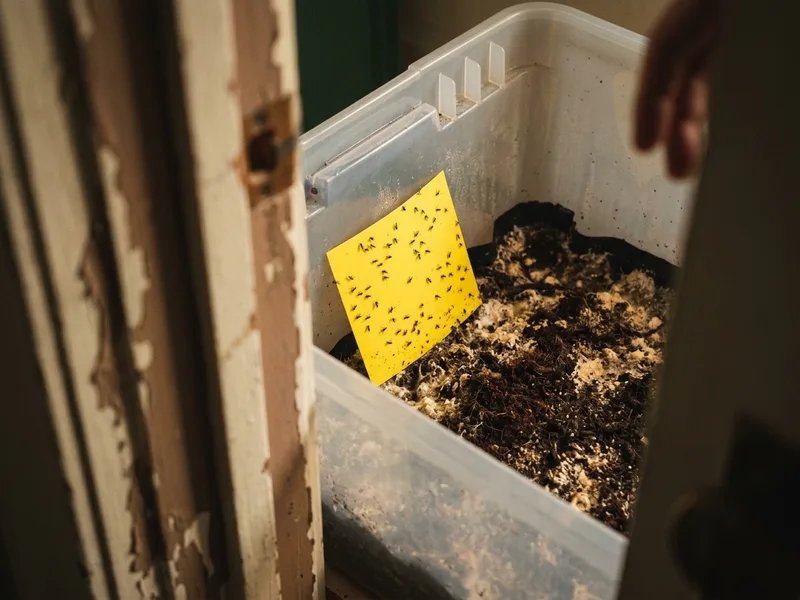
Yellow Sticky Traps
Traps catch adults, which tells you whether the population is rising or falling. They will not clear an infestation on their own because they do nothing to larvae, but they are the cheapest way to know if the BTI is working. One card per tub, replaced when covered.
When you buy through our links, it supports our mycology research at no extra cost to you.
The Treatment That Does Not Harm Mycelium
This is where growers go wrong, so it is worth being blunt: do not reach for a fungicide. Your crop is a fungus. Anything that kills a fungus gnat's fungal food source kills the thing you are growing.
The correct tool is BTI, Bacillus thuringiensis israelensis, a bacterium that produces a toxin lethal to fly larvae and inert to mycelium, plants, pets and people. It is sold as granules for mosquito control and is the same active ingredient in the products sold at ten times the price as "fungus gnat killer".
Breaking the Cycle
A fungus gnat goes egg to adult in roughly three to four weeks, faster in a warm room. That means one treatment is never enough: you have to keep treating across the full cycle or the next generation emerges from eggs laid before you started.
Treat, wait a week, treat again, and keep the traps up until you stop catching anything for a fortnight.
Prevention Is Cheaper
- Pasteurise bulk substrate properly. Most infestations arrive in the coir.
- Filter your air exchange. Micropore tape over drilled holes exchanges air without letting anything walk in, which is one of the quieter arguments for taping a monotub rather than leaving open holes.
- Deal with houseplants in the same room, or move the grow.
- Do not let the surface stay wet. Gnats lay in saturated material; a surface that dries slightly between mistings is far less attractive. If you are misting to hold humidity, your fresh air and humidity balance needs work rather than more water.

Mosquito Bits, BTI Granules
Steep a handful in water for half an hour, strain, and use that water on the affected surface. BTI targets fly larvae specifically and does nothing to mycelium. Buy the granules rather than a product marketed for fungus gnats: the active ingredient is identical and the granules cost a fraction as much.
When you buy through our links, it supports our mycology research at no extra cost to you.
What Does Not Work
- Fungicides. Again: your crop is a fungus.
- Sticky traps alone. They catch adults while the larvae keep feeding.
- Letting it ride. Light infestations in a healthy tub sometimes do pass, but the risk is not the gnats, it is what they carry between blocks. See the contamination field guide for what that looks like when it lands.
- Neem and soaps are for plant pests on leaves. There are no leaves here.
Related Guides
- Grain mites — the other pest that moves contamination between containers
- Contamination field guide — what gnats spread between blocks
- Green mould — the most likely passenger
- Monotub tek — taping holes rather than leaving them open
- Fresh air exchange — why a permanently wet surface is a symptom