
If your mushrooms come out with long thin stems and caps that never open properly, you do not have a humidity problem or a light problem. You have a carbon dioxide problem, and the fix is fresh air exchange.
Fresh air exchange, usually shortened to FAE, is simply replacing the stale air in a fruiting chamber with room air. It is the variable most new growers under-do, partly because the symptoms look like something else, and partly because every piece of advice online gives a number without saying where it came from.
What CO2 Actually Does to a Mushroom
Mycelium respires. It takes in oxygen and gives off carbon dioxide, and in a sealed chamber packed with colonised substrate, CO2 climbs fast.
During colonisation that is fine and even helpful. Elevated CO2 suppresses pinning, which is what you want while the mycelium is still running through the substrate. This is why a sealed bag or a taped tub colonises well.
During fruiting it is the enemy. A mushroom reads high CO2 as "you are still buried, grow upward to find air". So it does: the stem elongates, the cap stays small and underdeveloped, and in bad cases pins abort entirely.
That single mechanism explains most of the disappointing photographs people post. Long stem, tiny cap, otherwise healthy. Not enough air.
Species differ. Oysters are the most CO2-sensitive and will show it first. Lion's mane is moderate. Shiitake tolerates more than either. If you grow several species in one room, the oysters are your canary.
The Number Nobody Explains
Most guides tell you to aim for under 1,000 ppm CO2 during fruiting. Outdoor air is around 420 ppm and ordinary indoor air sits between 600 and 1,000, which tells you something useful straight away: for a small grow, "open a window and move some air" genuinely is the answer.
The number only starts to matter when you have enough substrate in a small space to outpace the room. A single monotub in a spare bedroom will not. Six blocks in a sealed tent will.
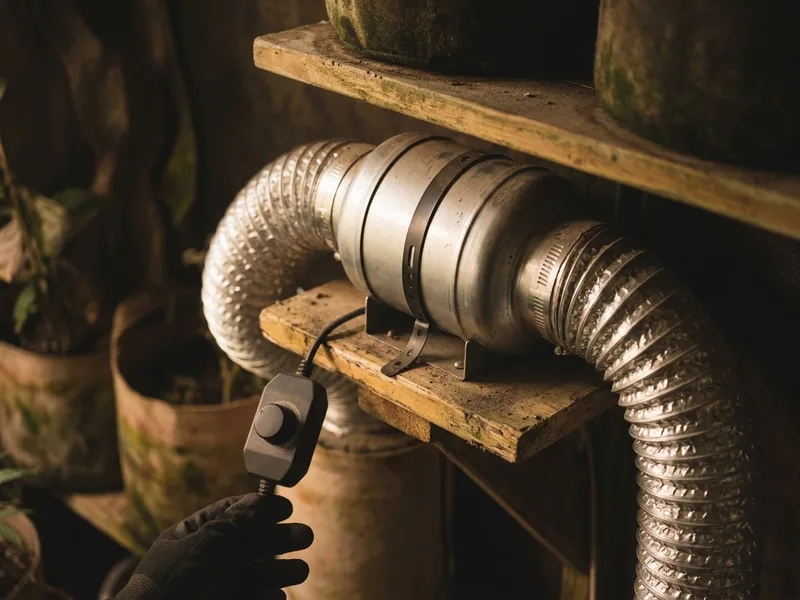
AC Infinity CLOUDLINE A4 Inline Duct Fan
A 4 inch EC-motor fan with a ten-speed controller, which is the part that matters: at speed one it moves little enough not to flatten your humidity. Quiet enough for a spare room, and the same fan handles a tent or a small fruiting room.
When you buy through our links, it supports our mycology research at no extra cost to you.
Working Out the Airflow You Need
Here is the arithmetic, because it leads somewhere surprising.
Take your chamber volume in cubic feet, multiply by the air changes per hour you want, and divide by 60 to get the CFM your fan must move.
A 3 ft by 3 ft by 6 ft tent is 54 cubic feet. At a generous 6 air changes per hour:
54 × 6 ÷ 60 = 5.4 CFM
Five and a half CFM. The smallest inline fan sold for grow tents moves about 165 CFM, roughly thirty times what that tent needs.
This is the single most useful thing to understand about FAE hardware: the fan is not the problem, the control is. Running an inline fan flat out in a small tent will strip the humidity out in minutes and leave your pins dry and crusted. You need it throttled, cycled on a timer, or both.
Passive Versus Active
Passive exchange is holes and diffusion. A monotub with a taped hole grid, or a shotgun fruiting chamber you fan by hand, exchanges air without a fan at all. For one or two tubs this is genuinely sufficient, and it is why the monotub remains the best low-effort format.
Active exchange is a fan moving a measured amount of air on a schedule. It becomes worth the money when you have a martha tent or a small room with several blocks, because the CO2 load finally exceeds what diffusion can clear.
The Tension Nobody Mentions
Every bit of fresh air you add removes humidity. That is not a side effect, it is the same process: you are swapping moist chamber air for drier room air.
So FAE and humidity are one system, not two. Turn the fan up and the humidifier has to work harder. Seal everything to hold humidity and the CO2 climbs. Growers who chase one number at a time oscillate between long stems and dried-out pins for weeks.
The practical answer is short, frequent exchanges rather than constant airflow. A minute or two several times an hour clears CO2 without giving humidity time to crash. That is exactly what a timer or a controller buys you.
AC Infinity CLOUDLINE T4 with Controller
The same fan with a temperature and humidity controller built in, so it can run on a cycle or trigger on humidity rather than sitting at one speed. Only worth the difference if you are away from the grow for days at a time.
When you buy through our links, it supports our mycology research at no extra cost to you.
Placement
- Exhaust high, intake low. You are trying to create a path through the chamber rather than a swirl in one corner.
- Never blow directly on pins. Moving air across a fruiting surface dries and crusts the caps and can stall a flush. Direct the flow along a wall, not at the blocks.
- Filter the intake if the room is dusty. Fresh air brings in whatever is floating in it, and you have just built a warm humid box for it to land in.
- Duct the exhaust out of the room if you are growing at any volume. Spore load in an enclosed space is a genuine respiratory irritant over time.
Reading the Symptoms
| What you see | Usual cause |
|---|---|
| Long thin stems, small caps | Not enough fresh air |
| Pins form then abort | CO2 spike, or airflow drying them |
| Caps crusted or cracked dry | Too much direct airflow, or humidity too low |
| Fuzzy white growth on the substrate surface | Often stale air encouraging aerial mycelium |
| Everything healthy but slow | Usually temperature, not air |
Aerial mycelium is worth singling out. That fluffy white growth climbing off the substrate instead of pinning is very often a stale air signal, and it is regularly mistaken for contamination. More FAE usually settles it.
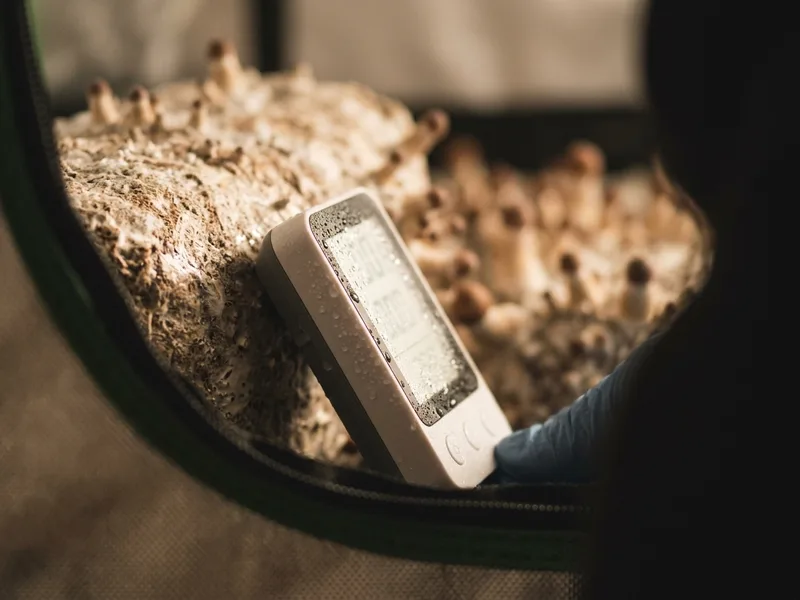
Portable CO2 Monitor, NDIR Sensor
Insist on NDIR. The cheap sensors labelled "eCO2" or "TVOC" infer carbon dioxide from other gases and are close to useless in a humid, mushroom-scented room. Worth borrowing before buying: a week of readings usually tells you the room was fine all along.
When you buy through our links, it supports our mycology research at no extra cost to you.
What to Do First
Before buying anything: open the chamber more often and see whether the next flush improves. That is free, and for most home growers it is the whole answer.
If it does not improve, borrow or buy an NDIR meter and get a week of readings. If your room genuinely sits above 1,000 ppm while fruiting, then buy the fan, and buy one with a speed controller.
Fresh air exchange is the cheapest variable in mushroom growing to get right and one of the most expensive to get wrong, because it costs you a whole flush each time.
Related Guides
- Monotub tek — passive exchange through a hole grid
- Shotgun fruiting chamber — hand fanning, and what it teaches
- Martha tent setup — where active FAE starts to pay
- Humidity controllers — the other half of the same system
- Growing temperatures by species — when it is not the air after all