
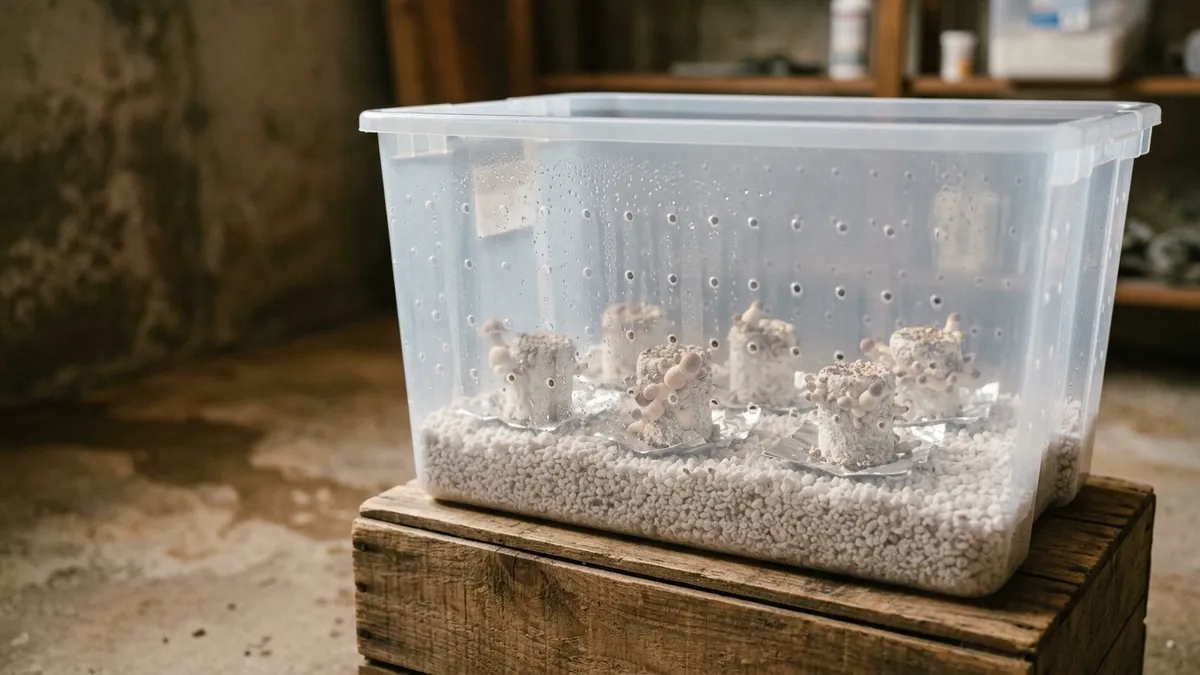
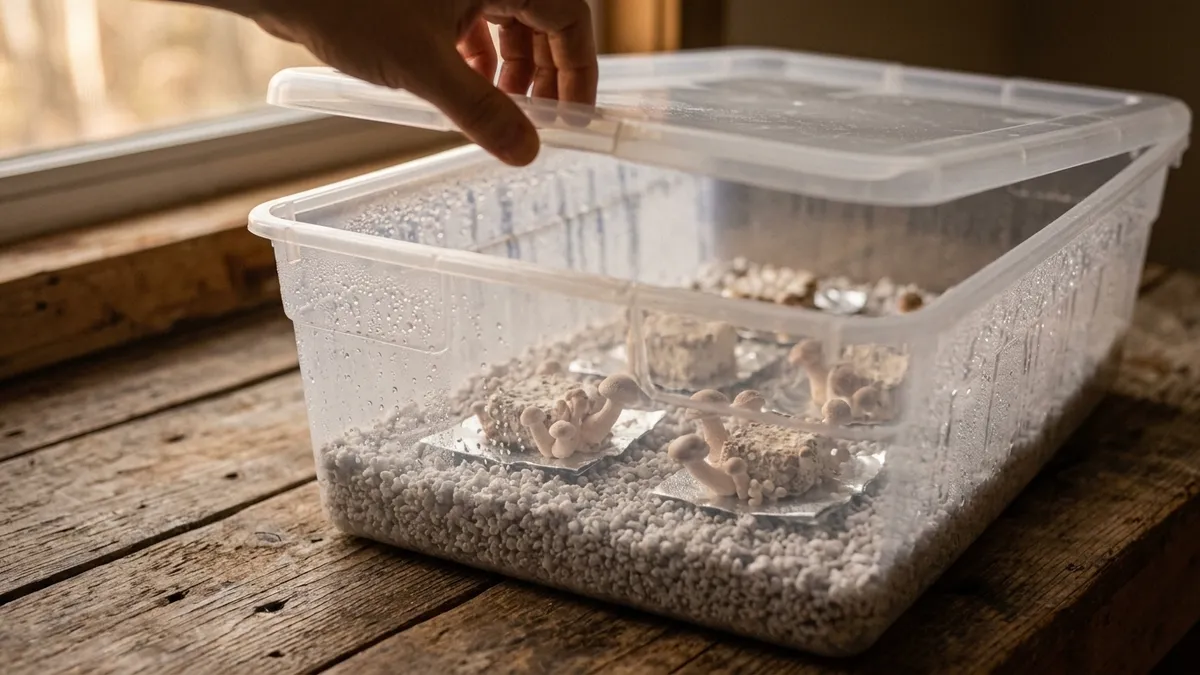
A shotgun fruiting chamber is a clear tote drilled full of quarter-inch holes with a bed of wet perlite in the bottom. The perlite evaporates to hold humidity, the holes let stale air out, and you swap the air by hand several times a day. It is the standard first chamber for anyone fruiting PF Tek cakes, and it costs about the price of a tub and a bag of perlite.
It is also the chamber most growers eventually abandon, and it is worth knowing why before you build one.
What the SGFC Actually Does
Three jobs, all passive except the last.
Humidity comes from water evaporating off a large surface area of wet perlite, not from misting. This is the part people get wrong. If you are spraying your cakes to keep humidity up, the perlite bed is too dry or too shallow.
Fresh air exchange happens through the hole grid whenever you fan the chamber. Mushrooms need oxygen and produce carbon dioxide; without exchange you get long stems, small caps and aborts.
Light reaches the cakes through the clear walls. Mushrooms do not photosynthesise, but most species use light as a directional cue for where to send stems.
The name comes from the holes, which look like a shotgun blast pattern.
What an SGFC Costs to Build in Canada
Canadian retail, October 2026, as ranges rather than false precision.
| Item | What to get | Cost (CAD) |
|---|---|---|
| Clear tote | 50–70 quart (47–66 L), rigid rather than bargain-flexible | $15–25 |
| Coarse perlite | One large horticultural bag, coarse grade | $25–35 |
| 1/4-inch drill bit | Brad-point or step bit, not a twist bit | $5–12 |
| Wide-mouth jars | 12-pack pint jars, if you are not already running PF Tek | $18–28 |
| Aluminium foil | For cake stands | $4–6 |
| Total | ~$70–105 |
Nothing here needs a specialty supplier: coarse perlite is on the shelf at Canadian Tire, Home Depot and most garden centres. Owning jars already puts the real spend at $45 to $70.
A monotub is the cheaper build, roughly $35 to $45 for tote, tape and polyfill with no perlite bed, but that only pays off if you are already running grain spawn and bulk substrate, which is where the real cost difference sits.
Tote Size and the Hole Grid
Use a clear tote somewhere between 50 and 70 quarts. Smaller dries out and swings temperature fast, larger gets unwieldy to fan properly.
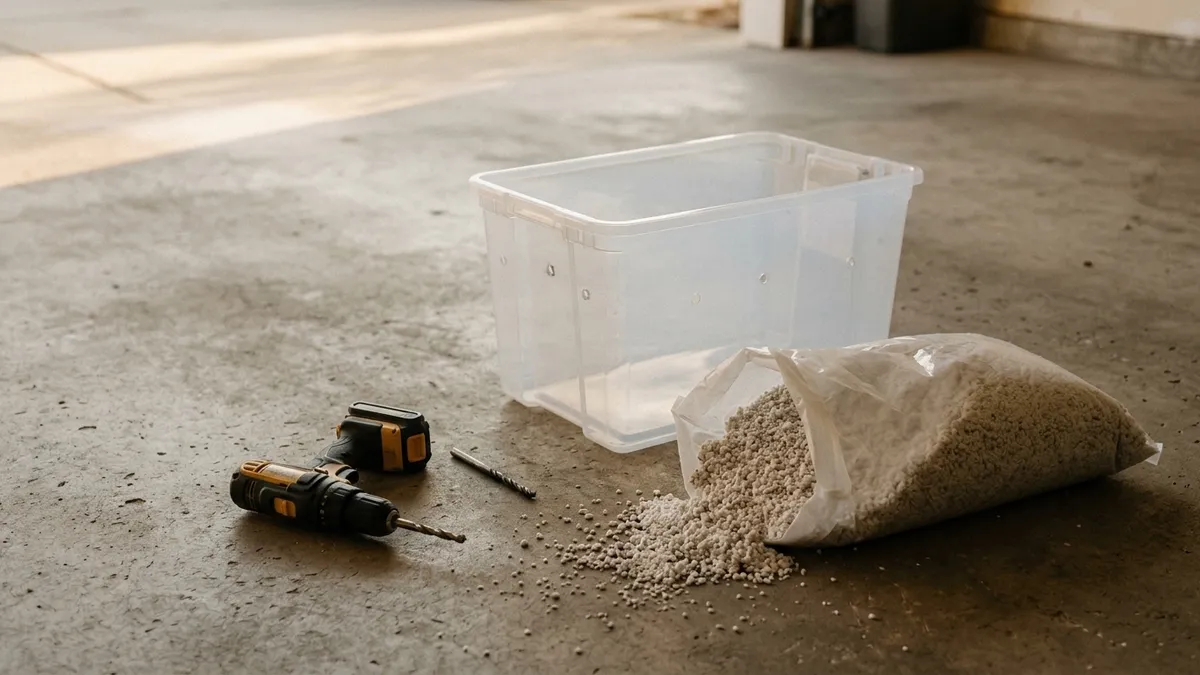
Drill quarter-inch holes on a two-inch grid across all six sides, including the bottom. The bottom holes matter: they let water drain out of the perlite rather than pooling, and they are part of what makes the air exchange work when you fan.
A few build notes that save rework:
- Drill from the inside out, or the plastic chips and cracks around every hole.
- A brad-point or step bit cuts cleanly where a twist bit grabs and shatters.
- Deburr each hole with a knife. Sharp plastic edges shred your hands during harvest.
- Raise the tub on blocks or a crate so the bottom holes are clear of the floor.
Tote Size, Hole Count and How Many Cakes Fit
The hole count falls out of the grid. On a two-inch grid each hole covers four square inches, so add up the area of all six faces in square inches and divide by four.
| Tote size | Rough footprint | Holes on a 2" grid | Perlite depth | PF Tek cakes that fit |
|---|---|---|---|---|
| ~45–50 L (48–53 qt) | 23 × 16 × 13" | ~400–440 | 4" | 4–6 |
| ~60–66 L (64–70 qt) | 26 × 18 × 15" | ~520–570 | 4–5" | 6–8 |
| 80 L+ (85 qt+) | 32 × 20 × 16" | ~690–740 | 5" | 10–12, hard to fan evenly |
Middle row as a worked check: (26×18 + 26×15 + 18×15) × 2 = 2,256 square inches, and 2,256 ÷ 4 is 564 holes.
The largest size is a false economy. Fanning moves air by pushing the lid, and that push dies before it reaches the corners of a 32-inch tub, so the capacity you added sits exactly where you cannot ventilate. For that much tray area, run small substrate blocks in grow bags under a fan rather than cakes in a hand-fanned tub.
Coarse Horticultural Perlite
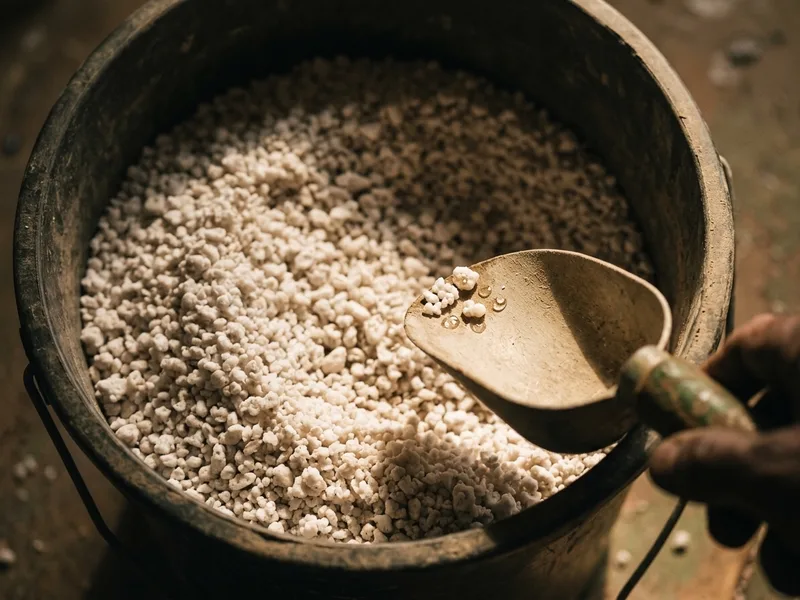
Coarse grade, not the fine seed-starting kind, which packs down and holds far less air. One large bag fills a chamber with plenty left over. Rinse before use to knock the dust down.
When you buy through our links, it supports our mycology research at no extra cost to you.
Perlite: Depth and Hydration
Four to five inches of perlite in the base. Less than that and the chamber cannot hold humidity through a full day.
Hydrate it to field capacity, which is the same standard used for bulk substrate: soak the perlite, then drain it until squeezing a handful produces a drop or two and no running stream. Perlite holding standing water breeds bacteria and smells sour within a week.
Rinse it first. Perlite dust is an irritant and it cakes on wet surfaces.
Perlite Hydration: Ratios That Actually Hold Humidity
Perlite reaches field capacity on roughly three parts perlite to one part water by volume. Add the water, leave it twenty minutes, then drain.
| Perlite in the bed | Water to add | After draining |
|---|---|---|
| 10 L | ~3 L | 0.3–0.5 L runs off, bed glistens and feels heavy |
| 20 L | ~6 L | 0.5–1 L runs off, no free water in the base |
| 30 L | ~9 L | 1–1.5 L runs off, tip it out before loading cakes |
Most builds land on the bottom row: a four-inch bed in a 50 quart tote takes about 24 L, and a four to five inch bed in a 66 quart tote takes 30 to 35 L.
The test is the field capacity standard named above, not a new one. Squeeze a handful hard and you want one or two drops, never a running stream.
A dry bed announces itself twice: the walls stay dry between fannings, and the overnight minimum on the hygrometer slides down. Watch that minimum, not the reading you catch at noon.
Re-wet every three to seven days, the short end of that in a heated Canadian house in winter. Pour fresh water down the side of the bed rather than over the cakes, and tip out anything that pools, because perlite standing in water goes sour inside a week.
Keeping Cakes Off the Perlite
Cakes sit above the perlite, never in it. Direct contact wicks water into the substrate and rots the base.
Stand them on squares of aluminium foil, on jar lids, or on a section of light rack. Foil is the usual answer because it is free and disposable between grows.
The Fanning Routine
This is the whole job, and it is why people give the format up.
Four to six times a day, take the lid off and fan the chamber with it for a few seconds, enough to visibly move the air. Replace the lid. That is one exchange.
Mist the walls, not the cakes. If the walls are dry between fannings, your perlite needs rehydrating. Misting cakes directly is how you get bacterial blotch, which shows as slimy brown patches on the caps.
Expect to do this from pinning through harvest, every day, for the whole flush. Miss a day of fanning in a warm room and you will see it in the next flush: long thin stems reaching upward and undersized caps.
Digital Hygrometer and Thermometer
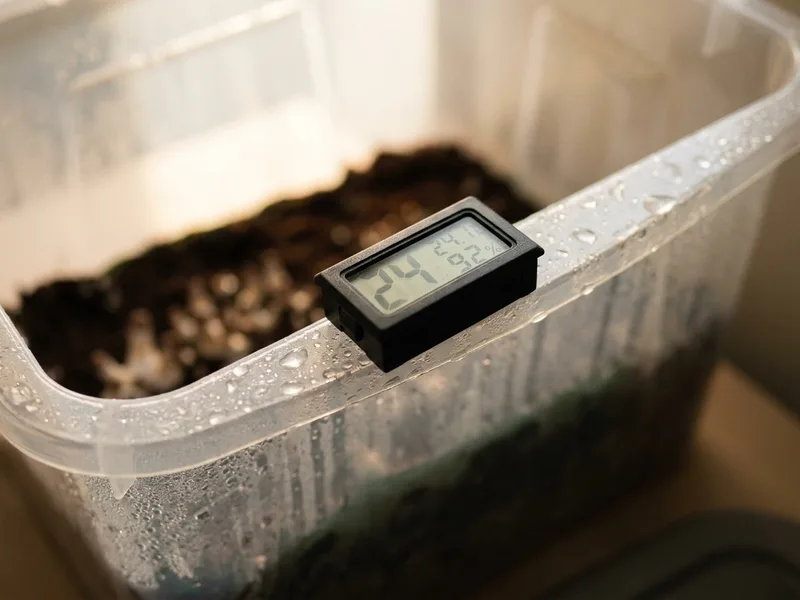
Look for a minimum and maximum readout. The overnight low is what tells you whether the chamber holds humidity between fannings, and that is the number the current reading hides.
When you buy through our links, it supports our mycology research at no extra cost to you.
A Day in the SGFC: Fanning and Misting Schedule
| Stage | Fannings per day | Mist the walls? | What you are watching for |
|---|---|---|---|
| Day 0–2, pin set | 4 | Only if the walls are dry | Tiny white dots across the cake surface |
| Day 3–5, pins developing | 5 | When they dry between fannings | Pins thickening rather than stalling or darkening |
| Day 6–8, rapid growth | 6 | As needed, the bed does the work | Caps widening, stems staying short and thick |
| Harvest day | 4 | No | Cap margins beginning to flatten |
| Between flushes | 4 | Only if the walls are dry | Re-wet the bed, pull anything mouldy |
No row sprays a cake, and that is the point: humidity comes from the perlite bed, not from misting, and the cakes themselves never get sprayed. Misting only tops up the walls. Reaching for the bottle more than twice a day means the bed is too shallow or too dry.
Oyster is the hungriest for fresh air and shows a shortfall first, as long stems. Lion's mane wants gentler exchange and shows it as corals that never form a solid clump. Shiitake is simply slower across the whole window. The count is really a proxy for how much fresh air exchange a species wants.
Conditions to Hold
Aim for roughly 90 to 95% humidity inside the chamber and a temperature suited to your species. The temperature ranges by species matter more than the humidity number, and they differ enough between oyster, shiitake and lion's mane that a single setting will not serve all three.
A cheap hygrometer sitting inside the chamber tells you within a day whether your perlite depth is right. Watch the minimum reading overnight rather than the number when you happen to look.
Common Problems
Long stems, small caps. Not enough fresh air. Fan more often, not harder.
Slimy brown patches on caps. Bacterial blotch from misting cakes directly or from water pooling. Mist walls only, and check the perlite is drained rather than soaking.
Chamber dries out overnight. Perlite bed too shallow, or the room is too dry and warm. Add depth before you add misting.
Green mould at the cake base. Usually contact with wet perlite. Raise the cakes. If it has taken hold, see the contamination field guide.
Nothing pins at all. Often temperature rather than the chamber. Check the range for your species before changing anything about the build.
Pins that go dark grey or black and stop. Aborts, almost always a moisture crash mid-flush, sometimes a knocked chamber. Harvest them with the flush rather than leaving them to rot in place.
Pins that stall or dry at the tip. The bed has dropped below field capacity, or a run of holes is drafting across the cakes. Re-wet before you change anything else.
Green mould across the top of a cake. Different from green mould at the base: this came in on the air or at inoculation. See the green mould guide. One cake infects the lot, so pull it the day you see it.
Long stems and small caps even though you are fanning on schedule. Each exchange has to visibly move the air, and two polite waves of the lid does not. See the fresh air exchange guide.
Water condensing on the walls and dripping onto the cakes. The room is colder than the chamber, usually a tub sitting on a concrete floor. Move it onto a crate, insulate underneath, and tip the lid clear of the cakes as you lift it.
Clear Storage Tote, 50 to 70 Quart
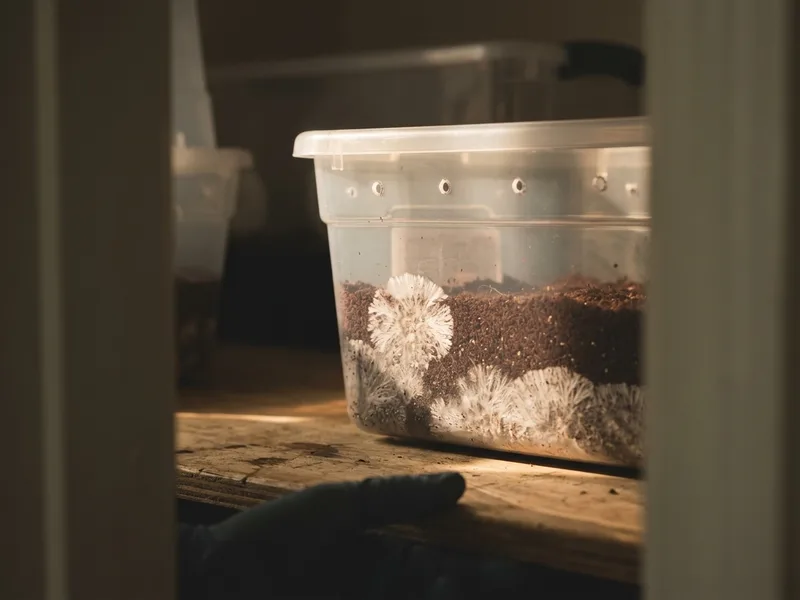
Clear rather than opaque, so light reaches the cakes and you can see what is happening without opening anything. Avoid the very flexible bargain totes: they flex when you fan and the holes distort.
When you buy through our links, it supports our mycology research at no extra cost to you.
When to Skip the SGFC
Be honest about this, because most growers cross the line within a season.
The shotgun chamber suits small grows of individual cakes, particularly PF Tek jars. It is cheap, it teaches you what fresh air exchange actually does, and it needs no electricity.
It is the wrong tool for bulk substrate. A monotub holds far more substrate, self-regulates humidity through the substrate mass itself, and needs a fraction of the daily attention. If you are working with grain spawn and bulk substrate rather than cakes, build the monotub instead and skip this format entirely.
It is also the wrong tool once you are running several grows at once. At that point a martha tent with a humidifier and a timer does the job while you sleep.
The SGFC's real value is as a teaching chamber. Build one, run a grow, feel how fast conditions drift when you skip a fanning, and you will understand why every larger setup automates exactly those two variables.
Hand fanning is fresh air exchange done manually. For what it is actually achieving, and the numbers behind it, see our fresh air exchange guide.
SGFC vs Monotub vs Martha Tent: Pick by What You Are Fruiting
| You are fruiting | Batch size | Budget | Best chamber | Why |
|---|---|---|---|---|
| PF Tek cakes | 4–8 cakes | $70–105 | SGFC | Cakes carry no humidity of their own, the bed supplies it |
| Bulk substrate, one tub | 1 tub | $35–45 plus spawn | Monotub | Substrate mass self-regulates, so no bed and no fanning |
| Several grows at once | 3+ blocks | $200+ | Martha tent | A humidifier and a timer run it while you sleep |
| Oyster on supplemented sawdust | Any | $35–200 | Martha or monotub | Its appetite for fresh air outruns hand fanning |
| Lion's mane | 1–2 blocks | $35–45 | Monotub, or fruit the block in its bag | Gentle exchange, and blocks do not fit a cake chamber |
Read it by the first column. Almost everyone who outgrows the SGFC does so by moving off cakes, not by disliking perlite.
That move means running grain spawn into bulk substrate, which adds a sterile transfer and a pasteurisation step that PF Tek folded into the jar for you. A different workflow, not a larger version of this one.
Frequently Asked Questions
How many holes does a shotgun fruiting chamber need?
Between roughly 400 and 740, depending on the tote. Quarter-inch holes on a two-inch grid means each hole covers four square inches, so add up all six faces in square inches and divide by four. A 66 quart tote at 26 by 18 by 15 inches gives 2,256 square inches, which is about 560 holes.
Does an SGFC need a fan?
No, and fitting one usually makes it worse. The chamber is built around hand fanning, and a running fan pulls humidity out through 500 holes faster than the perlite bed replaces it. A chamber that ventilates itself is a martha tent with a humidifier, not a modified shotgun chamber.
Can I use vermiculite instead of perlite in a fruiting chamber?
You can, but it is worse at this job. Vermiculite holds water, which is why PF Tek uses it inside the cake, but in a bed it packs into a dense mat with little exposed surface. Evaporation is a surface-area game, and coarse perlite stays loose where vermiculite compacts, so the same volume holds a lower and less steady humidity.
Do I need to sterilise the perlite?
No. Rinse it to knock the dust down, drain it to field capacity, and load it. Perlite comes out of the bag inert, and little grows in it as long as it drains rather than sitting in standing water. Boiling water poured over it does no harm, but it is belt and braces rather than a step you skipped.
Why are my mushrooms growing sideways out of the holes?
They are following the light, which arrives through the walls. Mushrooms orient their stems toward a light source, and in a clear tote near a window the brightest direction is sideways rather than up. It is cosmetic rather than a fault: light the chamber from above and give the tub a quarter turn every day or two.
Related Guides
- PF Tek from jar to harvest — the method the SGFC was designed around
- Monotub tek — the bulk substrate alternative
- Martha tent setup — when one chamber is no longer enough
- Still air box build — the other tote you will end up drilling
- Growing timeline — what should be happening, and roughly when