
If you want to grow mushrooms beyond the kit stage, you need a way to work with cultures without introducing contamination. That means agar plates, liquid culture syringes, grain jars, and spawn transfers. Every one of those tasks requires a clean environment where airborne contaminants are kept away from your work.
A still air box (SAB) is the simplest, cheapest solution. For under $15 and about 20 minutes of work, you can build one that will serve you for years. We've used SABs to do everything from pouring agar to inoculating dozens of grain jars, and our contamination rates stay consistently low when proper technique is followed.
This guide covers the full build, the technique that makes it work, and common mistakes that trip up beginners.
What Is a Still Air Box?
A still air box is exactly what it sounds like: a clear plastic tub turned upside down with two arm holes cut into one side. You reach inside through the holes, and the enclosed space prevents air currents from carrying contaminants onto your work. That is the entire device. No fan, no filter, no power cord, and nothing to service or replace.
It works because of one fact about contaminants: spores do not fly. They have no propulsion of their own, so they travel by riding air currents. Remove the currents and gravity takes them out of the air within minutes, settling them on the bottom and sides of the tub instead of on your plates and jars. That fact explains both halves of still air technique: why you seal the loaded box and let it sit before starting, and why every movement inside is slow and deliberate. A fast hand is a fan.
Be equally clear about what the box does not do. Unlike a laminar flow hood, it does not filter air. It does not sterilise anything, so the tub, your tools, and the outside of every jar have to be sanitised by you before they go in. And it will not rescue sloppy technique: the box supplies still air, and the grower supplies the clean work. Two people can use the same box in the same room and get very different contamination rates.
Cost is the other half of the appeal. A basic build runs under $15 CAD, since the tub is the only real expense and most growers already own the alcohol and paper towels. Add nitrile gloves and a butane torch and the full kit lands around $40-60 CAD. Both are approximate Canadian retail figures, but the order of magnitude is the point: a flow hood starts in the hundreds.
It's a low-tech approach, but it works remarkably well. Experienced growers routinely achieve contamination rates under 5-10% using a properly built and properly used SAB. That's good enough for any hobbyist and many small-scale commercial operations.
Why You Need One
If you're doing any of the following, you need either an SAB or a flow hood:
- Pouring or inoculating agar plates — agar is nutrient-rich and exposed. Without protection, mold spores land on it within seconds.
- Making or working with liquid culture — inoculating LC jars or drawing syringes from them exposes the liquid to open air.
- Inoculating grain jars — opening a sterilized grain jar outside of a clean environment is an invitation for Trichoderma and other contaminants.
- Doing grain-to-grain transfers — pouring colonized grain into fresh jars requires both jars to be open simultaneously.
- Cloning mushrooms — tissue culture involves cutting a small piece of mushroom and placing it on agar. Sterile conditions are essential.
You don't need an SAB for fruiting, harvesting, mixing substrate, or anything that happens after full colonization. The SAB is specifically for the vulnerable, sterile stages of cultivation.
Materials List
Here's everything you need. Total cost is typically under $15 CAD. If you add the optional extras below (gloves and a torch), the full kit lands closer to $40-60 CAD — still a fraction of the cost of a flow hood.
| Item | Estimated Cost | Notes |
|---|---|---|
| Clear plastic tub (64-106 qt / 60-100 L) | $8-12 | Sterilite or similar. Must be clear so you can see your work. Taller is better — you want room to maneuver inside. |
| Hole saw or soldering iron | $0-5 | A 10-13 cm (4-5 inch) hole saw attachment for a drill works best. A soldering iron or heated can also work. |
| Masking tape or marker | $0 | For marking hole positions. |
| Isopropyl alcohol (70%) | $3-5 | For sanitizing. You likely already have this. |
| Paper towels | $0 | For wiping down the interior. |
| Nitrile gloves | $10-15 (box of 100) | Snug fit; wipe gloved hands with alcohol before every session. |
| Butane torch or lighter | $10-15 | For flame-sterilizing scalpels and syringe needles between transfers. |
| Arm-length gloves (optional) | $10-20 | Shoulder-length disposable gloves for extra coverage; most growers do fine with nitrile + alcohol-wiped forearms. |
Optional but helpful:
- A small towel or mat to place inside the tub so items don't slide
- A spray bottle for the isopropyl alcohol
- Nitrile gloves
Still Air Box Sizes and What Fits in Them
Tote size is the one decision that is hard to undo, because the holes are already cut. The question is not how much the box holds, it is how many vessels you need open at once and whether you can reach all of them without stretching. Here is roughly how the 40-100 litre range breaks down, at approximate Canadian retail pricing.
| Tote Size | Approx. Cost (CAD) | Arm Hole Spacing | Best For | Too Small For |
|---|---|---|---|---|
| ~40-50 L | $6-9 | 25-30 cm | Agar plates, drawing and injecting syringes, one LC jar through the port | Grain bags, or anything with two containers open at once |
| ~60-70 L | $8-12 | 30-35 cm | The sweet spot: agar, LC jars, single grain jar inoculation | Grain bag work, jar-to-jar pours |
| ~80-100 L | $12-18 | 35-40 cm | Grain bag inoculation, and jar-to-jar work with two vessels open | Little, though far corners start to exceed easy reach |
| 100 L+ | $18-25 | 40 cm+ | Oversized bags or substrate blocks that need the footprint | Nothing, which is exactly the problem |
The 60-100 L band is the sensible default, and it matches the tub in the materials list above. Most growers who regret their tote bought too small, then wanted to inoculate grain a month later.
Plates are the least demanding case: flat, stackable, one lid off at a time. A 40-50 L box handles a full stack of pre-poured plates from our agar category comfortably, which is why small boxes feel adequate right up until the first grain jar.
Bigger is not automatically better, and this is where size advice usually goes wrong. A large box has more volume to settle, so it takes longer to go still after you load it. It exchanges more air through the arm holes every time you move. And the far corners end up past comfortable reach, which produces exactly the fast, stretching movements that ruin still air. A box you can work in calmly beats a box with spare room in it.
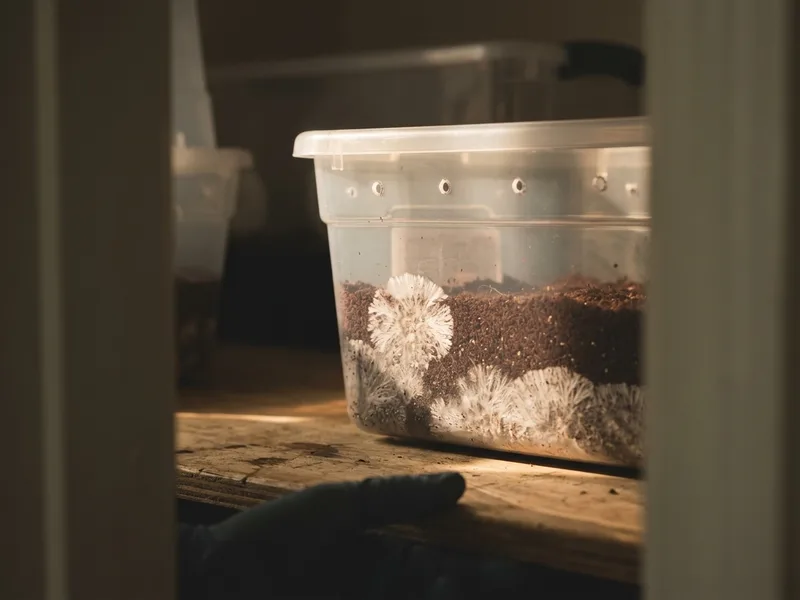
Sterilite 106 Quart Latching Box
A clear tote of roughly this size is the standard monotub shell. Latching lids hold a liner in place and the clear walls let you watch colonisation without opening anything. Depth matters more than footprint: aim for substrate about four to six inches deep.
When you buy through our links, it supports our mycology research at no extra cost to you.
Step-by-Step Build
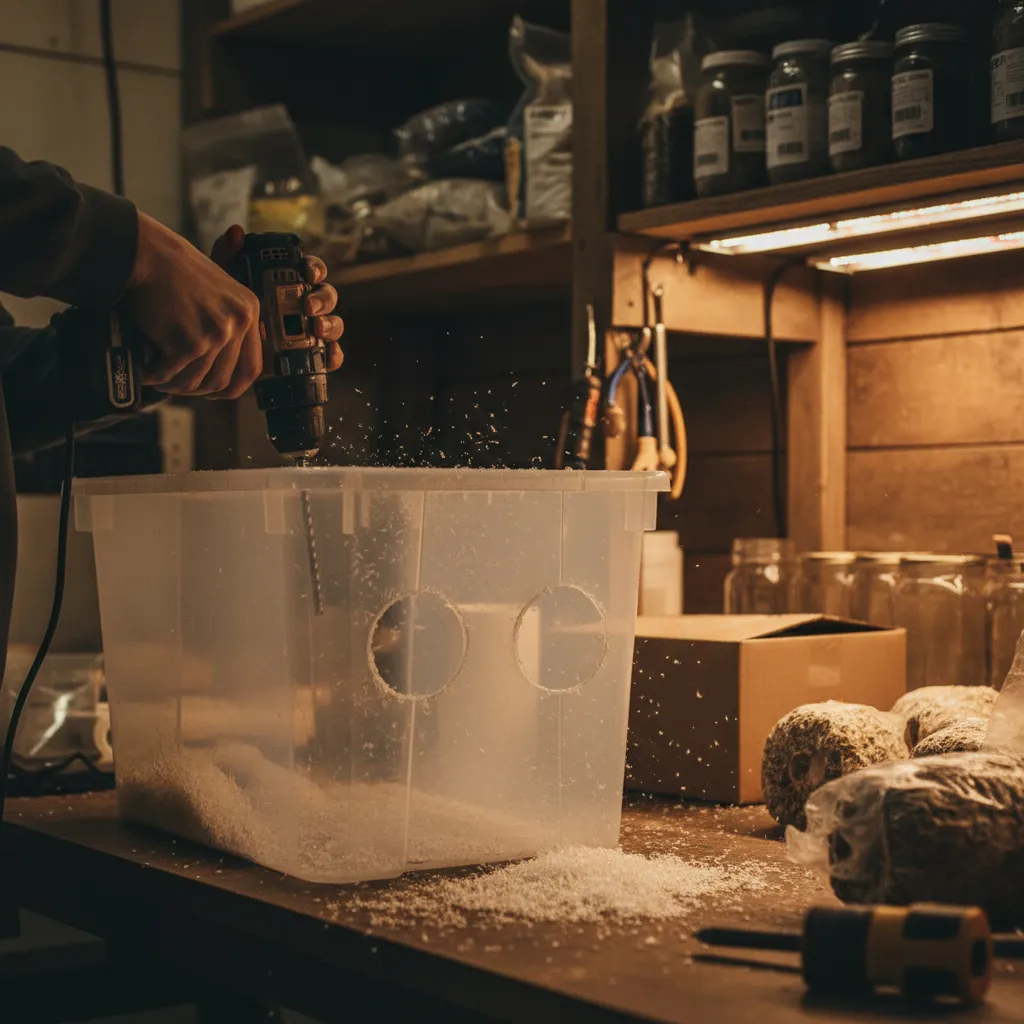
Step 1: Choose Your Tub
Look for a clear plastic storage tub in the 64-106 quart (60-100 litre) range. The Sterilite 106 qt tub from Canadian Tire or Walmart is a popular choice. You want it to be:
- Clear — you need to see what you're doing through the walls and lid
- Tall enough — at least 30 cm (12 inches) tall so you have room to work
- Wide enough — you'll have your arms inside, plus agar plates, a lighter, a scalpel, and whatever else you're working with
Step 2: Mark Your Arm Holes
Flip the tub upside down (the bottom facing up). The open side will face down toward your work surface when you use it.
On one of the long sides, mark two circles about 10-13 cm (4-5 inches) in diameter. Space them roughly shoulder-width apart, positioned in the lower half of the side wall. You want the holes low enough that your hands reach the bottom of the tub (which is now the top) comfortably.
Some growers put the holes on the bottom (now the top) of the tub instead. This works but makes it harder to see your work. Side-mounted holes are generally preferred.
Step 3: Cut the Holes
Hole saw method (recommended): Attach a 10-13 cm hole saw bit to your drill. Support the tub so the plastic doesn't flex too much, and drill through at moderate speed. The hole saw gives you a clean, round hole.
Soldering iron method: Heat the soldering iron and slowly melt through the plastic along your marked circle. This works but produces fumes — do it outside or in a well-ventilated area. The edges won't be as clean.
Hot can method: Heat an empty tin can on the stove and press it through the plastic. Crude but effective in a pinch.
Step 4: Smooth the Edges
Sand or file any rough edges around the holes. You'll be sliding your arms in and out, and sharp plastic edges will scratch you up. A few passes with fine-grit sandpaper is all it takes.
Step 5: Clean and Sanitize
Wipe down the entire interior of the tub with 70% isopropyl alcohol. Pay attention to corners and edges where dust accumulates. Let it air dry — 70% iso evaporates quickly.
That's it. Your SAB is built.
The box itself
How to Use Your SAB: Proper Technique
Building the box is easy. Using it correctly is where most contamination happens. Here's the technique that keeps your work clean.
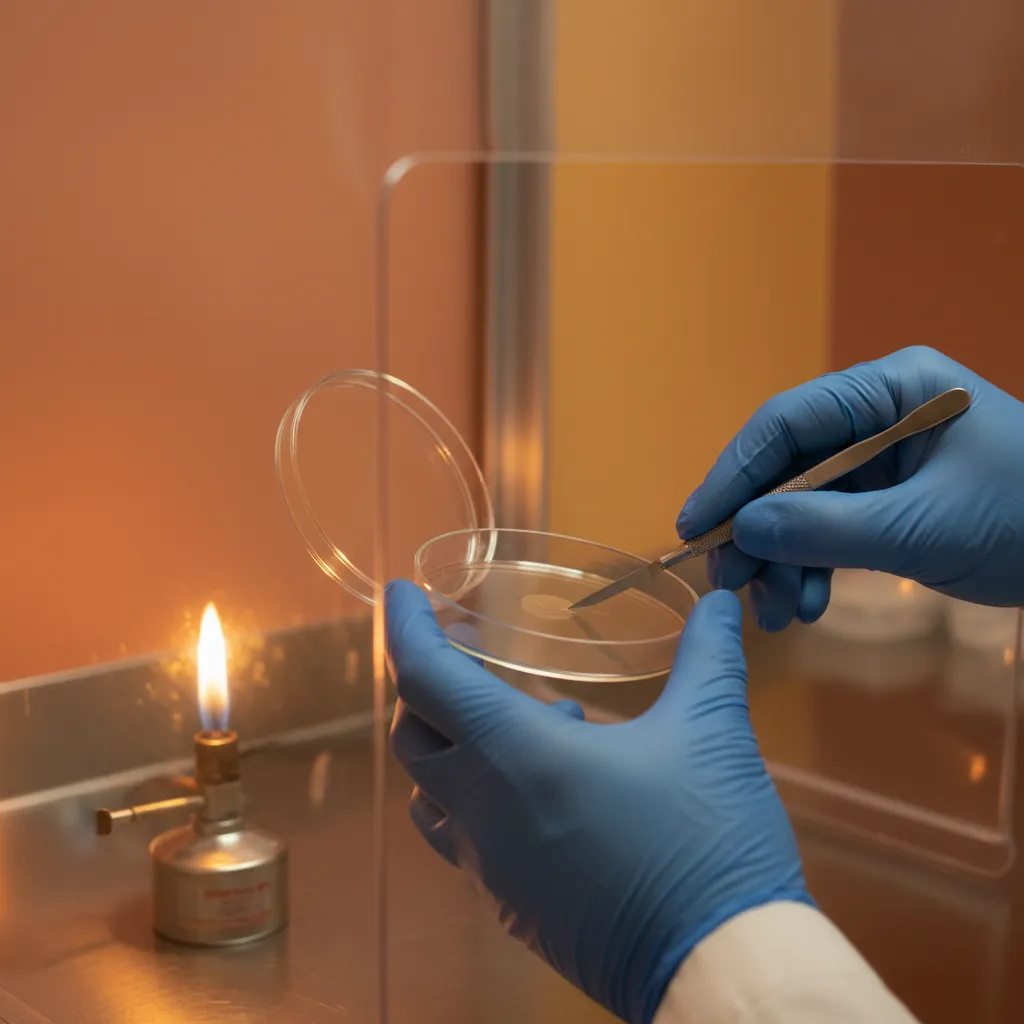
Setting Up Your Workspace
Choose a calm room. Turn off fans, close windows, shut off HVAC vents if possible. Any air current in the room is an air current inside your SAB. A bathroom or small room with the door closed works well.
Clean the room. Give the surfaces a quick wipe. Some growers spray Lysol in the room 15-20 minutes before working to knock airborne particles out of the air. Let it settle — don't work in a cloud of Lysol.
Prepare everything outside the box first. Get all your materials ready: agar plates, scalpel, lighter or alcohol lamp, parafilm, grain jars, syringes — whatever you're going to need. Arrange them on the table in front of you.
Wipe down the SAB interior with 70% iso and let it dry.
Wipe down every item that goes into the SAB. Jars, plates, tools, lighter, your gloved hands — everything gets a wipe or spray with iso.
Place items inside. Put everything into the SAB from the open bottom, then lower the tub over your workspace. Some growers prefer to put items in through the arm holes, but loading from underneath before flipping/lowering is easier.
Working Inside the SAB
This is where discipline matters.
Move slowly. Fast movements create air currents that stir up settled particles. Every reach, every pour, every movement should be deliberate and unhurried. Think of it like working underwater — smooth, controlled motions only.
Keep your arms still when not actively working. Your arms are pistons in the arm holes. Every time you move them, you pump air in and out of the box. Insert your arms, let the air settle for 30 seconds, then begin working.
Flame sterilize your scalpel and needle. Before every cut and every inoculation, heat your scalpel blade or needle in a flame until it glows red. Let it cool for a few seconds (don't blow on it — that defeats the purpose). This is non-negotiable, even inside the SAB.
Work near the bottom of the tub. Contaminants settle downward. The higher up in the SAB you work, the cleaner the air. Since the tub is flipped, the "top" of your workspace (the original bottom of the tub) is the cleanest zone.
Don't cough, sneeze, or breathe directly toward your work. Some growers wear a surgical mask. At minimum, turn your head away from the arm holes if you need to cough.
Open plates and jars for the minimum possible time. Have your inoculant ready, open the lid, do your work, close the lid. Seconds, not minutes.
Specific Tasks in the SAB
Agar work: Pour plates, inoculate with spore syringes, transfer cultures, and clone mushroom tissue inside the SAB. Have your parafilm strips pre-cut and ready. Seal each plate immediately after work.
Liquid culture inoculation: Shake your liquid culture jar, flame your needle, pierce the injection port, draw or inject, remove needle, done. Keep the jar upright the entire time.
Grain jar inoculation: Flame your needle, inject through the port or crack the lid just enough to insert the needle, inject 1-2 cc of liquid culture per jar, reseal immediately.
Common SAB Mistakes
We see these over and over, especially from growers who are getting consistent contamination:
Moving too fast. This is the number one mistake. Speed creates air currents. Slow down.
Not letting the air settle. After you put your arms in, wait. Thirty seconds minimum. The air you displaced needs to settle.
Working in a drafty room. The SAB doesn't seal airtight around your arms. If there's a draft in the room, it's getting into the box. Close windows, shut off fans, close the door.
Skipping flame sterilization. The scalpel touched the side of the tub? Flame it. The needle brushed your glove? Flame it. When in doubt, flame it.
Reaching in and out repeatedly. Every time you pull an arm out and put it back in, you create a piston effect that pushes and pulls air. Get everything you need inside the box before you start, and work through your batch without removing your arms.
Not wiping items down. That grain jar just came out of the pressure cooker and looks sterile, but the outside of the jar was exposed to room air. Wipe it with iso before it goes in the SAB.
Cluttered workspace. Too many items inside the SAB means more things to bump, more air currents, and less room to work. Only put in what you need for the current task.
When a Still Air Box Is the Wrong Tool
A still air box handles most of what a home grower needs, but it is not always the right answer, and mistaking a tooling problem for a technique problem wastes a lot of time. A few jobs work against it.
Grain-to-grain transfer at volume. The clearest case. A grain-to-grain transfer needs two vessels open at once, and the transfer itself is a pour of dry, dusty material. Pouring generates the one thing the box depends on not having: moving air carrying loose particles. One or two done slowly are fine. A dozen is fighting the tool.
Opening many bags or jars in one session. Every in-and-out cycle pistons room air through the arm holes, and the box has to re-settle before the next vessel is safe to open. Under a flow hood the clean air is continuous, so vessel forty is no riskier than vessel one. In a still air box the per-unit risk climbs across a long session, because that discipline is hard to sustain for an hour with your arms in a tub.
Any work where you need to move quickly. Deadline work, a large batch, anything where slow and deliberate hands are not realistic. Still air technique is not optional, so if the schedule will not allow it, the box is the wrong choice for that session.
As a rough rule of thumb rather than a hard number: below roughly a dozen plates or jars per session the box is entirely adequate and a hood is not worth the money. Around 20-30+ vessels per session, or weekly batches that size, the time cost of working at still air pace plus the higher contamination rate starts to exceed what a hood costs. The table below and our flow hood vs still air box breakdown cover the trade-offs.
SAB vs Flow Hood: A Quick Comparison
| Feature | Still Air Box | Laminar Flow Hood |
|---|---|---|
| Cost | $10-15 | $300-800+ |
| Setup time | 20 minutes | Hours (if building) |
| How it works | Gravity settles particles | HEPA filter removes particles |
| Contamination rate | 5-10% (with good technique) | 1-2% |
| Best for | Hobbyists, small-batch work | Scaling up, high-volume |
| Portability | Easy to store anywhere | Bulky, semi-permanent |
| Learning curve | Technique-dependent | More forgiving |
For most home growers, an SAB is all you'll ever need. If you're making dozens of plates or jars per session, or if you're starting to scale toward a commercial operation, a flow hood becomes worth the investment. We have a full breakdown in our flow hood vs SAB comparison.
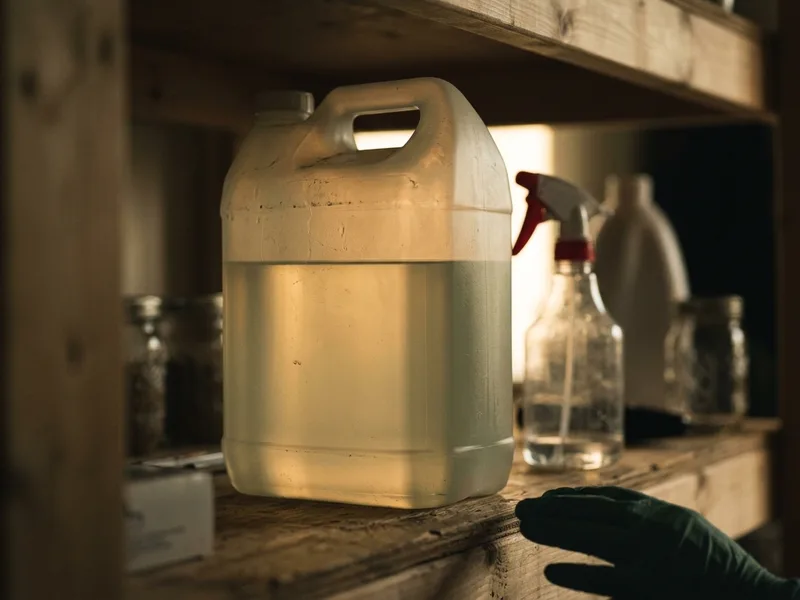
Isopropyl Alcohol 70% — 4 Litre Jug
The 4L jug is the best value for mushroom growers. 70% concentration is more effective at killing contaminants than 99% because the water content helps penetrate cell walls.
When you buy through our links, it supports our mycology research at no extra cost to you.
Tips for Better SAB Results
Use an alcohol lamp instead of a lighter. An alcohol lamp provides a continuous flame and an updraft of warm air above it. That rising air column creates a small sterile zone. Position your work near (but not directly over) the flame for an extra layer of protection. You can make an alcohol lamp from a small glass jar, a cotton wick, and 70% iso or high-proof alcohol.
Dampen the inside walls. A light mist of water on the inside walls of the SAB helps trap airborne particles on the plastic surface rather than letting them float.
Work at night. There are fewer airborne contaminants circulating when the house is quiet — no one walking around, no doors opening, no cooking.
Batch your work. Rather than opening and closing the SAB repeatedly over several days, do all your agar transfers, inoculations, and culture work in a single session.
Keep a clean tub. After each session, wipe the SAB down with iso and store it inverted (holes facing down) to keep dust out.
Your First Projects Inside the SAB
The box is built, the room is calm, and your gloved hands are wiped down. So what should you actually do in there first? These two projects are the classic starting points. Both are forgiving enough for a first session, and both teach the slow, deliberate movements that every later technique depends on.
Agar-to-Agar Transfers
Transferring a wedge of healthy mycelium from one plate to a fresh one is the fundamental skill of culture work, and the SAB is the perfect place to learn it. Set both plates inside the box — the colonized plate and a fresh one — along with your scalpel, flame, and pre-cut parafilm strips. Flame the scalpel blade until it glows, then let it cool for a few seconds (touching a corner of the fresh agar is a quick way to confirm it won't melt a trench). Open the colonized plate just enough to cut a small wedge from the growing edge of the mycelium — the newest, most vigorous growth, not the older centre. Lift the wedge, crack the lid of the fresh plate, and place it mycelium-side down in the middle. Close and seal with parafilm right away.
If you don't want to pressure-cook and pour your own plates yet, pre-poured plates from our agar category skip that step entirely — the LME Agar Plates 6-Pack is a ready-to-use starting point, so your first SAB session is all transfer practice and no prep. Once your plates are coming out clean, the same transfer discipline applies directly to grain-to-grain transfers. And cloning a mushroom is really just this same transfer with a piece of mushroom tissue as the source instead of a wedge of agar.
Liquid Culture Inoculation
The second classic first project is inoculating a liquid culture jar, either from a clean agar wedge or from a culture syringe. If you're working from a syringe: shake it well to distribute the mycelium, flame the needle until it glows, let it cool, then work through the jar's injection port — no need to open the lid at all. Inject 1-2 cc, withdraw the needle, and wipe the port with alcohol. If you're transferring from agar, cut a small wedge exactly as described above, crack the LC jar's lid just wide enough to drop it in, and reseal immediately.
Keep everything low and slow inside the box. The jar stays on the work surface, your movements stay smooth, and lids come off for seconds, not minutes. A purpose-made vessel makes this much easier for a first attempt: the Sterile LC Expansion Jar comes pre-sterilized with an injection port and breathable filter already installed, so there's no canning or lid-modifying required — you supply the culture, it supplies the clean container. Browse our cultures category if you'd rather start from a lab-isolated culture than a spore syringe; isolated cultures colonize faster and behave more predictably, which makes your first LC a lot more satisfying.
What You Can Do With an SAB
Once you have a working SAB, the entire upstream side of mushroom cultivation opens up to you:
- Pour and inoculate agar plates to isolate clean cultures
- Make and inoculate liquid culture
- Clone your best mushrooms onto agar
- Inoculate grain spawn jars and bags
- Do grain-to-grain transfers to multiply your spawn
- Work with spore prints and spore syringes
A $15 tub with two holes in it is genuinely all that stands between you and self-sufficient mushroom cultivation. Build one this weekend, grab some agar plates from our shop, and start learning. The technique takes a few sessions to dial in, but once you've got it, you'll wonder why you ever bought pre-made syringes.
The other tote worth drilling is a shotgun fruiting chamber, which handles fruiting the same way this box handles transfers.
An open flame inside a sealed tote is awkward, which is why disposable loops suit a still air box better than nichrome. See inoculating loops and agar tools.
Still Air Box FAQ
How big should the arm holes be?
Aim for 10-13 cm (4-5 inches) in diameter — big enough to slide your forearms in and out without scraping, small enough to limit air exchange. Space them roughly shoulder-width apart so your arms sit naturally, and position them in the lower half of the side wall so your forearms rest comfortably while your hands reach the work surface. If the holes force you to hold your arms up at an awkward angle, you'll fatigue quickly and start making rushed movements.
Do I need arm-length gloves, or are bare arms okay?
Bare forearms wiped down with 70% isopropyl alcohol are the standard approach, and most growers get clean results this way. The non-negotiable part is nitrile gloves on your hands, re-wiped with alcohol as you work. Arm-length disposable gloves are an optional comfort upgrade — some growers like the extra coverage, others find they reduce dexterity. If your contamination rates are good with bare wiped forearms, there's no reason to change.
How often should I wipe down with alcohol?
Wipe every surface — the SAB interior, every jar and tool going in, and your gloved hands — before each session. While working, re-wipe your gloves between plates or jars, especially after touching anything that isn't part of the current transfer. And any time you pull your arms out of the box and put them back in, wipe your gloves again before resuming. It feels excessive at first; it becomes automatic within a few sessions.
How do I clean and store my SAB between sessions?
Wipe the entire interior with 70% isopropyl alcohol at the end of each session and let it dry fully before putting it away. Store the tub upside down (holes facing down) or with the lid on so dust can't settle on the interior surfaces you worked so hard to keep clean. Never store it damp — trapped moisture in a closed plastic tub is an invitation for exactly the kind of growth you don't want.
When should I upgrade to a laminar flow hood?
Upgrade when volume makes the SAB the bottleneck — if you're pouring dozens of plates or inoculating dozens of jars every week, the slow pace of SAB work starts costing you real time. Don't upgrade because of contamination at hobby scale; that's almost always a technique problem a flow hood won't fix. Our flow hood vs still air box comparison breaks down the costs and the crossover point in detail.
How much does a still air box cost to build?
Under $15 CAD for a working box. The tub is the only real expense at roughly $8-12, and most growers already have the 70% isopropyl alcohol and paper towels. A hole saw attachment is a few dollars if you own a drill; a soldering iron or a heated can does the same job for free.
Budget closer to $40-60 CAD for the full working kit, which adds a box of nitrile gloves and a butane torch for flame-sterilising tools. Both figures are approximate Canadian retail. The useful comparison is the order of magnitude: a flow hood is a $300-800+ purchase.
Do you need to sterilise a still air box?
No, and the distinction matters. You sanitise a still air box, you do not sterilise it. Sterile means no viable organisms at all, which is achievable inside a pressure cooker and is not achievable for a plastic tote sitting in your spare room. It is also not necessary.
What the box needs is a wipe-down with 70% isopropyl alcohol before each session, left to dry before you load it. Wipe the outside of every jar, bag, and tool going in as well, since a jar fresh out of the pressure cooker still has room dust on its exterior.
Sterility is a property of what goes into the box, not of the box itself: the grain, the agar, and the tools you flame between transfers.
How long should a still air box sit before you work in it?
Load everything in, seal the box, and give it about five minutes before you start. That is enough for the air you disturbed while setting up to settle. If you have just wiped the interior down or carried the box across the room, give it ten.
There is a second wait that growers skip more often: after you put your arms through the holes, hold still for another thirty seconds before touching anything. Your forearms displace a surprising amount of air on the way in, directly over your work surface.
Both waits feel like wasted time and neither is. Sitting still costs nothing but patience, and it does more for your success rate than any extra wipe-down.
Can you do grain transfers in a still air box?
Yes, for one or two, with care. Keep both vessels low and close together, open them one at a time rather than both up front, and pour from as little height as you can manage. Height is what turns a pour into a dust cloud, so tip the source vessel against the rim of the receiving one. Flame the rim or spoon between vessels and reseal each container immediately.
The catch is that this is the one common task where the tool works against you. A pour of dry grain generates airborne particles by design, inside a box whose only defence is their absence. Careful technique manages that for a couple of jars. It does not scale.
For volume work, see when a still air box is the wrong tool above. Our grain-to-grain transfer guide covers the technique in full either way.
Still air box or flow hood for a beginner?
Start with the still air box, even if you can comfortably afford the hood. Under $15 CAD and twenty minutes makes the decision nearly free to reverse, and it will carry you through agar work, liquid culture, and jar inoculation without complaint.
The stronger argument is what the box teaches you. Still air forces slow hands, staged tools, and real flame discipline, because it punishes you immediately when you skip any of them. Those habits transfer directly to a flow hood and make you faster and cleaner under it. The reverse is not true: a hood is forgiving enough that sloppy movement goes unpunished, so a grower who starts there never builds the technique.
Note that this is a different question from when to upgrade, answered just above. That one is about when volume makes the box a bottleneck. This one is about where to begin, and the answer is the cheap tub that teaches you the most. Our flow hood vs still air box comparison has the numbers side by side.
Have a mushroom-growing question? Ask Dr. MycoTek for AI help with your grow. Sign in to use your free monthly allowance.