
Every mushroom grower eventually faces this question: should I stick with my still air box, or is it time to invest in a laminar flow hood? The answer depends on how much sterile work you're doing, what contamination rate you can tolerate, and what your budget looks like.
Both tools solve the same problem — keeping airborne contaminants away from your work during sterile procedures like agar transfers, liquid culture inoculation, and grain spawn preparation. But they solve it in fundamentally different ways, and understanding those differences will help you make the right choice for your situation.
How a Still Air Box Works
A still air box (SAB) is a clear plastic tub with two arm holes cut in one side. You work inside the enclosed space, relying on the principle that in still air, contaminant particles settle downward due to gravity rather than floating freely.
The key word is "still." When air moves — from a draft, a fan, your arm moving too fast — particles get stirred up and can land on your agar plates, grain jars, or whatever you're working with. In perfectly still air, those same particles are constantly settling out of the air column onto the surfaces of the tub.
An SAB doesn't filter, purify, or sterilize air. It simply stops air from moving, letting gravity do the cleanup work.
SAB Strengths
- Cost: $10-15 CAD. A clear tub and a drill bit. That's it.
- Build time: 20 minutes. No technical knowledge required.
- No maintenance. Wipe it with iso before each use. Done.
- Portable and storable. Slide it under a bed when you're not using it.
- No electricity. Works anywhere, any time.
SAB Limitations
- Technique-dependent. The SAB only works as well as the person using it. Move too fast, and you create air currents that defeat the purpose. Success requires disciplined, slow, deliberate movements.
- Arm hole problem. Your arms act as pistons. Every time you insert or move them, you push and pull air in and out of the box. This is the fundamental weakness of the SAB design.
- Not suitable for high volume. Working in an SAB is slower because of the technique requirements. If you need to process 50 agar plates or inoculate 30 grain bags, it becomes a bottleneck.
- Contamination rate: ~5-10%. With good technique, expect 90-95% success rates. With great technique in ideal conditions, you can approach 98%. But the SAB's physics impose a floor that a flow hood doesn't have.
How a Laminar Flow Hood Works
A laminar flow hood pushes room air through a HEPA (High-Efficiency Particulate Air) filter, which removes 99.97% of particles 0.3 microns and larger. The filtered air flows in a smooth, uniform sheet (laminar flow) across your work surface, creating a clean zone where you work.
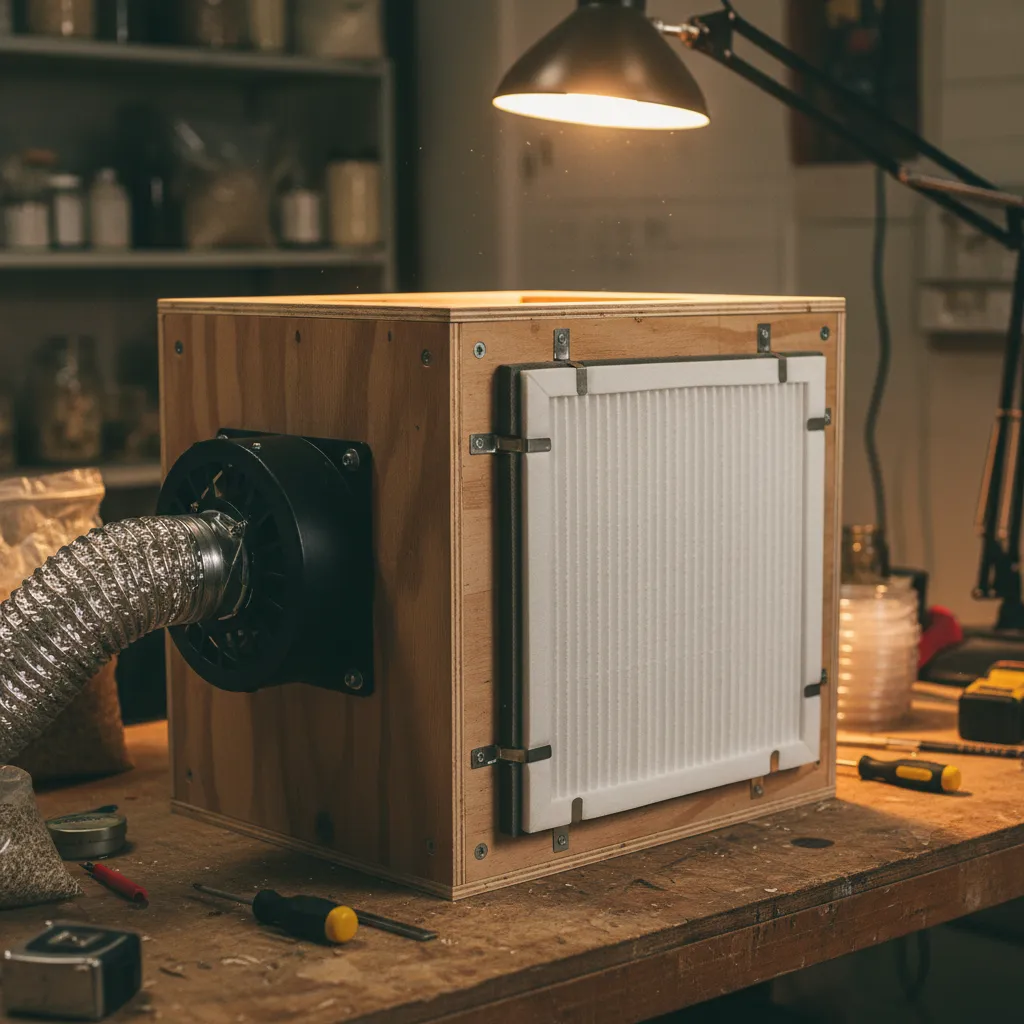
Anything downstream of the filter is bathed in clean air. Contaminant particles can't reach your work because they're being pushed away by the constant stream of filtered air.
How It's Built
A typical flow hood consists of:
- A HEPA filter — the heart of the system. Usually a 60 x 60 cm (24 x 24 inch) or 60 x 120 cm (24 x 48 inch) HEPA panel. You can buy complete fan filter units that include both the HEPA and blower in one assembly.
- A blower/fan — pushes air through the HEPA filter at the correct velocity. The blower must be matched to the filter's resistance — too weak and you won't get proper laminar flow.
- A housing/box — a plywood or metal enclosure that channels air from the blower through the filter and across the work surface.
- A pre-filter — a washable filter on the air intake that catches large particles and extends the HEPA filter's lifespan.
The air velocity across the work surface should be approximately 0.5 m/s (100 feet per minute). This is fast enough to push particles away but gentle enough not to blow agar plates around.
Flow Hood Strengths
- Contamination rate: ~1-2%. When properly functioning, a flow hood makes contamination almost irrelevant. The clean air zone is genuinely sterile.
- Technique-forgiving. You can work at normal speed. You can reach across your workspace without creating problematic air currents. The clean air stream compensates for imperfect technique.
- High volume. You can process dozens of plates, jars, or bags in a single session without fatigue from maintaining SAB discipline.
- Consistent results. The hood's performance doesn't depend on your technique having a good day. The physics are reliable every time.
Flow Hood Limitations
- Cost: $300-800+ CAD for DIY. The HEPA filter alone costs $100-250 depending on size. A matched blower adds $80-150. Housing materials, pre-filter, and miscellaneous costs bring the total to $300-500 for a functional DIY build. Pre-built units run $600-2000+.
- Space. A flow hood is semi-permanent. A typical unit is 60-120 cm wide, 60 cm deep, and 60 cm tall. It needs a permanent home on a table or bench.
- Noise. The blower runs the entire time you're working. Sound levels vary but most DIY hoods are noticeable — comparable to a bathroom exhaust fan or louder.
- Filter replacement. HEPA filters have a finite lifespan (typically 3-5 years with a pre-filter). Replacement filters cost $100-250.
- Proper setup required. A poorly built flow hood (wrong blower, filter leaks, incorrect air velocity) is worse than useless — it gives a false sense of security while not actually providing clean air. The blower must be properly matched to the filter.
The Real-World Comparison
| Factor | Still Air Box | Laminar Flow Hood |
|---|---|---|
| Cost | $10-15 | $300-800+ (DIY) |
| Contamination rate | 5-10% (technique dependent) | 1-2% |
| Setup time | 20 minutes | Hours to days |
| Batch capacity | 6-12 items comfortably | 20-50+ items per session |
| Technique required | High discipline | Standard care |
| Portability | Excellent | Poor |
| Noise | None | Moderate to loud |
| Electricity | None | Required |
| Maintenance | Wipe with iso | Pre-filter changes, HEPA replacement |
When the SAB Is the Right Choice
You're a hobbyist. If you're making 6-12 grain jars at a time, doing a handful of agar transfers per month, and growing mushrooms for personal consumption, an SAB handles everything you need. The 5-10% contamination rate on that scale means losing maybe one jar per batch — annoying but not costly.
You're just starting out. Before investing $500+ in a flow hood, you need to know if mushroom cultivation is something you'll stick with. An SAB lets you learn every sterile technique — agar work, liquid culture, grain inoculation, cloning — for under $15.
You have limited space. A tub that slides under a bed beats a permanent bench fixture in a small apartment.
You're on a tight budget. Fifteen dollars versus several hundred. If money is the constraint, the SAB is the answer and it works just fine.
When to Upgrade to a Flow Hood
Your contamination rate is costing you. Do the math. If you're losing 3 out of 30 jars per batch (10%), that's 3 jars worth of grain, time, and culture. Multiply that across batches per month, factor in the cost of your time, and the flow hood starts paying for itself.
You're scaling up. If you're moving toward starting a small mushroom farm, a flow hood becomes essential. Commercial operations can't absorb even a 5% contamination rate at volume. The speed and reliability of a flow hood also means less time doing sterile work and more time on everything else.
You're doing high-value culture work. If you're isolating strains on agar, maintaining a genetic library of clones, or producing liquid culture for sale, the cultures are too valuable to risk with a 5-10% contamination rate. A single lost plate of a rare strain is worth more than the contamination rate difference.
You're frustrated with SAB technique. Some people find the discipline of SAB work genuinely stressful — the slow movements, the careful arm insertion, the constant awareness. If SAB technique is a source of anxiety rather than a meditative practice, a flow hood removes that stress entirely.
Building a DIY Flow Hood: Overview
If you decide to build your own, here are the key components and decisions.
HEPA Filter
Buy a certified HEPA filter panel from a HVAC or cleanroom supplier. Common sizes are 60 x 60 cm (24 x 24 inches) for a compact hood and 60 x 120 cm (24 x 48 inches) for a larger work area. Make sure it's a true HEPA (99.97% efficiency at 0.3 microns), not a "HEPA-type" or "HEPA-style" filter.
Blower
The blower must push enough air through the filter to maintain approximately 0.5 m/s (100 FPM) across the filter face. This requires matching the blower's output (in CFM) to the filter's size and resistance (measured in inches of static pressure). The filter manufacturer will specify the resistance at a given airflow.
A common choice is a squirrel cage blower rated for 300-600 CFM depending on filter size. Oversizing the blower slightly and using a speed controller to tune it is better than undersizing.
Housing
Build a plywood box that channels air from the blower through the filter. The air must pass through the filter uniformly — no gaps or bypasses. Seal every joint and seam. Any leak around the filter frame means unfiltered air reaching your workspace.
Many growers also add a pre-filter on the blower intake. A cheap furnace filter works — it catches large particles and dramatically extends the HEPA filter's lifespan.
Testing
A smoke test (incense stick or smoke pencil) held near the filter face will show you the airflow pattern. You should see smooth, uniform flow moving straight out from the filter with no eddies, dead spots, or turbulence. Test the edges and corners — these are where leaks are most likely.
Cost Breakdown (Approximate CAD)
| Component | Cost |
|---|---|
| HEPA filter (24x24) | $120-200 |
| Blower | $80-150 |
| Plywood and hardware | $40-80 |
| Pre-filter | $10-20 |
| Speed controller | $15-30 |
| Sealant, screws, misc | $20-30 |
| Total | $285-510 |
A pre-built flow hood from a specialty supplier will run $600-2000 CAD depending on size and quality.

HEPA H14 Fan Filter Unit (FFU) — Complete Laminar Flow Hood
If you want to skip the DIY build, this complete fan filter unit includes the HEPA filter, blower, and housing in one plug-and-play assembly. Designed for mushroom cultivation and lab use.
When you buy through our links, it supports our mycology research at no extra cost to you.
The Tier System: Our Recommendation
We suggest thinking about it in tiers based on where you are in your mushroom growing journey:
Tier 1: Getting Started ($15)
Build a still air box. Learn sterile technique. Make your first agar plates, your first liquid cultures, your first grain spawn. Get comfortable with the process and find out if this hobby sticks.
Tier 2: Committed Hobbyist ($15 + good technique)
You're making spawn regularly, cloning your best mushrooms, running monotubs or a Martha tent. Your SAB technique is solid and contamination is manageable. You don't need a flow hood yet — but you're starting to think about it.
Tier 3: Scaling Up ($300-500 DIY)
You're producing more than your household can eat. Maybe you're selling at a farmers' market or supplying a restaurant. You're making 20+ grain jars per batch, maintaining multiple strains on agar, and running culture work weekly. A flow hood pays for itself within a few months at this scale.
Tier 4: Commercial Production ($500-2000+)
You need a flow hood. Period. Commercial mushroom farming at any scale requires the contamination rates and workflow efficiency that only a flow hood provides. Consider a larger commercial unit or multiple hoods for different workflow stages.
Which clean workspace you choose also decides your tools: nichrome and a flame under a hood, disposables in a box. See inoculating loops and agar tools.
One Last Thing
Whichever tool you use, it's only as good as the rest of your process. A flow hood won't save you from poorly sterilized grain. An SAB won't help if your liquid culture is contaminated from the start. Clean air is one link in the chain — sterilization, proper substrate preparation, quality cultures, and good general hygiene all matter equally.
Start with an SAB, learn the fundamentals, and upgrade when the math makes sense. That's the most practical path for the vast majority of Canadian growers.
Have a mushroom-growing question? Ask Dr. MycoTek for AI help with your grow. Sign in to use your free monthly allowance.