
Quick answer: Grain spawn lasts 2-3 weeks at room temperature and 2-3 months refrigerated. Fresh spawn always performs better — use it as soon as you can.
Grain Spawn Shelf Life
Grain spawn is living mycelium growing on sterilized grain (typically rye, wheat, or millet). Like any living organism, it doesn't last forever.
| Storage Condition | Expected Viability |
|---|---|
| Room temperature (20-24°C) | 2-3 weeks |
| Refrigerated (2-4°C) | 2-3 months |
| Frozen | Not recommended — kills mycelium |
At room temperature, the mycelium continues growing and consuming the grain. Eventually it exhausts the nutrients, and the grain begins to break down. The spawn becomes overgrown, clumpy, and less vigorous.
Refrigeration slows the mycelium's metabolism dramatically, preserving it in a semi-dormant state. This is the best way to extend shelf life if you can't use your spawn immediately.
How to Store Spawn Properly
If using within 1-2 weeks: Room temperature is fine. Keep the bag out of direct sunlight and away from heat sources. The filter patch on the bag allows gas exchange — don't seal it in an airtight container.
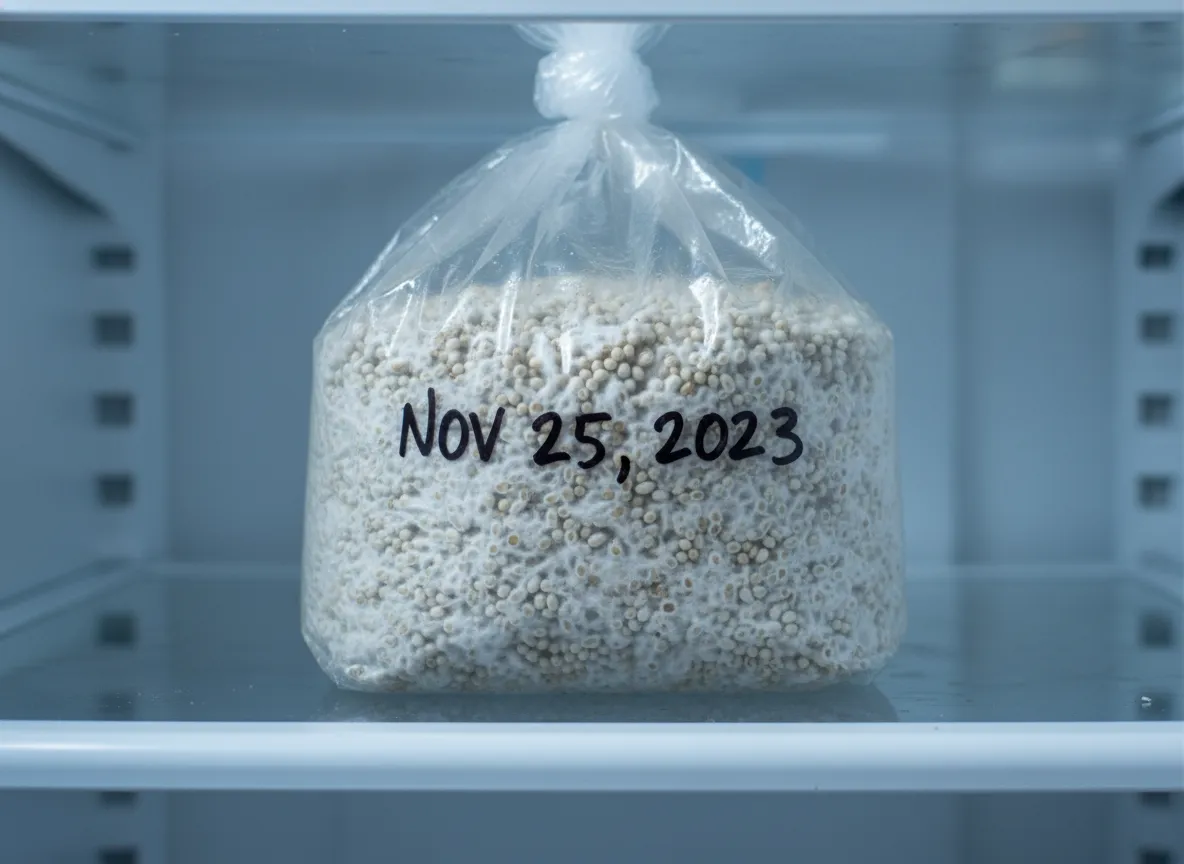
If storing longer: Place the bag in your refrigerator at 2-4°C. A fridge thermometer helps you verify the temperature stays in the right range. The crisper drawer works well. Don't freeze it — ice crystals rupture cell walls and kill the mycelium.
Other tips:
- Keep the bag sealed until you're ready to use it. Every time you open the bag, you introduce potential contaminants.
- Label bags with date labels or a marker so you always know when spawn was produced.
- Store upright so moisture doesn't pool at the bottom.
- Don't stack heavy items on top — crushed grain is more susceptible to bacterial contamination.
- Break up the bag gently every week or so if storing long-term, to prevent the spawn from forming a solid brick.
- Use a digital kitchen scale to weigh spawn before and after storage -- weight loss indicates moisture loss and declining viability.
How to Tell If Spawn Is Still Good
Healthy spawn is easy to identify:
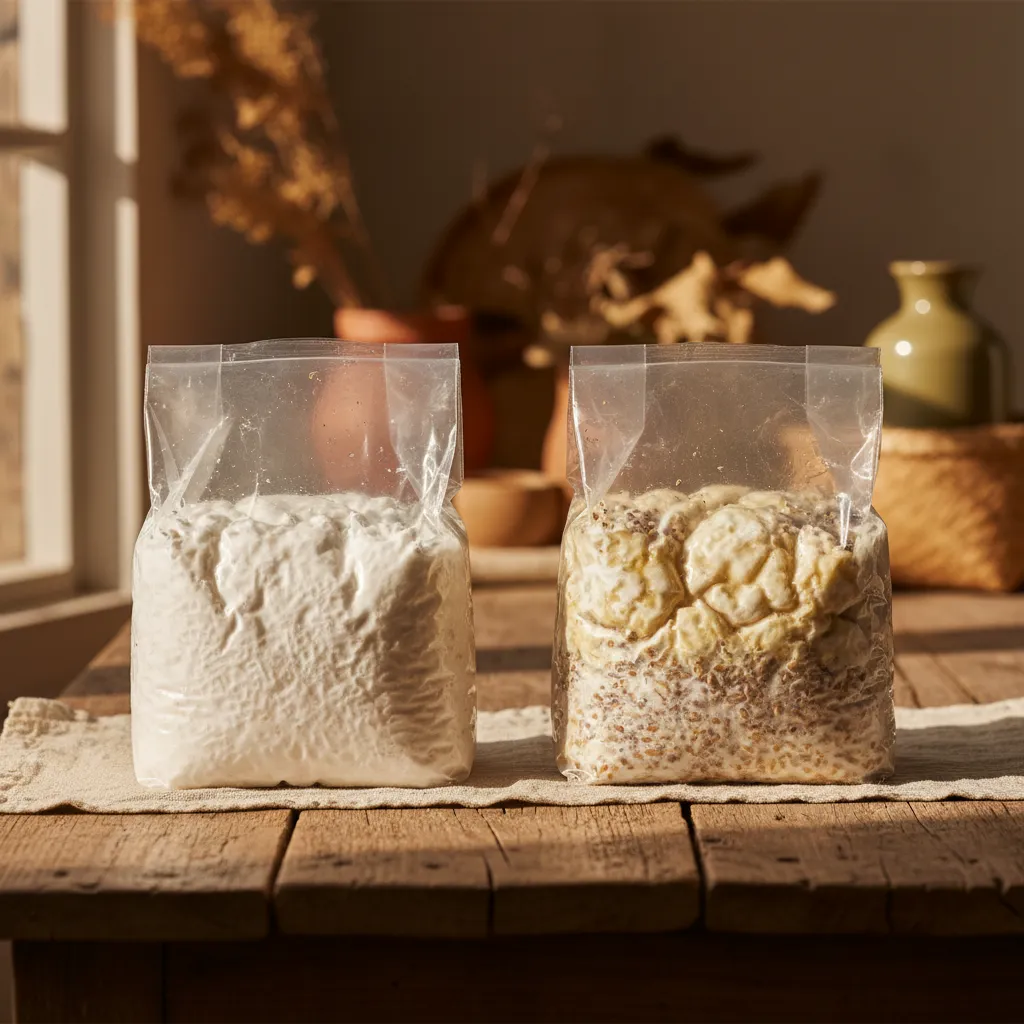
- White, uniform mycelium covering the grain kernels
- Fresh, mushroomy smell — clean and earthy
- Grain separates easily when you break up the bag
Signs your spawn may be past its prime:
- Yellowing or browning of the mycelium — some metabolite production is normal, but heavy discolouration indicates age
- Sour or fermented smell — indicates bacterial contamination
- Green, black, or orange patches — contamination, do not use
- Grain is mushy or wet — bacterial breakdown has begun
- Won't break apart — severely overgrown and compacted
If your spawn shows contamination (off-colours, bad smell), do not use it. Inoculating substrate with contaminated spawn guarantees failure.
If it's simply old but still white and clean-smelling, it will likely still work — just expect slower colonization. Old spawn gives contaminants more time to establish, so use higher spawn rates (20%+) to compensate.
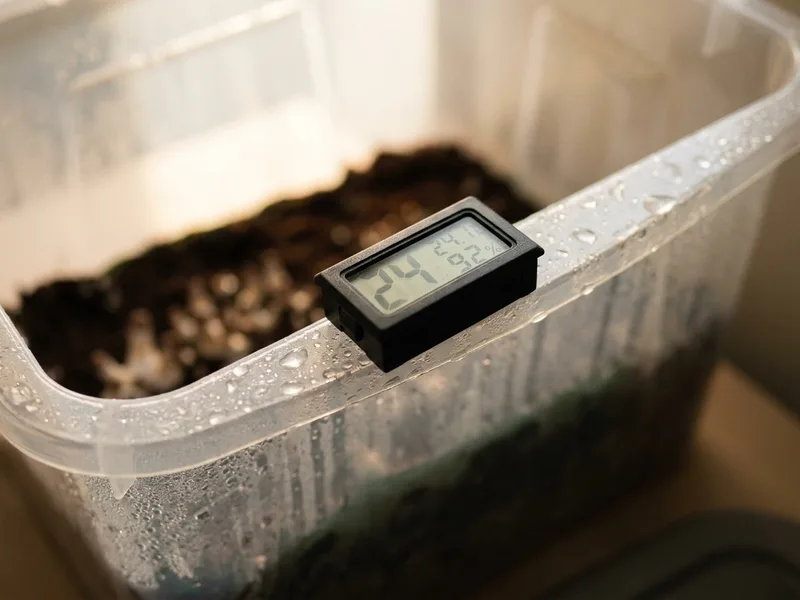
TempPro TP50 Digital Hygrometer & Thermometer
Place one in your fridge to verify spawn storage temperatures stay in the 2-4°C sweet spot. The max/min records alert you if temperatures spike during power outages.
When you buy through our links, it supports our mycology research at no extra cost to you.
Signs Your Spawn Has Gone Bad
Knowing when to toss a bag of spawn can save you weeks of wasted effort. Here's a visual breakdown of what contamination looks like in grain spawn:
Green or Blue-Green Patches (Trichoderma)
The most common contaminant. Trichoderma starts as white mycelium (easily confused with healthy growth) before revealing its true colours — bright green or blue-green sporulation. Once you see green, the bag is done. Do not open it indoors. For a deeper dive into identifying contaminants, read our mushroom contamination field guide.
Black Spots (Aspergillus or Black Mould)
Dark black or charcoal-coloured patches indicate Aspergillus or similar black moulds. These produce harmful spores — dispose of the bag sealed and do not inhale near it.
Orange or Pink Discolouration (Neurospora)
Neurospora (bread mould) appears as bright orange or pinkish-orange fuzz. It spreads explosively and can contaminate your entire workspace if the bag is opened. Discard immediately.
Sour or Alcoholic Smell (Bacterial Contamination)
Even without visible colour changes, a sour, fermented, or yeasty smell when you open the filter patch indicates wet-spot bacteria have taken hold. The grain often looks slimy or overly wet in affected areas.
Wet, Dark Grain (Wet Spot)
Individual kernels that appear dark, translucent, and waterlogged — even while surrounding grain looks normal — signal Bacillus bacterial contamination. This is common when spawn is stored too warm or when the original grain prep had excess moisture.
Rule of thumb: When in doubt, throw it out. A $15-30 bag of spawn is not worth risking your entire grow. Order fresh grain spawn rather than gambling on questionable material.
How Different Species Affect Shelf Life
Not all mushroom mycelium behaves the same in storage. Growth rate and metabolic activity directly impact how long spawn remains viable.
Oyster Mushrooms (Pleurotus spp.)
Oyster spawn is the most aggressive coloniser, which is a double-edged sword. It colonises grain quickly (great for production speed) but also exhausts the grain faster in storage. Expect:
- Room temperature: 1-2 weeks before it becomes overgrown and clumpy
- Refrigerated: 6-8 weeks reliably
Oyster spawn forms dense, ropey mycelium that mats together quickly. Break it up weekly if refrigerating. Learn more in our oyster mushroom growing guide.
Shiitake (Lentinula edodes)
Shiitake mycelium grows more slowly and steadily, meaning it stores slightly longer:
- Room temperature: 2-3 weeks
- Refrigerated: 2-3 months
Shiitake spawn sometimes produces brown metabolite liquid (a yellowish-brown exudate) in storage. This is normal and not contamination — it's a stress response. The spawn is usually still viable.
Lion's Mane (Hericium erinaceus)
Lion's mane has fine, wispy mycelium that's more delicate than oyster or shiitake:
- Room temperature: 2-3 weeks
- Refrigerated: 2-3 months
Lion's mane spawn is more sensitive to temperature fluctuations. Keep it in the back of your fridge where temperatures stay most consistent, not in the door. See our lion's mane growing guide for complete cultivation details.
Reishi (Ganoderma lucidum)
Reishi is slow-growing but resilient:
- Room temperature: 3-4 weeks
- Refrigerated: 3-4 months
Reishi's lacquered, thick mycelium tolerates storage well. It's one of the hardiest species for long-term spawn storage.
Fridge vs Room Temperature Storage
Understanding the difference between these two approaches helps you plan your grows better.
Room Temperature (18-24°C)
Pros:
- Mycelium stays active and ready to colonise immediately upon inoculation
- No cold-shock recovery period needed
- Convenient — no fridge space required
Cons:
- Spawn exhausts nutrients within 2-3 weeks
- Higher contamination risk as bacteria also thrive at room temperature
- Mycelium mats together into a solid brick faster
- Metabolic byproducts accumulate, reducing vigour
Best for: Growers who plan to use spawn within 1-2 weeks of receiving it.
Refrigerated (2-4°C)
Pros:
- Extends viability to 2-3 months (species-dependent)
- Dramatically slows bacterial competitors
- Preserves mycelial vigour for faster colonisation when used
- Reduces metabolite buildup
Cons:
- Mycelium needs 12-24 hours at room temperature to "wake up" before inoculation
- Temperature fluctuations (opening/closing fridge frequently) can stress mycelium
- Condensation can form inside bags, creating wet spots
- Takes up fridge space
Best for: Anyone not using spawn within a week, bulk growers storing multiple bags, or those building up supplies before a large production run.
Pro tip: When you take spawn out of the fridge, let it warm to room temperature for 12-24 hours before inoculating. This gives the mycelium time to resume metabolic activity. Cold spawn inoculated directly into warm substrate can experience thermal shock, slowing colonisation by days.
Can You Freeze Mushroom Spawn?
The short answer: no, not standard grain spawn. Freezing destroys mushroom mycelium because ice crystals form inside the hyphal cells, rupturing cell walls and killing the organism.
Why Freezing Doesn't Work
Mushroom mycelium cells contain high water content. When water freezes, it expands. The expanding ice crystals physically puncture the delicate cell membranes. When thawed, the cells cannot repair themselves — you're left with dead, mushy grain that will simply rot.
Exceptions and Alternatives
- Agar slants with cryoprotectant: Professional labs store cultures long-term using glycerol solutions (10-15%) at -20°C or -80°C. The glycerol prevents ice crystal formation. This is not practical for grain spawn.
- Freeze-dried cultures: Some culture banks use lyophilisation (freeze-drying) for decades-long storage. Again, not applicable to grain spawn bags.
- Liquid culture with glycerol: Some advanced growers add sterile glycerol to liquid culture syringes before freezing. Success rates are mixed and this is considered an advanced technique.
For home growers, refrigeration at 2-4°C remains the gold standard for extending mushroom spawn shelf life. If you need cultures stored longer than 3 months, maintain them on agar plates and transfer to fresh plates every 2-3 months.
How to Extend Spawn Shelf Life
Beyond basic refrigeration, here are proven techniques to get the most life out of your spawn:
1. Order What You Need, When You Need It
The single best strategy is timing. Calculate your spawn ratio for the batch you're planning, order accordingly, and have your substrate ready before spawn arrives. Fresh spawn always outperforms stored spawn.
2. Maintain Consistent Refrigerator Temperature
Temperature swings are more damaging than a steady slightly-warmer temperature. Use a thermometer with min/max recording to track fluctuations. Avoid storing spawn in the fridge door where temperatures fluctuate most.
3. Store Bags Upright
Gravity pulls moisture downward. Storing bags flat causes water to pool, creating anaerobic conditions at the bottom of the bag where bacteria thrive. Standing bags upright distributes moisture more evenly.
4. Break Up the Bag Periodically
Every 7-10 days, gently break up refrigerated spawn through the bag (without opening it). This prevents the mycelium from forming an impenetrable brick and redistributes moisture. Handle gently — rough shaking can damage mycelium.
5. Keep Spawn in the Dark
Light triggers fruiting responses in many species. Keeping spawn bags in a dark section of your fridge or wrapped in a paper bag prevents premature pinning, which wastes the spawn's energy reserves.
6. Don't Open the Bag Until Ready
Every time you open a spawn bag, you introduce airborne contaminants. If you need to split a bag across multiple projects, do all your inoculation at once rather than opening and resealing repeatedly. Work in front of a laminar flow hood or inside a still air box for best results.
Liquid Culture Shelf Life
Liquid culture (LC) — mycelium growing in a sterile sugar-water solution — lasts longer than grain spawn:
| Storage Condition | Expected Viability |
|---|---|
| Room temperature | 1-2 months |
| Refrigerated | 4-6 months (sometimes longer) |
Liquid culture is a more shelf-stable format because the mycelium is suspended in a nutrient solution rather than consuming a finite grain supply. It's also easier to verify cleanliness — a contaminated liquid culture usually turns cloudy or develops visible bacterial colonies.
Read our grain spawn vs liquid culture comparison for help deciding which format is right for you.
Use It or Lose It
The most important advice: fresh spawn colonizes faster. Fast colonization is your best defence against contamination. A bag of spawn used within a week of production will outperform one that's been sitting in the fridge for two months, even if the older spawn is still technically viable.
When you order spawn from Nature Lion, we produce it fresh and ship it promptly from our facility in Brantford, Ontario. Plan your grows so you're ready to inoculate when your spawn arrives — have your substrate prepared, your bags ready, and your workspace clean.
The best spawn is the spawn you use right away.
Frequently Asked Questions
How long does mushroom spawn last in the fridge?
Grain spawn stored at 2-4°C typically lasts 2-3 months, depending on the species. Aggressive colonisers like oyster mushrooms may decline after 6-8 weeks, while slower species like reishi can remain viable for 3-4 months. Always check for off-smells and discolouration before use.
Can I use old spawn that's been in the fridge for months?
If the spawn is still white, smells earthy (not sour), and breaks apart when you squeeze the bag, it's likely still viable — just less vigorous. Compensate by using a higher spawn rate (15-20% instead of 10%) and ensure your substrate is properly prepared. Colonisation will be slower, so monitor closely for contamination.
How should I ship or transport spawn in hot weather?
During summer months, spawn degrades quickly in transit. If shipping or transporting spawn when temperatures exceed 25°C, use an insulated container with a cold pack (not directly touching the spawn bag — wrap the cold pack in newspaper). Avoid leaving spawn in a hot vehicle. When you order from Nature Lion, we ship with appropriate insulation during warm weather.
Does spawn expire? Is there an expiration date?
There's no hard expiration date stamped on spawn bags because viability depends on storage conditions. A bag kept at a steady 3°C will outlast one stored at fluctuating room temperatures. As a general rule, use grain spawn within 2-3 months of production for best results. Beyond that, viability declines — it doesn't stop abruptly.
What's the difference between spawn viability and spawn vigour?
Viability means the mycelium is alive and capable of growing. Vigour refers to how aggressively it colonises. Old spawn may still be viable (it grows) but lack vigour (it grows slowly). Low-vigour spawn gives contaminants a head start, which is why fresh spawn from a reliable supplier always produces better results than aged material.
Can you freeze mycelium?
No — freezing kills living mycelium in grain spawn, liquid culture, and colonized substrate. Ice crystals rupture the hyphal cell walls, and what thaws out is dead, mushy material that will rot rather than grow. The only exceptions are lab techniques that use a cryoprotectant like glycerol, which aren't practical at home. If you need long-term storage, keep cultures on agar plates in the fridge and transfer to fresh plates every 2-3 months instead.
Do mushroom spores need to be refrigerated?
Spores are far tougher than mycelium. Spore prints stored in a cool, dark, dry place stay viable for years without refrigeration, though the fridge (in a sealed bag with a desiccant) extends that further. Spore syringes are best refrigerated at 2-8°C and used within 8-12 months. Note the difference: spores tolerate cold and time well, but living mycelium — spawn and liquid culture — needs refrigeration and has a much shorter clock.
Can you store sterilized grain before inoculating it?
Yes, briefly. Sealed, sterilized grain bags or jars can sit at room temperature for 1-2 weeks before inoculation as long as the seal is intact — the risk isn't the grain expiring, it's contamination slipping in through any breach and having free rein with no mycelium to compete against. Store them somewhere clean and dust-free, inspect for any wet spots or off smells before inoculating, and inoculate sooner rather than later.
Have a mushroom-growing question? Ask Dr. MycoTek for AI help with your grow. Sign in to use your free monthly allowance.