
Almost everyone's first batch of mushroom jerky comes out as crisps. Good flavour, completely wrong texture — it shatters instead of pulling. The recipe is rarely the problem. The problem is that mushrooms are around 90 per cent water, and the window between "chewy" and "cracker" is about forty minutes wide.
Jerky is defined by where you stop, not by what you marinate. Get the thickness right, get the end point right, and almost any savoury marinade will work. Get them wrong and the best marinade in the world gives you seasoned crisps.
Which Mushrooms Actually Make Jerky
Texture comes from the mushroom, not the marinade. You want dense flesh with the grain running in one direction, because that is what produces a strip that pulls apart in fibres rather than snapping.
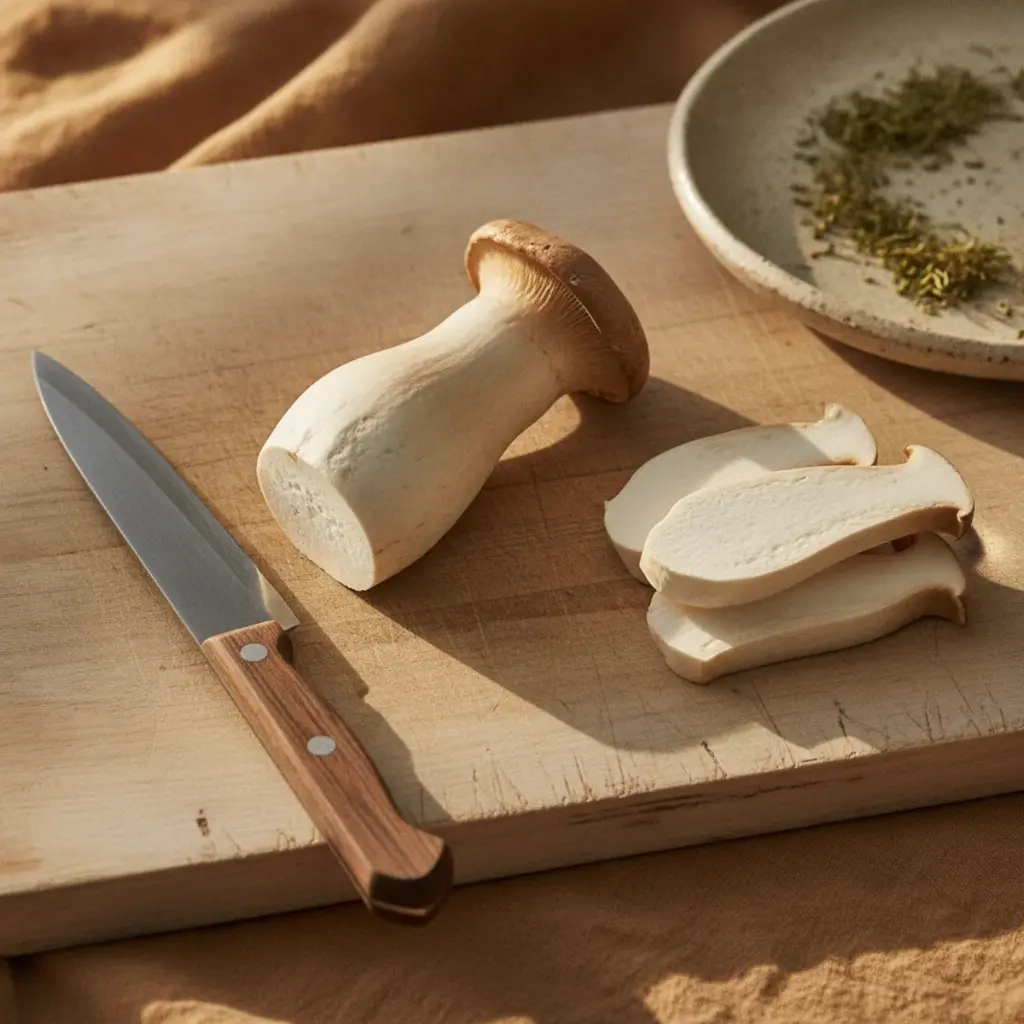
- King oyster is the best by a wide margin. The thick stem is uniform, dense and almost completely free of gills, and it slices into even planks that shred along the grain like meat. If you only try one, try this.
- Portobello and large cremini work well sliced thick. More earthy, slightly softer finish.
- Shiitake gives the strongest flavour of any of them and a firm, slightly leathery chew. Use the caps; the stems are too fibrous.
- Lion's mane tears into genuinely meat-like strands and takes marinade beautifully, though it shrinks more than the others. Our lion's mane steak recipe uses the same pressing trick that helps here.
- Oyster mushrooms make a thinner, more bacon-like strip. Excellent, but closer to a crisp than a jerky — lean into that rather than fighting it. There are more ideas for them in our oyster mushroom recipes.
Skip anything delicate. Enoki, shimeji and most small foraged species disappear to nothing.
Why Most Mushroom Jerky Comes Out Crisp
Fresh mushrooms lose roughly 90 per cent of their weight when fully dried. A kilogram of king oyster becomes about 100 grams of fully dry product — that is the ratio our wet-to-dry weight calculator exists to work out, and it is the number that explains the texture problem.
Jerky is not fully dried. You are aiming for roughly 75 to 80 per cent weight loss, not 90. A kilogram of fresh strips should come off the trays at 200 to 250 grams, still pliable, with no visible surface moisture. Push on to 100 grams and you have made crisps.
This is why a kitchen scale matters more than a timer. Weigh the loaded trays before you start, write the number down, and weigh again as you get close. Time is a guess that changes with humidity, thickness and how full the machine is; weight is the actual measurement.
Recommended Gear

KitchenTour Mini Gram Scale for Coffee, Jewelry and Small Items, 500g x 0.01g Digital Pocket Scale with Tare, 6 Units, Back-Lit LCD, 2 Trays, Black
Getting your pellet-to-water ratio right is the key to perfect substrate moisture. A kitchen scale takes the guesswork out of hydration every time.
As an Amazon Associate we earn from qualifying purchases. It costs you nothing and does not change what we recommend.
How to Make Mushroom Jerky
Slice Thick and Even
Cut planks 6 to 8 mm thick, along the length of the stem. Thinner than 5 mm and you cannot avoid crisps; thicker than 10 mm and the middle stays damp while the edges overdry. Even thickness matters more than exact thickness, which is the one argument for a mandoline over a knife.
Salt and Press First
Toss the strips in a teaspoon of fine salt per 500 g and leave them 20 minutes, then press gently between tea towels. This pulls out the loose surface water that would otherwise dilute your marinade, and it starts the texture change that makes the strips chewy rather than brittle.
Marinate for Flavour, Not Moisture
Keep the marinade concentrated and low volume — you want it clinging to the strips, not a bath for them. A base that works for 500 g of mushrooms:
- 60 ml soy sauce or tamari
- 2 tbsp maple syrup
- 1 tbsp rice vinegar or cider vinegar
- 2 tsp smoked paprika
- 1 tsp garlic powder
- 1/2 tsp black pepper
- Optional: 1/2 tsp liquid smoke, a pinch of chilli flakes
Toss, then leave 30 minutes to two hours. Longer does not help much; mushrooms take on surface flavour quickly and do not absorb marinade the way meat does. A teaspoon of mushroom powder in the marinade deepens the savoury base without adding liquid, which is exactly what you want here.
Drain properly before loading. Dripping strips take hours longer and come out patchy.
Dry at 57 to 60 C
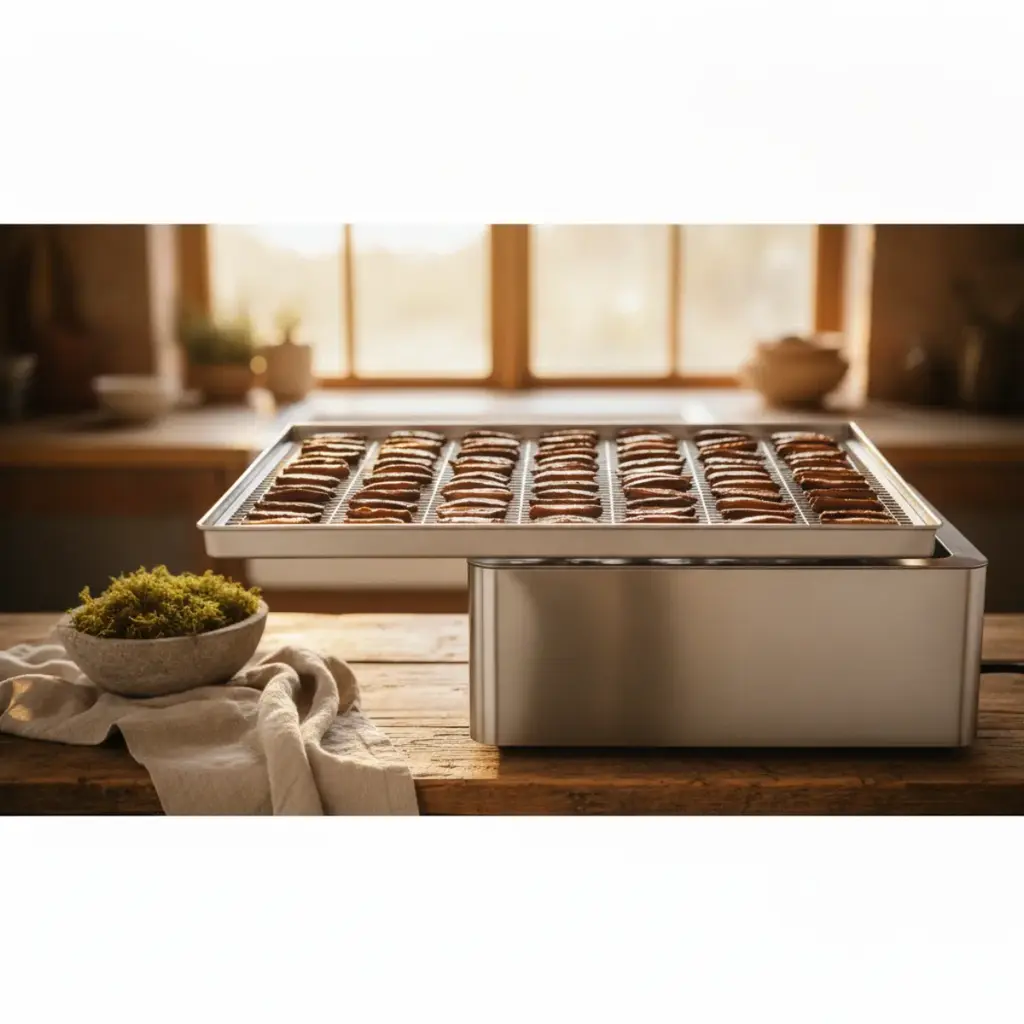
Lay the strips out without touching and run the dehydrator at 57 to 60 C (135 to 140 F). Expect 4 to 6 hours for 6 mm king oyster strips, longer in a humid kitchen or a full machine. Rotate the trays once if your unit dries unevenly, which most do.
Start checking at three hours. Lower temperatures take far longer without improving texture; higher temperatures case-harden the outside while the middle stays wet.
Stop at the Bend Test
Take a strip out and let it cool for a minute — warm strips always feel softer than they are. Then bend it:
- Bends and springs back, no moisture at the fold: done.
- Bends and stays folded, feels damp: 30 to 60 minutes more.
- Cracks or snaps: you have gone past jerky. Still delicious, now a crisp.
Condition Before You Store It
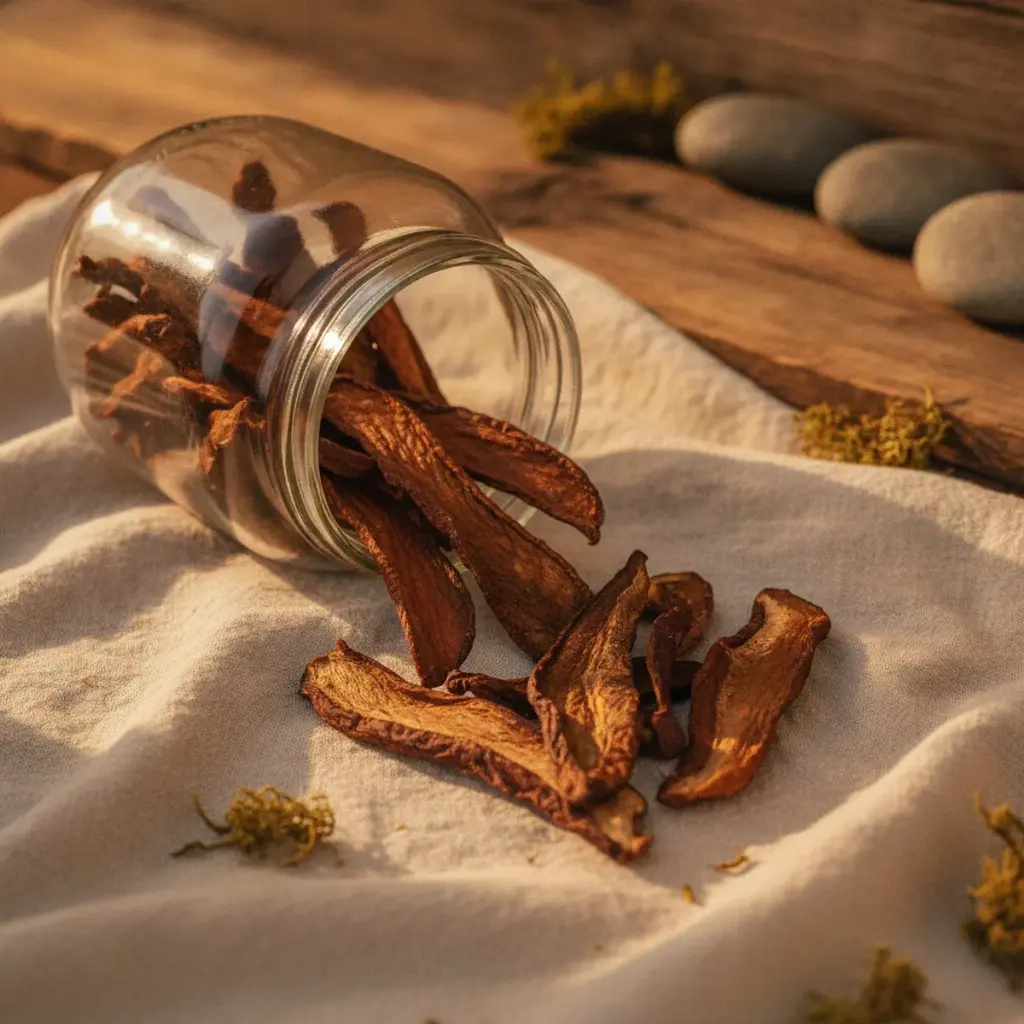
Put the cooled strips in a sealed jar for 24 hours and shake it occasionally. Any remaining moisture redistributes between the strips, so slightly overdried pieces soften and slightly underdried ones give up their damp spots. If you see condensation on the glass, the batch needs another hour on the trays.
If You Don't Have a Dehydrator
An oven works, with caveats. Set it as low as it goes — 65 to 75 C for most, which is already hotter than ideal — prop the door open with a wooden spoon to let moisture escape, and use a wire rack so air reaches both sides. Check from 90 minutes. You will get usable jerky with slightly more cooked flavour and less even results.
A dedicated dehydrator earns its place quickly if you dry anything regularly, and the stacked-tray airflow is the whole reason it beats an oven. We compared the ones worth owning in the best dehydrators for drying mushrooms.
Our Pick

Myco Labs 350 Watt Mushroom Dehydrator with Adjustable Temperature Control and Extra Tall Trays
Designed specifically for mushroom growers with extra tall trays that fit whole mushrooms. The 360-degree airflow dries evenly without tray rotation. This is the dehydrator we recommend to every mushroom grower.
As an Amazon Associate we earn from qualifying purchases. It costs you nothing and does not change what we recommend.
Storage and Shelf Life
Properly conditioned jerky keeps two to three weeks in a sealed jar at room temperature and several months in the freezer. It is not shelf-stable the way fully dried mushrooms are, precisely because you left moisture in it — that is the trade for the texture.
If you want to keep a batch for months without freezing, dry it the rest of the way to the 90 per cent mark and store it as fully dried mushrooms, then treat it as a cooking ingredient rather than a snack. Our guide to mushroom spawn shelf life and storage covers the same moisture-and-oxygen principles that govern any dried mushroom product.
On the Store-Bought Stuff
Commercial mushroom jerky — Pan's being the brand most people have seen — is made the same way, with shiitake and a sweet-savoury marinade, and the packets are small for the price because of that 10-to-1 shrink. There is nothing to reverse-engineer. You are paying for someone else's dehydrator time.
What you get at home is control of the three things that actually decide the result: thickness, salt, and where you stop.
Mentioned in the guide

As an Amazon Associate we earn from qualifying purchases. It costs you nothing and does not change what we recommend.
Growing the Mushrooms First
King oyster is the best jerky mushroom and also one of the more satisfying species to grow, because the stem — the part you want — is the part that bulks up. A single block will give you a few hundred grams of dense stems per flush.
If you are starting from nothing, a mushroom grow kit fruits on a kitchen counter with no equipment. If you are already growing, grain spawn into bulk substrate is the cheaper route per kilogram, and our guide to growing king oyster mushrooms covers the fruiting conditions that produce thick stems rather than thin ones.
Frequently Asked Questions
Why is my mushroom jerky crispy instead of chewy?
You dried it too far, sliced it too thin, or both. Jerky should lose about 75 to 80 per cent of its fresh weight; fully dried mushrooms lose 90 per cent. Weigh the trays rather than trusting a timer, and cut strips 6 to 8 mm thick.
What is the best mushroom for jerky?
King oyster. The stem is dense, uniform and almost gill-free, and it shreds along the grain like meat. Shiitake caps give the strongest flavour, and lion's mane gives the most meat-like strands.
How long does mushroom jerky last?
Two to three weeks in a sealed jar at room temperature, or several months frozen. It keeps less well than fully dried mushrooms because you deliberately left moisture in it. Condition it in a jar for 24 hours first and re-dry if you see condensation.
Do I need to cook the mushrooms before dehydrating?
No. Slicing, salting and pressing is enough. Cooking first adds water and makes the strips harder to dry evenly.
Can I make mushroom jerky without a dehydrator?
Yes, in an oven on its lowest setting with the door propped open and the strips on a wire rack. The results are less even and taste slightly more cooked, and you will need to check from 90 minutes.
Is mushroom jerky the same as mushroom bacon?
Same method, different end point. Bacon is sliced thin — 2 to 3 mm, usually oyster or shiitake — and taken further toward crisp. Jerky is thick-cut and stopped while still pliable.
Product prices and availability are accurate as of the date/time indicated and are subject to change. Any price and availability information displayed on Amazon.com at the time of purchase will apply to the purchase of this product. Certain content that appears on this site comes from Amazon. This content is provided ‘as is’ and is subject to change or removal at any time.