
King oyster mushrooms (Pleurotus eryngii) are the crown jewel of the oyster mushroom family. Where blue and pink oysters grow in delicate shelf-like clusters, king oysters produce thick, meaty individual stems with small brown caps — a shape and texture that's earned them the nickname "king trumpet." They're prized by chefs for their dense, scallop-like texture that holds up to searing, grilling, and braising in ways no other mushroom can match.
They're also one of the most rewarding species to grow at home, once you understand that they play by different rules than their oyster cousins. King oysters are top-fruiters, they prefer cooler temperatures, and they benefit from a casing layer — techniques most growers don't encounter with standard oyster mushrooms.
This guide covers the complete process from substrate preparation to harvest, including the specific adjustments that make king oyster cultivation successful.
What Makes King Oysters Different
If you've grown blue oyster or pink oyster mushrooms before, you need to unlearn a few habits. King oysters break several rules that apply to other Pleurotus species.
Top Fruiting vs Side Fruiting
Standard oyster mushrooms are side-fruiters — they grow out of holes cut in the sides of bags. You slash the bag, maintain humidity, and clusters push out horizontally.
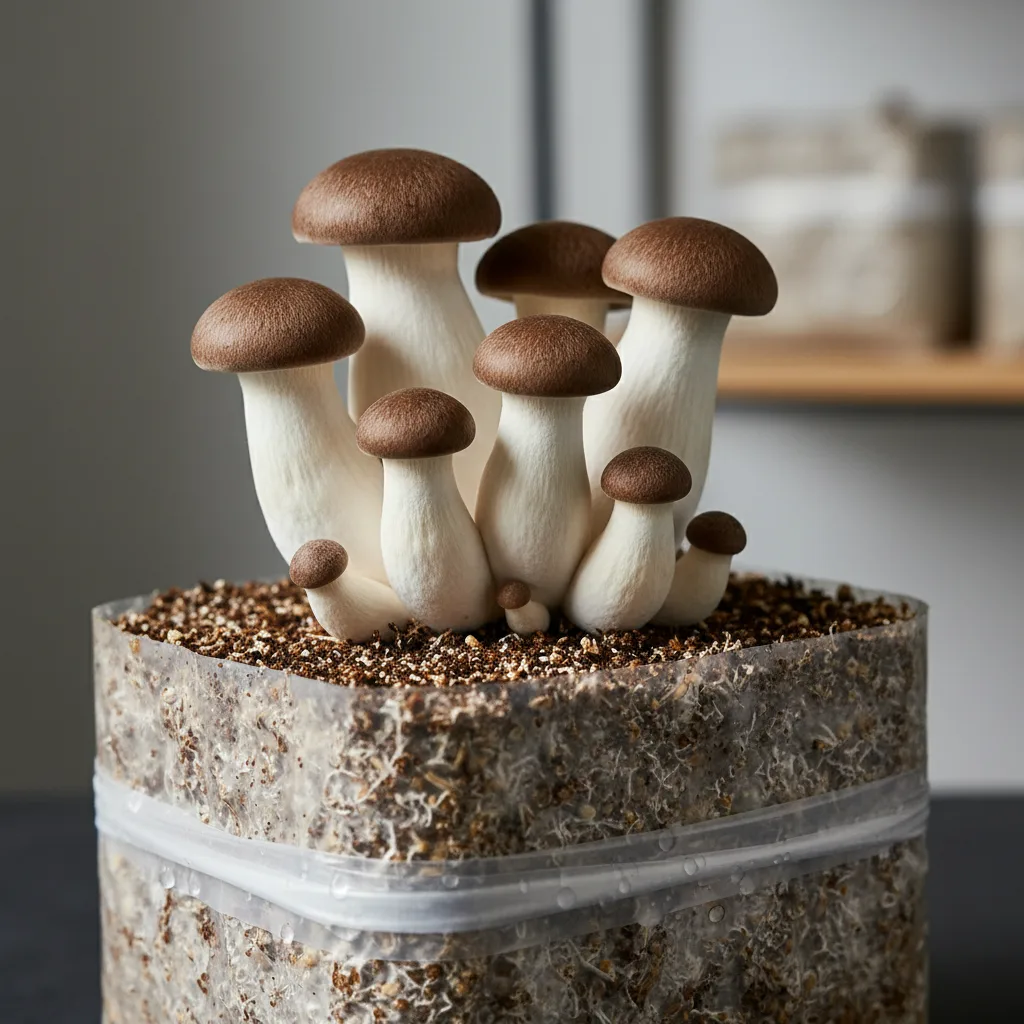
King oysters fruit from the top. You open or remove the top of the bag, apply a casing layer, and the mushrooms grow upward. Trying to side-fruit king oysters produces deformed, leggy mushrooms with thin stems — the opposite of what you want. The thick, meaty stem is the premium part.
Individual Mushrooms, Not Clusters
Blue oysters produce massive bouquets of interconnected caps. King oysters produce individual mushrooms, each growing independently from the substrate surface. A well-fruited block might produce 4-8 individual mushrooms, each with a stem 3-5 cm in diameter and 10-15 cm tall.
Slower and Cooler
King oysters colonize more slowly than other oyster species and fruit best at cooler temperatures — 10-16°C (50-61°F) for optimal stem development. This makes them a natural fit for Canadian basements and garages in spring and fall, or any space where you can maintain cool conditions.
Casing Layer Required
Unlike most oyster species that fruit directly from colonized substrate, king oysters perform significantly better with a casing layer — a thin layer of non-nutritive material applied to the top of the colonized block. The casing helps maintain surface moisture and triggers pinning. More on this below.
Substrate for King Oysters
King oysters need a supplemented hardwood substrate. They won't produce well on straw, coffee grounds, or unsupplemented sawdust — the nutrition isn't there to build those thick, dense stems.
The Standard Recipe (Masters Mix)
The most reliable substrate for king oysters is a 50/50 mix of hardwood pellets and soy hull pellets, hydrated to field capacity:
- 50% hardwood fuel pellets (HWFP)
- 50% soy hull pellets (available at feed stores as livestock feed)
- Water to field capacity (approximately 1.5-1.8 litres per kg of dry pellets)
This is the same Masters Mix used for lion's mane and shiitake. The soy hulls provide the nitrogen that king oysters need.
Alternative: Hardwood + Wheat Bran
If you can't find soy hull pellets:
- 80-85% hardwood sawdust or pellets
- 15-20% wheat bran
- Water to field capacity
Wheat bran provides similar supplementation. The key is that supplemented substrates must be sterilized, not pasteurized. The added nutrition supports contamination as readily as it supports mushroom growth.
Sterilization
Bag your substrate in filter-patch grow bags and sterilize at 15 PSI for 2.5 hours. See our sterilization guide for the complete process. Alternatively, use our Pre-Sterilized Hardwood Substrate to skip this step entirely.
Inoculation and Colonization
Spawn
Use grain spawn at a rate of 15-20% by weight. King oysters colonize slower than blue or pink oysters, so a higher spawn rate compensates for the pace and reduces contamination risk. See our spawn ratio guide for exact calculations.
Break up the spawn thoroughly and mix it evenly into the cooled, sterilized substrate inside a still air box or in front of a flow hood. Seal the bag and shake it gently to distribute.
Colonization Conditions
- Temperature: 21-24°C (70-75°F)
- Light: Dark or dim — light isn't needed during colonization
- Duration: 21-30 days for full colonization (longer than most oyster species)
- Don't open the bag. Check progress visually through the bag walls.
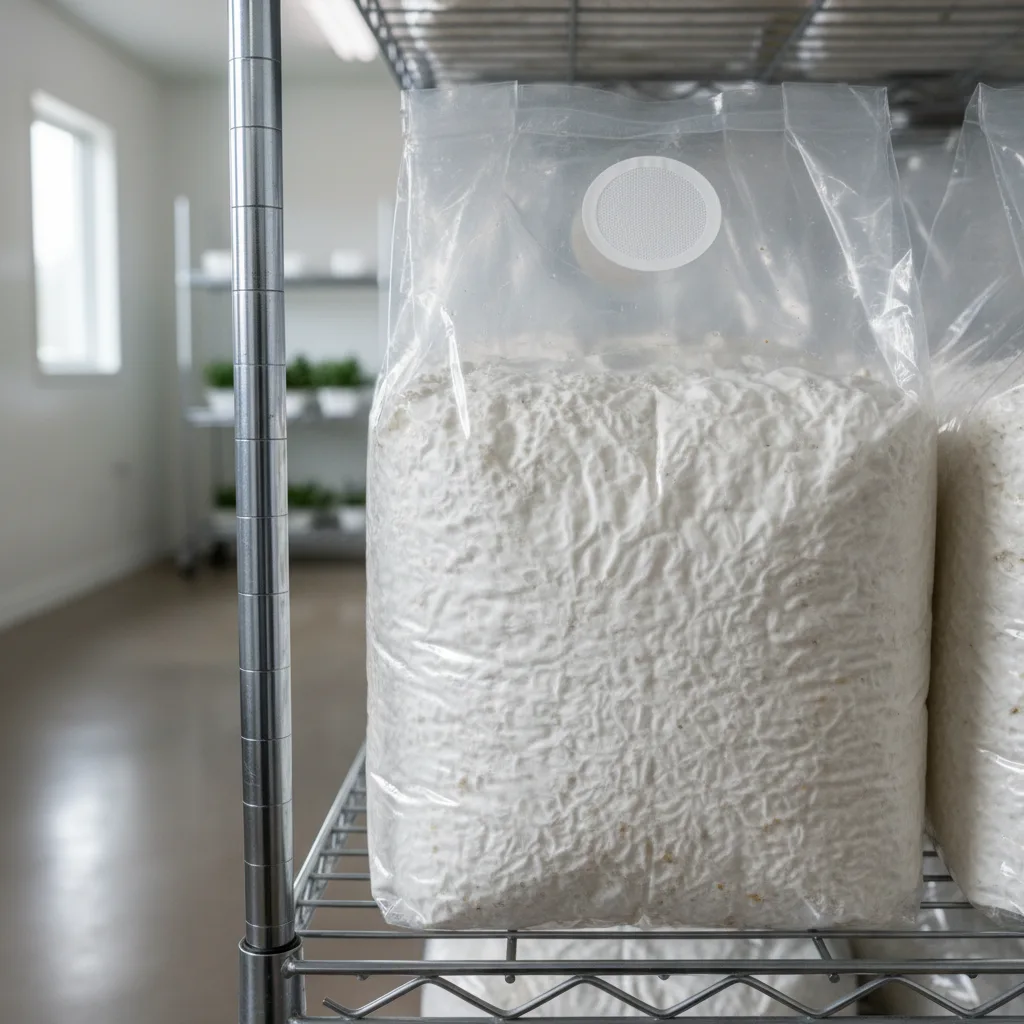
The mycelium should appear dense and uniformly white throughout the block. Unlike the ropey, aggressive mycelium of blue oyster, king oyster mycelium is finer and more evenly distributed. Be patient — rushing to fruit before full colonization leads to poor yields and contamination.
Fruiting: The Top-Fruiting Technique
This is where king oyster diverges from standard oyster growing. Follow these steps carefully.
Step 1: Open the Top
Once the block is fully colonized, cut the top of the grow bag open. Some growers remove the bag entirely; others fold it down to create a collar around the block. Either works — the important thing is that the top surface is fully exposed.
Step 2: Score the Surface (Optional)
Lightly scratch the top surface of the colonized block with a clean fork or knife. This creates micro-injuries that stimulate pinning. Don't go deep — just break the surface mycelium layer. Some growers skip this step and get fine results.
Step 3: Apply the Casing Layer
Mix your casing material:
- 50% peat moss + 50% vermiculite — the standard recipe
- Add 1% hydrated lime (by weight) to raise the pH and prevent casing contamination
- Hydrate the mix until it holds together when squeezed but doesn't drip
Apply a 1-2 cm layer across the top of the block. The casing serves two purposes: it maintains surface moisture (critical for pin formation) and it provides a microclimate transition zone that triggers the mushroom's fruiting response.
Pasteurize the casing first. Microwave the mixed casing material in a covered container for 2-3 minutes, or pour boiling water over it and drain. Let it cool completely before applying. Unpasteurized casing can introduce contamination.
Step 4: Cold Shock
King oysters pin most reliably after a cold shock. After applying the casing, move the block to a cold environment — 4-10°C (39-50°F) — for 24-48 hours. A fridge works, or an unheated garage in Canadian spring or fall.
This temperature drop signals to the mycelium that conditions have changed and it's time to produce mushrooms. Not all growers do this step, but it significantly improves pinning consistency.
Step 5: Fruiting Conditions
After the cold shock, move the block to your fruiting space with these conditions:
- Temperature: 10-16°C (50-61°F) — this is cooler than most mushroom species. Warmer temperatures (above 18°C) produce thin, leggy stems with oversized caps. Cool temps produce the thick, meaty stems that king oysters are known for.
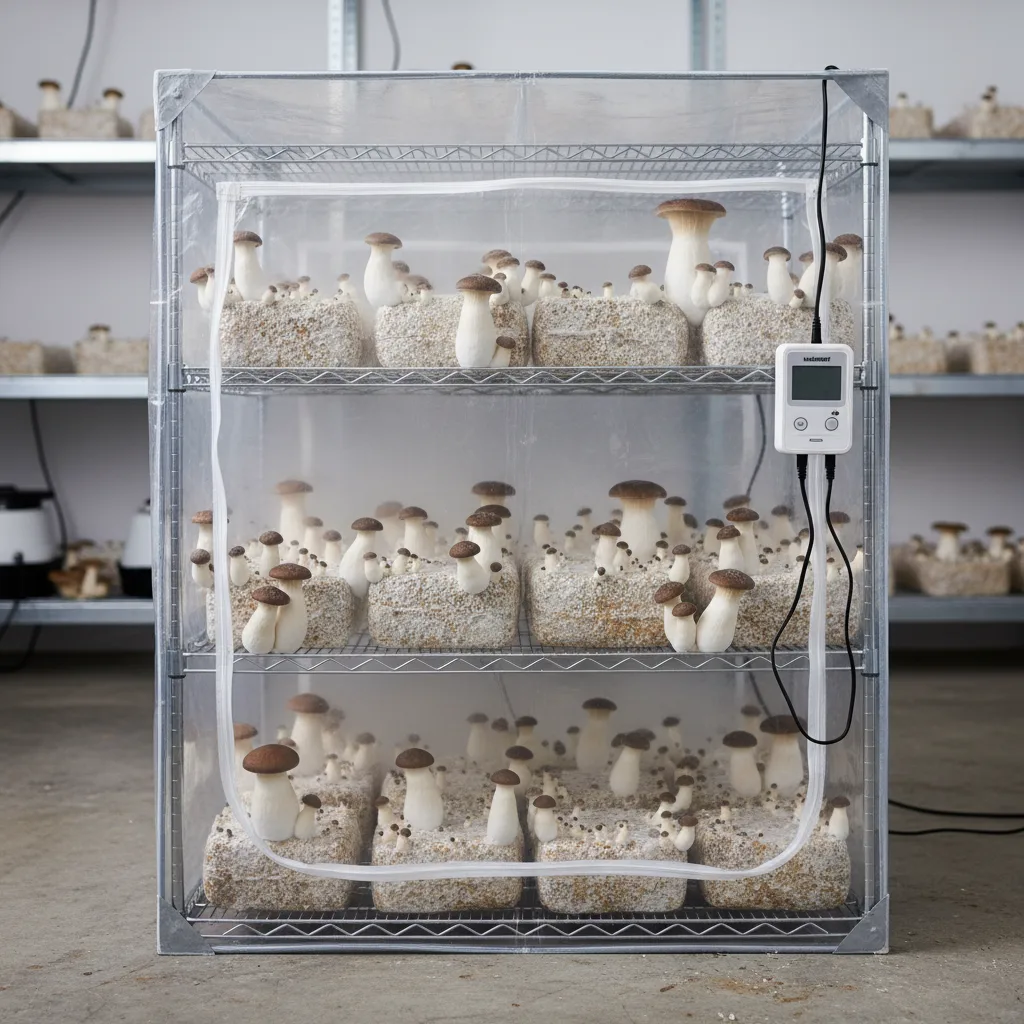
- Humidity: 85-95%. A Martha tent with a humidity controller is ideal. Mist the casing surface 2-3 times daily if you don't have automated humidity.
- Fresh air exchange: Moderate. King oysters need some CO2 to develop thick stems (unlike regular oysters that need heavy FAE). Don't fan aggressively — gentle air exchange is enough.
- Light: 12 hours of indirect light per day. A north-facing window or a simple LED is fine.
Step 6: Pin Development
Pins should appear within 7-14 days of initiating fruiting conditions. They'll emerge from the casing surface as small white bumps that develop into miniature versions of the final mushroom — small dark cap on a thickening white stem.
Thin to 4-6 pins per block if you want larger individual mushrooms. More pins means more mushrooms but each will be smaller. Commercial growers typically thin aggressively for premium-sized specimens.
Harvest
King oysters are ready to harvest when:
- The stem is firm and thick — 3-5 cm in diameter for a well-grown mushroom
- The cap is still slightly convex (curving downward) — not fully flattened or curling up
- The cap edges haven't started to wave or tear
- The mushroom is approximately 10-15 cm tall
Harvest too early and you lose yield. Harvest too late and the texture becomes spongy and the spore load increases.
How to harvest: Twist the entire mushroom at the base where it meets the casing, or cut with a clean knife. King oysters detach cleanly from the substrate.
Expected yield: 150-300g per 2.5 kg block on the first flush. A second flush is possible (soak the block for 12 hours between flushes) but produces 40-60% less than the first.
Common Problems and Solutions
Long, Thin Stems with Large Caps
Cause: Temperature too warm. Above 18°C (64°F), king oysters develop thin stems and large caps — the opposite of the desired morphology.
Fix: Lower the fruiting temperature to 10-16°C. If you can't cool your space enough, try fruiting in spring or fall when ambient temperatures are naturally cooler, or use a grow tent in an unheated garage.
No Pinning After 3 Weeks
Cause: Usually a combination of insufficient cold shock, no casing layer, or insufficient humidity.
Fix: Re-apply the cold shock (48 hours at 4-10°C). Ensure the casing layer is moist but not waterlogged. Boost humidity to 90%+.
Contamination on the Casing
Cause: Casing material wasn't pasteurized, or it was applied too wet.
Fix: Pasteurize all casing material before application. If you see green or black mould on the casing, carefully scoop out the contaminated area with a clean spoon. If contamination is widespread, the block may be compromised — see our contamination guide.
Mushrooms Growing from the Sides
Cause: Light leaking through the bag, or the bag was removed entirely.
Fix: If you removed the bag, wrap the sides of the block with black plastic or aluminium foil, leaving only the top exposed. King oysters will fruit toward light, so directing light only from above encourages top-fruiting.
King Oyster vs Regular Oyster: Quick Comparison
| Feature | King Oyster | Blue/Pink/Pearl Oyster |
|---|---|---|
| Fruiting direction | Top | Side |
| Growth habit | Individual | Clusters |
| Fruiting temp | 10-16°C (50-61°F) | 15-24°C (59-75°F) |
| Casing layer | Required | Not needed |
| Colonization time | 21-30 days | 14-21 days |
| Substrate | Supplemented hardwood | Straw, sawdust, coffee |
| Cold shock | Highly recommended | Optional |
| Stem value | Premium (thick, meaty) | Moderate |
| Difficulty | Intermediate | Beginner |
Cooking King Oysters
The thick stems are the prize. Slice them lengthwise into 1 cm slabs and sear in a hot pan with butter or oil until golden brown on both sides — 3-4 minutes per side. The texture when properly seared is remarkably similar to scallops. Season with salt, pepper, and a squeeze of lemon.
Other excellent preparations:
- Grilled — brush with oil, grill over medium-high heat until char marks appear
- Roasted — halve lengthwise, roast at 200°C (400°F) for 20-25 minutes
- Pulled — shred the stems with a fork, season and pan-fry for "pulled mushroom" sandwiches
- Stir-fried — slice into coins, high-heat wok cooking
King oysters store better than other oyster species — 7-10 days refrigerated in a paper bag, compared to 3-5 days for blue or pink oysters.
Frequently Asked Questions
Can I grow king oysters on straw?
Not reliably. King oysters need the nutrition provided by supplemented hardwood (sawdust + soy hull or wheat bran). Straw doesn't provide enough nitrogen for the thick stem development that makes king oysters valuable. Use Masters Mix or buy pre-sterilized substrate.
What's the difference between king oyster and king blue oyster?
King oyster (Pleurotus eryngii) is a distinct species — top-fruiting, individual thick stems, small caps. King blue oyster is a hybrid between king oyster and blue oyster that produces clusters of larger-capped mushrooms. Both are excellent eating, but the growing technique is different. This guide covers true king oyster.
Do king oysters need a pressure cooker?
Yes. Because the substrate is supplemented (contains added nutrition like soy hull or wheat bran), it must be sterilized at 15 PSI — pasteurization isn't sufficient. A pressure cooker or autoclave is essential. The alternative is using pre-sterilized substrate.
How many flushes can I expect?
Typically 1-2 flushes. The first flush produces the best mushrooms (thickest stems, best texture). A second flush is possible after soaking the block for 12 hours. Third flushes are uncommon and produce significantly smaller mushrooms. See our flush guide for more detail.
Can I fruit king oysters at room temperature?
You can, but the results will be disappointing. At 20°C+ (68°F+), king oysters produce thin stems and large caps — essentially looking like regular oyster mushrooms but growing much more slowly. The cool fruiting temperature (10-16°C) is what produces the characteristic thick stems.
King oyster mushrooms reward patience and precision. They're not a beginner species — if you're new to cultivation, start with blue oyster or a grow kit and work up to king oysters once you're comfortable with sterilization and environmental control. But once you nail the technique, you'll be producing restaurant-quality mushrooms that sell for $20-30/kg at Canadian farmers' markets. Browse our grain spawn and liquid cultures to get started.
Have a mushroom-growing question? Ask Dr. MycoTek for AI help with your grow. Sign in to use your free monthly allowance.