
If chicken of the woods is the wild mushroom that stops you in your tracks, hen of the woods is the one that makes experienced foragers keep secrets. A single hen (Grifola frondosa) can weigh five, ten, even twenty kilograms — a ruffled, grey-brown cluster the size of a basketball or bigger, hiding in plain sight at the base of an oak tree. It is one of the finest edible mushrooms in eastern Canada, it fruits reliably from the same trees year after year, and its season is short enough that people guard their spots like fishing holes.
This guide covers everything you need to find and use it: identification, the lookalikes (all of them forgiving), where and when to hunt in Ontario, how to harvest without killing the golden goose, and how to cook it once you have hauled one home.
What Is Hen of the Woods?
Hen of the woods is a polypore — a shelf-type fungus — that grows in large clusters of overlapping, spoon-shaped caps at the base of hardwood trees, almost always oaks. Each individual cap (or "frond") is grey to grey-brown on top, 2–7 cm across, and the whole cluster radiates from a single branching white core. From a few steps away it genuinely resembles the fluffed tail feathers of a nesting hen, which is where the English name comes from.
You may also know it by its Japanese name, maitake — "dancing mushroom," supposedly because foragers danced when they found one. Same species, same mushroom. In Canada you will see fresh wild ones called hen of the woods and cultivated or dried ones sold as maitake.
| Factor | Detail |
|---|---|
| Species | Grifola frondosa |
| Season in Ontario | Late August through October |
| Host trees | Oaks (occasionally maple, elm) — at the base, not up the trunk |
| Size | 1–20+ kg per cluster |
| Edibility | Choice — one of the best wild edibles |
| Difficulty | Beginner-friendly ID with no dangerous lookalikes |
What to take with you
Foraging needs very little kit, and the three things that matter each do a different job: carry the find without crushing it, cut it without damaging what is left behind, and clean it dry.
How to Identify Hen of the Woods
Work through these features in order. A true hen shows all of them:
- Growing at the base of a hardwood, almost always oak. Hens fruit from the roots and butt of the tree, at ground level. If the mushroom is growing up on the trunk or on a branch, it is something else.
- A cluster of many small, overlapping caps. Dozens to hundreds of grey-brown, fan- or spoon-shaped fronds, each usually under 7 cm wide, all emerging from one branching central core.
- Grey to grey-brown colour on top, white underneath. The cap surface is smoky grey, tan, or brown — never bright orange or yellow.
- Pores, not gills. Flip a frond over: the underside is white and finely pored, and the pore surface runs down the short stalk.
- Firm, white flesh with a rich mushroomy smell. No bruising to dramatic colours, no bitter smell.
Standing Over a Cluster: Confirm or Walk Away
The list above is what a hen is. This is what to do standing at the foot of an oak with an unknown ruffle in front of you. Work the checks in this order, because each ends in a decision: carry on, or stop.
1. Where is it attached? Get your eyes to ground level and find the attachment point. A hen comes off the butt, root flare or a buried root of a hardwood, almost always oak. If the cluster shelves up the trunk, sits on a branch, or emerges from a conifer, stop here: it is not a hen. Clusters a metre out from the trunk still count, because roots run further than people expect.
2. One branching core, or many separate mushrooms? A hen is a single organism wearing hundreds of fronds. Lift it gently and trace two or three fronds back toward the ground: they should converge on one white branching core. If every cap sits on its own stem and lifts away as a complete little mushroom, stop and look at umbrella polypore instead.
3. Frond size and count. A hen carries dozens to hundreds of fan- or spoon-shaped fronds, each usually under 7 cm across. A handful of thick fronds at 10–20 cm is the signature of black-staining or Berkeley's polypore. Not a stop on its own, but go straight to check five.
4. Flip it: pores, not gills. Turn a frond over. You want a white, finely pored surface running down onto the short stalk. Gills, meaning thin blades radiating from a stem, mean you walk away from the hen identification entirely. The top side should read grey, tan or smoky brown, never bright orange or sulphur yellow.
5. Press and cut, then wait a minute. The flesh should be firm and white, and should stay white. Cut a frond edge and give it a minute or two. A slow black bruise creeping out from the cut is black-staining polypore, not a hen. Stop: it is worth eating only very young, and turns leathery fast.
6. Smell and condition. The check people skip. A prime hen smells richly mushroomy, feels dry-ish and has crisp frond edges. A sour smell, sliminess or crumbling edges means leave it even when every identification feature checks out. A correctly identified rotten mushroom is still a bad dinner.
| What you see | What it means | What to do |
|---|---|---|
| Base of an oak, one branching core, hundreds of small grey-brown fronds, white pores, no colour change | Hen of the woods | Harvest, cook thoroughly |
| Everything matches, but a cut frond bruises black within a minute or two | Black-staining polypore | Leave it; worth eating only when very young |
| Only a few thick coarse cream-to-tan fronds, each 10–20 cm | Berkeley's polypore | Leave it; tough and bitter unless very young |
| Brilliant orange and sulphur-yellow shelves part way up the trunk | Chicken of the woods | A different species, identify it before eating |
| Growing from the base or roots of a conifer | Not a hen, a hardwood specialist | A different species, identify it before eating |
| Flat cream-coloured noodle-like ribbons, usually at a conifer base | Cauliflower mushroom | A different species, identify it before eating |
| Many small round caps, each on its own central stem | Umbrella polypore | A different species, identify it before eating |
| Right features, but sour-smelling, slimy, waterlogged or crumbling | An old or spoiled hen | Do not eat; mark the tree and come back next September |
None of those outcomes is a near miss with something dangerous. Hen of the woods has no deadly look-alikes in eastern Canada, so the honest cost of a mistake here is a tough dinner, not a hospital visit. The reason to run all six checks anyway is habit: the forager who confirms every feature on an easy species still confirms them on a hard one. Whatever you carry out, cook it thoroughly and eat a small portion the first time.
Hen of the Woods vs Chicken of the Woods
These two get confused constantly — because of the names, not the mushrooms. Side by side they look nothing alike, and our chicken of the woods guide covers the other bird in detail. The short version:
| Hen of the Woods | Chicken of the Woods | |
|---|---|---|
| Colour | Grey, tan, brown | Brilliant orange and sulphur yellow |
| Where on the tree | At the base, from the roots | Shelves up the trunk or on logs |
| Structure | Hundreds of small ruffled fronds | Large fused shelves |
| Texture cooked | Tender, meaty, layered | Dense, fibrous, "like chicken" |
| Flavour | Deep, savoury, earthy | Mild, lemony, chicken-like |
| Season overlap | Late Aug–Oct | Jun–Oct |
If it is orange, it is chicken. If it is a grey-brown ruffle at the foot of an oak, it is hen. Nobody who has seen both will ever mix them up again.
Lookalikes to Know
Hen of the woods is one of the safest wild mushrooms to learn because its lookalikes are not dangerous — the worst outcome is a tough, disappointing dinner.
Black-staining polypore (Meripilus sumstinei) — The most common mix-up in Ontario. Also grows in big rosettes at the base of hardwoods, but its fronds are larger (often 10–20 cm), and the flesh slowly bruises black when handled or cut. Edible when very young but quickly becomes leathery. If your "hen" is staining black at the edges, that's what you have.
Berkeley's polypore (Bondarzewia berkeleyi) — Bigger, paler, cream-to-tan fronds that are much thicker and coarser. Edible young, tough and bitter old.
Umbrella polypore (Polyporus umbellatus) — A genuinely good edible that looks like a hen made of tiny round caps, each with a central stem. Rarer, and a happy find rather than a problem.
Cauliflower mushroom (Sparassis) — Noodle-like, cream-coloured ribbons rather than fanned fronds, and typically at the base of conifers, not oaks. Also edible.
None of these will hurt you. That said, always confirm every feature and cook any wild mushroom thoroughly the first time you try it, in a small portion.
Here is the whole comparison at a glance:
| Species | Cap colour | Underside | Bruising | The one feature that separates it | Does the mix-up matter? | Edibility |
|---|---|---|---|---|---|---|
| Hen of the woods | Grey to grey-brown, small fronds under 7 cm | White, finely pored | No colour change | Hundreds of thin fronds under 7 cm from one branching core | This is the one you want | Choice edible, always cooked |
| Chicken of the woods | Brilliant orange and sulphur yellow | Yellow pores | No colour change | Brilliant orange, shelving up the trunk, not at the base | No, edible cooked, a completely different mushroom | Edible cooked (young shelves) |
| Black-staining polypore | Grey-brown, larger fronds 10–20 cm | White pores | Stains black when cut or handled | Flesh bruises black within a minute or two of cutting | No, edible very young, just tougher | Edible only when very young, quickly leathery |
| Berkeley's polypore | Cream to tan, thick coarse fronds | White pores | No colour change | Few thick coarse cream fronds, not many thin grey ones | No, edible young, bland after that | Edible young, tough and bitter with age |
| Umbrella polypore (Polyporus umbellatus) | Pale tan to grey-brown, small round caps | White pores | No colour change | Each small round cap has its own central stem | No, edible and a better find | Choice edible, always cooked |
| Cauliflower mushroom (Sparassis spp.) | Cream to pale yellow, no caps at all | Smooth, no pores or gills | No colour change | Flat noodle-like ribbons, at the base of conifers | No, edible and worth carrying home | Edible cooked, needs patient cleaning |
If the cluster at your oak matches the top row on every column, you have a hen.
Every realistic hen look-alike in that table is edible, so a mix-up inside this group costs you a bland dinner rather than your safety, which is exactly why hen is a good species to learn on. The confusion that does carry a real cost in a fall oak woodlot is a different one: picking a gilled mushroom off the ground near the oak, because destroying angel grows across southern Ontario and southern Quebec and death cap has turned up under oaks in urban and suburban southern Quebec. A hen is a polypore with a finely pored underside and one branching white core, and nothing about it resembles an Amanita, so the pores-not-gills check is the whole defence.
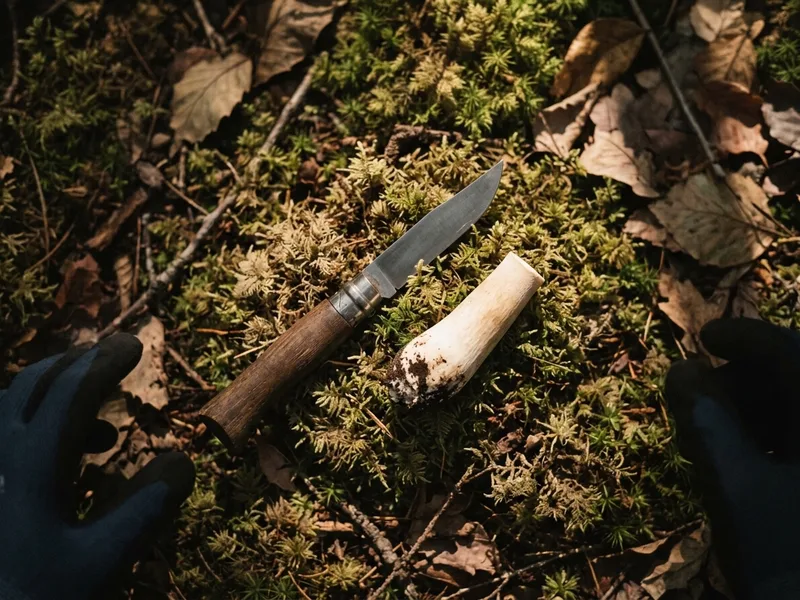
Opinel No. 08 Mushroom Knife
A curved blade cuts the stem cleanly at the base instead of tearing the mycelium out with it, and the boar bristle brush is set into the handle so cleaning happens in the field rather than at the sink.
When you buy through our links, it supports our mycology research at no extra cost to you.
Where and When to Find It in Ontario
Hen of the woods is an oak specialist, so in Ontario you hunt it where mature oaks grow: the Carolinian forests of the southwest, oak ridges through the GTA and the Oak Ridges Moraine, older hardwood stands in Eastern Ontario, and parks or river valleys with big veteran red and white oaks. Urban and suburban foragers do surprisingly well — cemetery oaks, old fencerow trees, and ravine edges all produce (just avoid trees near sprayed lawns or busy roads).
The season runs late August through October, peaking in September after the first cool nights and soaking rains. The single most valuable thing to know: hens refruit from the same trees for years. The fungus lives in the roots of the host tree, and a productive oak will throw a cluster every fall, sometimes several, until the tree dies. Find one hen and you have found a patch; mark the tree and come back every September.
Check both sides of the trunk and a metre or two out from it — clusters sometimes emerge from buried roots and look like they are growing from bare ground. Our broader Ontario mushroom foraging guide covers the general rules on where you can legally forage, including Crown land and conservation areas.
Season Windows Across Eastern Canada
The pattern holds anywhere mature oaks grow east of the prairies. The trigger is the same everywhere: the first stretch of cool nights after a good soaking rain.
| Region | Typical window | Peak |
|---|---|---|
| Southwestern Ontario & GTA | Early September to late October | Mid to late September |
| Eastern Ontario & Ottawa Valley | September to mid October | September |
| Quebec (St. Lawrence and Ottawa River valleys) | September to early October | September |
| Maritimes | Mid September into early November | Late September and October |
| Great Lakes shoreline and Niagara Escarpment | September to early November | Late September into October |
| Southern Quebec (Estrie and the Outaouais) | September to mid October | September |
| New Brunswick (Saint John valley and Fundy lowlands) | Late September into November | October |
| Nova Scotia (mainland hardwood country) | September into November | Late September and October |
Wherever you are, the rule from above still applies: the fungus lives in the roots, so a producing oak keeps producing. A tree you find in Halifax or Gatineau is worth the same yearly September visit as one in Hamilton.
Where to Find It Beyond Ontario
Grifola frondosa is not an Ontario species, it is an oak species, and oaks are the only real constraint on hunting it in Canada. Anywhere mature red or white oak stands east of the prairies, hens are possible: southern Quebec, the Saint John River valley, mainland Nova Scotia and the lower Great Lakes shoreline. The eastern edge of its Canadian range runs out through the Maritimes, so the further east you go, the more patient a find it becomes.
Southern Quebec
Quebec's best hen country is the Estrie, the Eastern Townships: Appalachian hills south of Montréal around Magog, Sherbrooke, Sutton and Lac-Mégantic. This is the most Carolinian-influenced forest in the province: sugar maple, American beech, yellow birch, oak and hickory, and the oak component is what matters. Look for veteran red and white oaks on warm lower slopes and old field edges, not deep inside the maple stands.
The Outaouais and the St. Lawrence valley south of Montréal are the other zones worth walking. The Outaouais corridor carries scattered mature oak through mixed bottomland, and the St. Lawrence Lowlands turn up occasional hens in whatever oak stands survived the agricultural belt. Those finds reward the effort because they are so localised: an isolated farm-country oak often has no competition at all.
The Quebec window is September into October, tighter than Ontario's, triggered by cool nights after a soaking rain. Our Quebec mushroom foraging guide covers access rules province-wide. One caution on the island of Montréal: Parc du Mont-Royal and the Grands parcs network hold mature oak and fruit well in a wet September, but Montréal's park by-laws prohibit removing vegetation and no mushroom exemption is written into them. Treat city parks as photograph-and-learn ground: note the tree it came off and leave the cluster standing.
The Maritimes
New Brunswick is the stronger of the two hen provinces. The southern Saint John River valley, the corridor south of Fredericton toward Saint John, holds the remaining mature oak stands, and hens appear at their bases where oak survives among cottonwood, elm and silver maple bottomland. The Fundy lowlands are the other half: in the lowland oak of the Caledonia Highlands behind the national park, clusters come on from late September. Fundy National Park itself is closed to harvesting under federal regulation, so the ground that produces is the adjacent Crown land.
Nova Scotia sits at the eastern edge of the range and behaves like it. The finds are in mainland hardwood country: the Acadian interior through the Cobequid Hills, Pictou County and Antigonish, the Annapolis Valley and the coastal lowlands, wherever mature oak has established among the sugar maple, yellow birch, hemlock and red spruce. Cape Breton is too boreal for this species. Our Nova Scotia foraging guide has the access rules.
Both provinces run September into November, later than Quebec because the maritime climate holds off hard frosts, peaking late September and October. Treat hen hunting here as oak reconnaissance done in advance: finding the oak in July is the real work, checking it weekly from late September the easy part.
The Great Lakes Basin
The lower Great Lakes shoreline is the most oak-rich landscape in the species' Canadian range, and it reads better as one basin than as provincial territory. On the Canadian side that means the Niagara Escarpment forests around Owen Sound and the Bruce Peninsula, the Lake Erie and Lake Ontario shore woodlands, and the Carolinian southwest. Much of it is privately owned and the Bruce national park is closed to harvesting, so permission and a map come before the walk.
The terrain to read is moraine and escarpment: old oak on dry upper slopes and ridge shoulders, oak-hickory on sandy shoreline flats, and veteran trees left in fencerows, cemeteries and ravine edges. Red and white oak are the hosts to learn. Big open-grown oaks with heavy low limbs are usually the oldest trees in a woodlot, and they carry the root mass that throws a large cluster.
The same oak habitat continues around the basin into Michigan, Ohio and New York State, which is why American hen reports and Canadian ones line up closely. The difference worth knowing is timing: the lakes moderate the air near the water, so the shoreline window stretches later than inland, running September into early November on the warmest Erie and Ontario shores while stands inland finish through October.
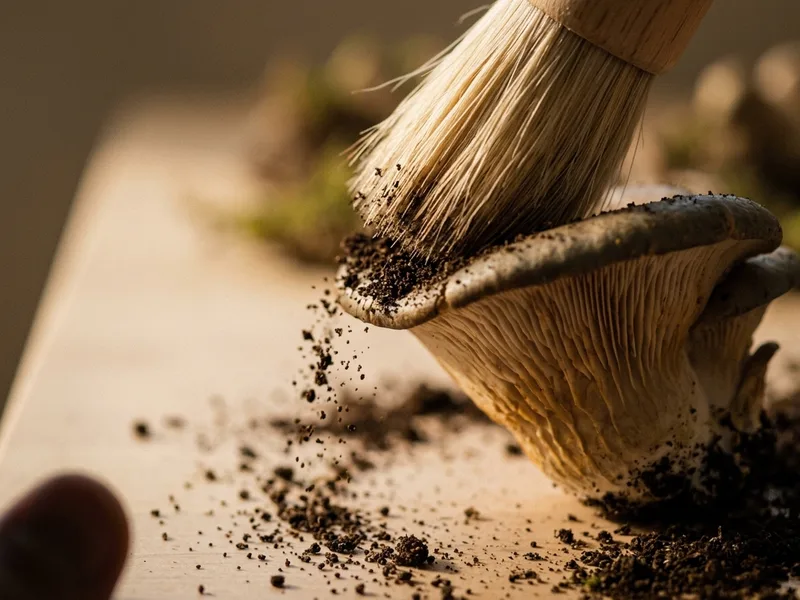
Redecker Natural Pig Bristle Mushroom Brush
Soft enough to take soil off a cap without tearing the skin. Mushrooms absorb water, so brushing dry beats rinsing every time, and anything you plan to dry has to be cleaned this way.
When you buy through our links, it supports our mycology research at no extra cost to you.
How to Harvest a Hen
Cut, don't pull. Slice the whole cluster off at the base with a good knife, leaving the buried core and the tree's roots undisturbed — that's what fruits again next year. Then, in the field, do the future-you a favour:
- Shake it and fan the fronds apart. Hens grow at ground level and collect leaves, dirt, slugs, and beetles deep in the ruffles. Every minute of field cleaning saves five at the sink.
- Take the tender parts if the hen is huge. On an older monster cluster, the outer frond tips stay tender while the dense core turns woody. It is fine to harvest the fronds and leave the core.
- Skip waterlogged or old specimens. A prime hen is firm and dry-ish with crisp edges. Soft, sour-smelling, or crumbling clusters are past it.
- Carry it in a basket or paper bag, never sealed plastic, so it doesn't sweat.
A big hen is a lot of mushroom. Plan to process it the same day: clean it, cook what you'll eat this week, and preserve the rest.
Cooking Hen of the Woods
This is where hen of the woods earns its reputation. The fronds have a layered, almost feathered texture that crisps beautifully, and a deep savoury flavour stronger than almost any cultivated mushroom.
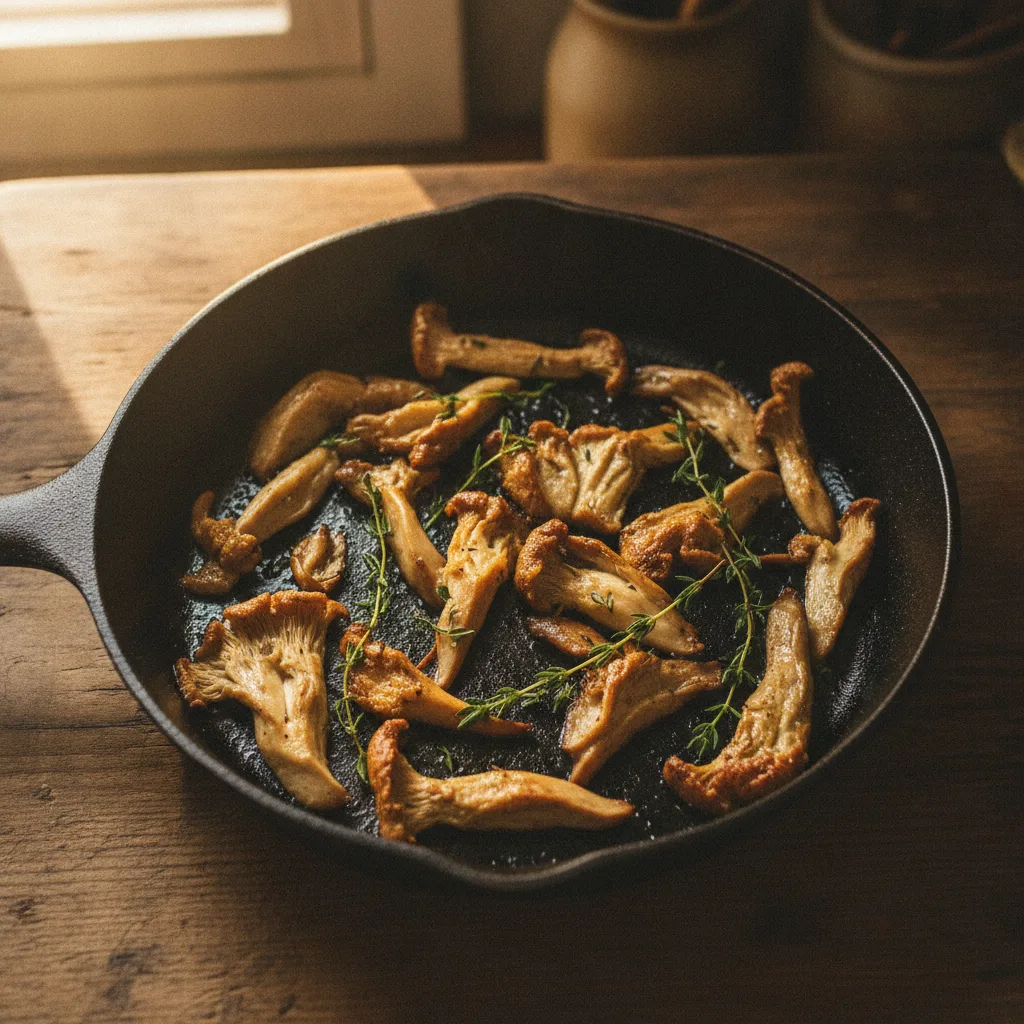
- Tear, don't slice. Pull the cluster apart along its natural fronds. The ragged edges brown and crisp far better than knife-cut faces.
- High heat, enough fat, don't crowd the pan. Roast at 220°C or sear in a cast iron pan until the edges go golden and crispy. Salt at the end.
- Simplest great preparation: torn hen, olive oil or butter, salt, thyme, roasted 20–25 minutes until the edges shatter. It goes with steak, pasta, eggs, or on its own.
- It also shines in broths and gravies — the flavour is strong enough to carry a soup the way dried porcini does.
- Always cook it thoroughly. Like most polypores, it is not a raw mushroom.
Hens freeze well once sautéed, and they dehydrate into an intensely flavoured stock ingredient that grinds into powder beautifully. A single September haul can season your cooking until spring.

Growing Gourmet and Medicinal Mushrooms
Most people who forage for a season start wondering whether they can grow the same species deliberately. This is the standard cultivation reference, with substrate, spawn and fruiting conditions worked through species by species. A different book from a field guide and worth owning alongside one.
When you buy through our links, it supports our mycology research at no extra cost to you.
Preserving a Big Find
A ten-kilogram hen is a wonderful problem. Here is how to keep it from going to waste, in order of effort:
In the fridge (up to a week). Clean, dry fronds keep five to seven days loosely wrapped in paper towel inside a paper bag. Never seal fresh hen in plastic; it sweats and sours fast. Cook the densest core pieces first, since they turn before the thin frond tips do.
Sauté and freeze (up to six months). Tear the hen into fronds, sauté in batches with a little oil until the moisture cooks off, cool, and freeze flat in bags. Frozen raw, the texture collapses to mush; cooked first, it comes out of the freezer nearly as good as fresh. This is the best method for keeping that roasted-frond texture.
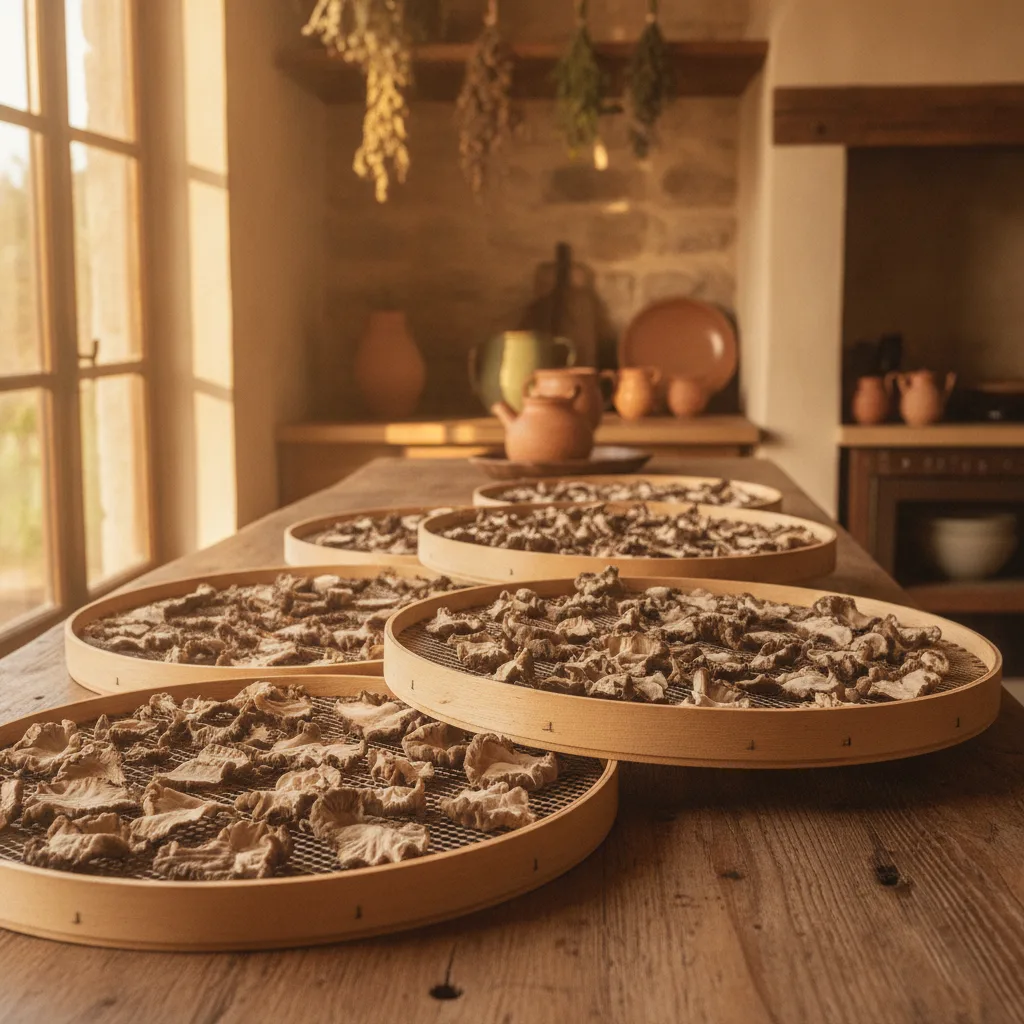
Dry it (a year or more). Hen of the woods dehydrates beautifully. Slice or tear into thin pieces and dry at 50–60°C until cracker-crisp, then store in airtight jars. Dried hen rehydrates into soups and braises, and grinding it to powder gives you a savoury seasoning that carries stocks, gravies, and rubs through the winter. If you are drying more than the odd tray, our dehydrator review for mushroom drying covers which machines are worth it.
Whichever route you take, process the hen the same day you cut it. The bugs hiding in the ruffles do not wait.
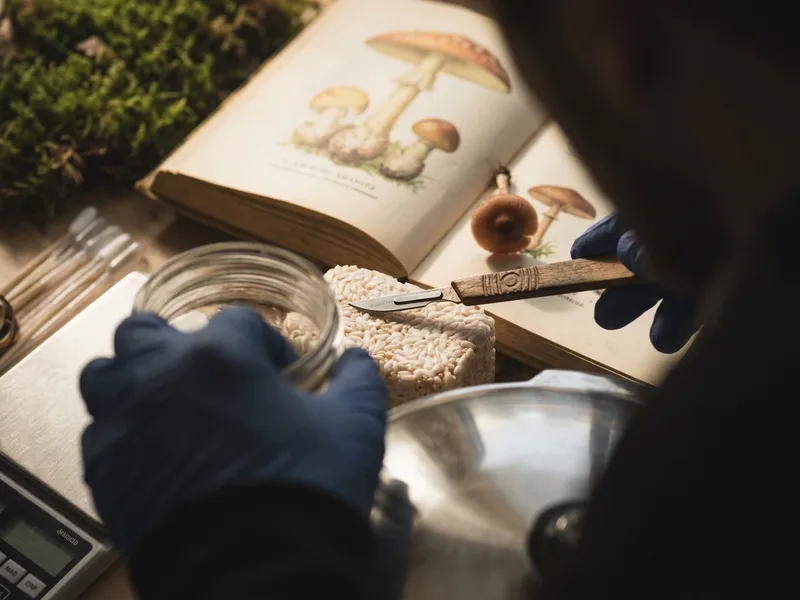
Edible and Medicinal Mushrooms of New England and Eastern Canada
A photographic key to the species you will actually meet in eastern Canada, organised by what the mushroom looks like rather than by taxonomy. The regional focus is the point: a guide written for another continent shows you the wrong look-alikes.
When you buy through our links, it supports our mycology research at no extra cost to you.
Can You Grow Hen of the Woods?
Yes, though it is a slower, more advanced project than oysters or turkey tail. Outdoors, hardwood logs or buried stumps inoculated with Grifola frondosa spawn can begin fruiting in two to four years — the mycelium needs time to build the root-scale mass that produces those huge clusters. Indoors, supplemented hardwood sawdust blocks fruit far sooner but demand dialled-in conditions and patience through a long colonization.
If you want to try, start from a verified liquid culture or agar culture and follow the same sterile process as our substrate and spawn-making guides. For most people, though, the best "cultivation" strategy for this species is finding one good oak — and for maitake powder in your kitchen year-round, our mushroom powders shelf has you covered without the two-year wait.
Frequently Asked Questions
Are hen of the woods and maitake the same mushroom?
Yes. Maitake is the Japanese name for Grifola frondosa, the same species called hen of the woods in North America. Fresh wild specimens are usually sold or discussed as "hen of the woods," while the cultivated and dried versions common in grocery stores and powders usually carry the maitake name.
When is hen of the woods season in Ontario?
Late August through October, with the peak in September after cool nights and steady rain. Clusters can appear quickly — checking known oaks weekly during September is the reliable strategy, because a fresh hen can go from prime to bug-eaten in under two weeks.
Does hen of the woods have poisonous lookalikes?
No dangerous ones. The common confusions — black-staining polypore, Berkeley's polypore, umbrella polypore, and cauliflower mushroom — are all edible or merely tough, not toxic. Confirm the full feature list anyway: base of a hardwood, many small grey-brown fronds from one core, white pored underside, firm white flesh.
What is the difference between hen of the woods and chicken of the woods?
Completely different mushrooms despite the matching names. Hen is a grey-brown ruffled cluster at the base of oaks with a deep savoury flavour; chicken is a bright orange-and-yellow shelf fungus on trunks and logs with a mild, chicken-like taste and texture. See our full chicken of the woods guide for the other side of the comparison.
Can you eat hen of the woods raw?
No. Like most polypores it is indigestible raw and can cause stomach upset. Cook it thoroughly; high heat is also where the flavour and crispy texture come from, so raw preparations waste the mushroom anyway.
How big does hen of the woods get?
Most clusters run one to five kilograms, roughly the size of a cauliflower to a basketball. Exceptional hens exceed twenty kilograms, and a single old oak can throw several clusters in one season. If you find a monster, harvest the tender outer fronds and leave the woody core.
Does hen of the woods regrow on the same tree?
Yes, and this is the single most useful fact about the species. The fungus lives in the roots and butt of the host oak, so a producing tree typically fruits every fall for years, until the tree itself dies. Cut clusters off cleanly at the base rather than ripping them out, mark the tree, and come back each September.
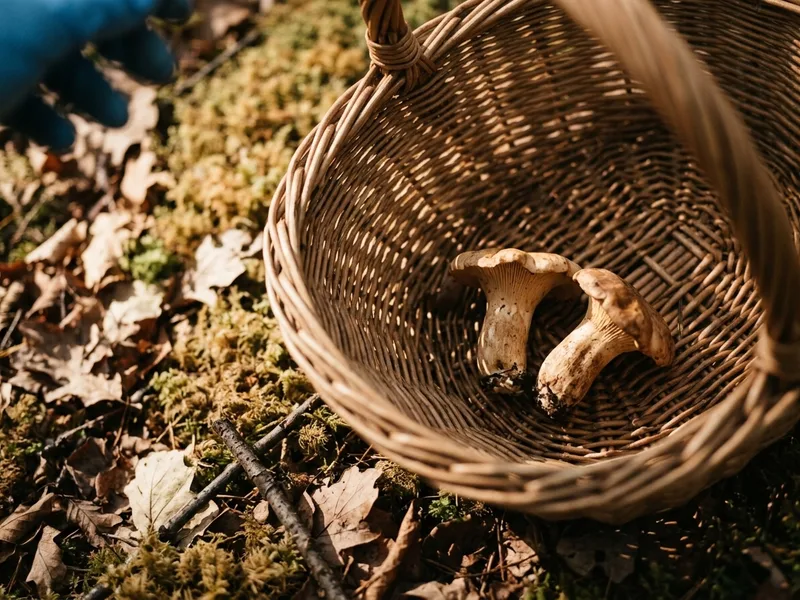
Wicker Foraging Basket
An open weave lets spores drop back through as you walk, which a plastic bag does not, and it stops a soft cap being crushed under everything picked after it. Size it to the walk, not the best day you have ever had.
When you buy through our links, it supports our mycology research at no extra cost to you.
Grow Gourmet Mushrooms at Home
Maitake is one of the harder species to cultivate yourself; as covered above, even a sawdust-block grow is a long, fussy project. But if hunting hens has you curious about growing gourmet mushrooms, the indoor species are genuinely easy. Our ready-to-fruit grow kits produce oyster and lion's mane harvests on a kitchen counter in a couple of weeks, and the Chestnut Mushroom Kit grows clusters with a nutty, earthy character that hen hunters tend to love. When you are ready to scale past kits, grain spawn lets you run your own buckets and bags. Wild hens in September, homegrown flushes the rest of the year.
One Oak Is All It Takes
Hen of the woods rewards exactly one habit: paying attention to oak trees in September. Learn the five ID features, find one producing tree, and you have a personal supply line that renews itself every fall. Bring a knife and a basket, cut cleanly, and leave the roots to build next year's cluster.
Have a mushroom-growing question? Ask Dr. MycoTek for AI help with your grow. Sign in to use your free monthly allowance.